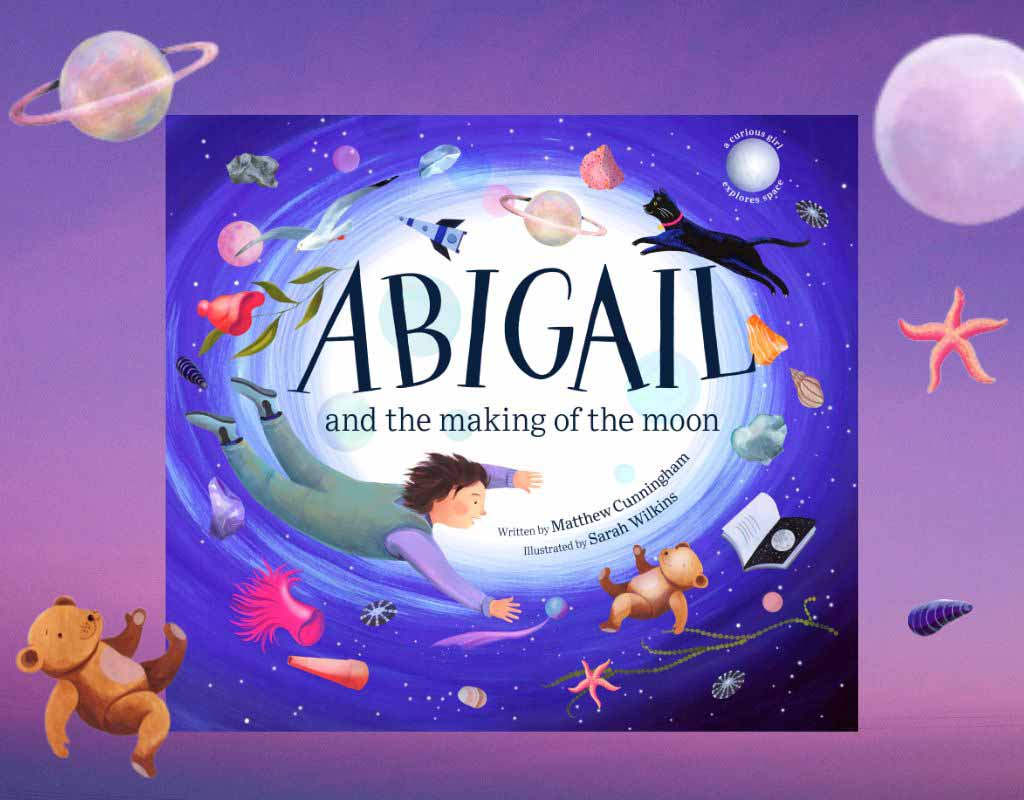
Promotion for Penguin Books
Join Abigail on a discovery mission to find out where the Moon came from and how it stays in the sky in this delightful new book that is perfect for every budding astrophysicist or curious kid.
Abigail and the Making of the Moon is the third book in this award-winning series by Matthew Cunningham and Sarah Wilkins.
Where did the moon come from?
One clear day, Abigail thinks of a question and knows that she won’t be able to do anything else if she doesn’t have an answer to it.
“Daddy,” she asked, “where did the Moon come from?”
“From the Earth, Abigail,” replied Daddy. “The Moon was once a part of the Earth.”
“It was?” Abigail asked. “But how did it get in the sky? And how does it stay in the sky? And why do we only ever see one side of the Moon?”
What follows is an evocatively simple story-within-a-story explaining how the newborn Earth collided with another planet and how gravity acts like invisible hands reaching out and keeping the Moon spinning around the Earth, the Earth spinning around the Sun, and the Sun spinning around the galaxy. And of course, by dinner time, Abigail has thought of a new big question …
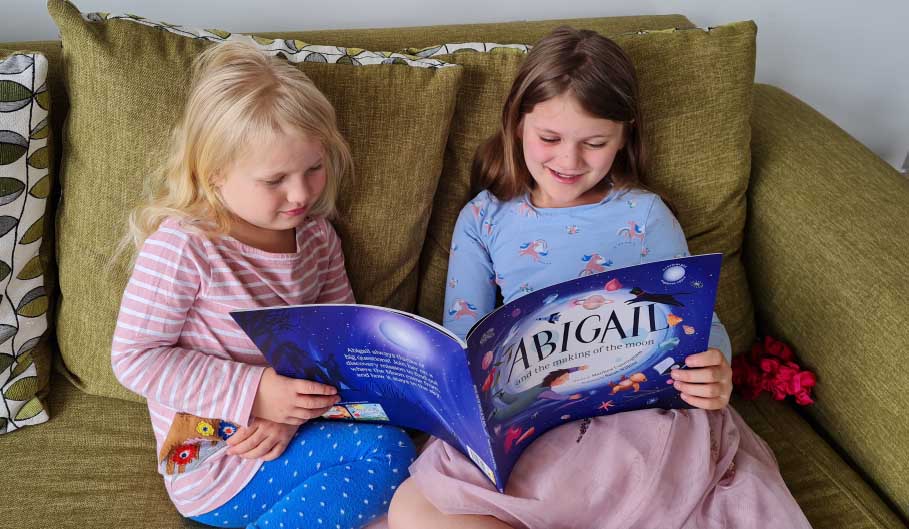
Reader review – Alice (4), Charlotte (7) and mum Katie
Questions, questions
“The greatest gift is not being afraid to question.’” – Ruby Dee, Civil Rights activist, poet and playwright
Kids are full of questions. I feel like my kids ask me about 1000 questions per day, ranging from the small (like, “What are we having for dinner?”) through to much larger conceptual musings (like, “Why do the leaves fall off the trees?”).
Whilst these questions don’t always come at the best of times I know that they are helping them to form a sense of how, and why, the world works. This natural curiosity is something we have always tried to foster and is something that as adults we hope they continue to develop. A questioning mind is something that Abigail, the main character from the book series bearing her name, definitely has, and is one of the main reasons why our little family loves reading them. We loved learning through her previous questions about how the Sun was formed and how rain occurs, and we were all so excited to join her as she learns about the making of the moon.
The story
In this latest adventure, Abigail is once again asking a big question about our universe. This time we are looking beyond the Earth, as she questions how the Moon was formed. As usual, her Dad is there to answer her question, explaining this concept at a level suitable for any age. This book introduces how carbon, water and other minerals arrived on the Earth, how the Moon was formed from a massive collision, and how the Moon remains in Earth’s orbit, as well as the rest of the universe, as a result of gravity.
As a scientist myself, it is really awesome to see concepts such as this being introduced in a format which is so accessible.
A note from Alice
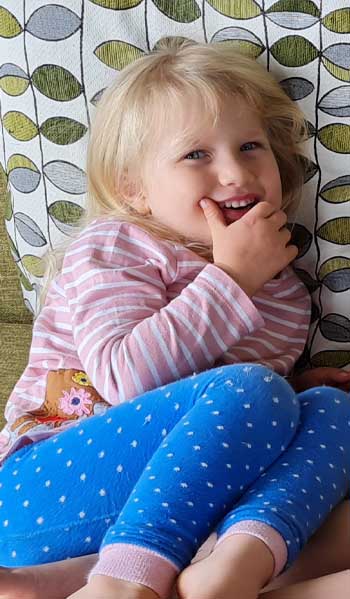
I really liked all of this book. I liked looking at the pictures, especially the ones of the planets swirling around.
I liked pretending to be planets swirling around. I liked learning how the Moon was made. I hope there is another book with Abigail in for me to read soon.
Science explained simply
As ever, the language chosen by Matthew Cunningham is perfectly placed, managing to walk the line between science and literature beautifully. This is a book which feels like a kids’ fiction book which you can snuggle up with and read as a family, but you never lose sight of the fact that it is explaining a massive scientific theory. The language is all easy to grasp, with no complex words or specific scientific ‘jargon’. My 7-year-old was easily able to read the book to her sister on her own and both of them could easily understand what was happening and ask their own questions as a result. We decided to lay on our backs and think of our own big questions to ask and that is something which I will continue to do with the girls to encourage them to question, and to talk though things which are puzzling them.
Aroha
Another concept which comes across strongly in this book is the mother and child relationship written between the Earth and the Moon as part of the story. Even when they are separated, they hold onto each other, and with a love this strong, they will never be truly apart. This is such a powerful concept, especially for many children (and adults) who have separation anxiety. In particular, I could see this really resonating with my 4-year-old who is due to start school in a few months’ time. I know this is a book we will be able to bring out over and over again to reinforce that even if you aren’t physically with the person, the love between you forms an invisible bond to keep you together and which you can take wherever you go. Both of my girls loved holding hands pretending to be the Moon and the Earth, and then letting go, closing their eyes, and ‘feeling’ the same touch in their heads even though they weren’t physically touching.
The story in illustrations
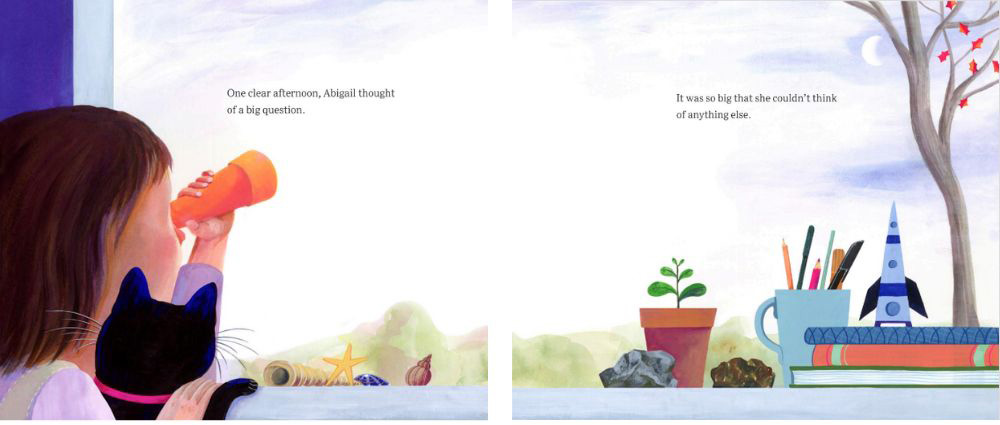
The illustrations by Sarah Wilkins are stunning and blend perfectly with the text. Illustrations in a book such as this are absolutely crucial to getting kids to engage, and these are a fantastic example of hitting the brief on the head. They are whimsical and attention-grabbing, yet illustrate the concepts the words are explaining beautifully, engaging both of my daughters into the story. The colour palette is vibrant enough to capture the attention and engage the imagination of even the youngest readers.
My 4-year-old in particular loved the illustrations of the planets swirling around the universe, and we all had great fun spinning around like planets in the sky swirling around the Sun.
A note from Charlotte
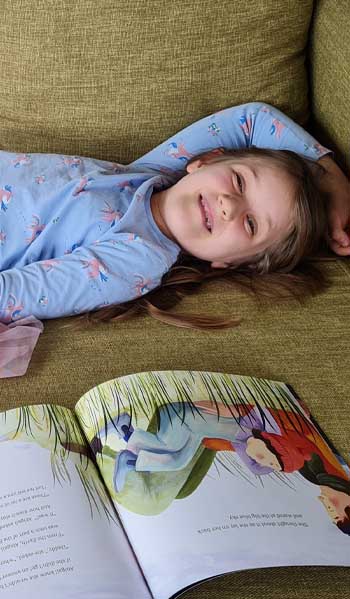
I really like how Abigail asks questions because I love asking questions too. I really love how her Daddy explains how the moon was made to Abigail. I like getting answers from my Mum and Dad.
I liked pretending to be the sun, the Earth and the moon with Mum and Alice, and I also liked lying on my back and thinking of my own big questions to ask.
I will definitely keep reading this book as I really enjoyed it.
Our whole family gives this book 5 stars ⭐️⭐️⭐️⭐️⭐️
Overall, I think it’s safe to say that this was a massive hit in our house. Suitable for all ages, stages and those who find scientific topics easy to grasp or not. Teaching kids that asking questions is a good thing can never be underrated and this book is such a great encouragement. I know that we will continue to revisit and explore this book as a family and we cannot wait to see what Abigail’s next big question will be.
Find out more about the moon with these fun activities
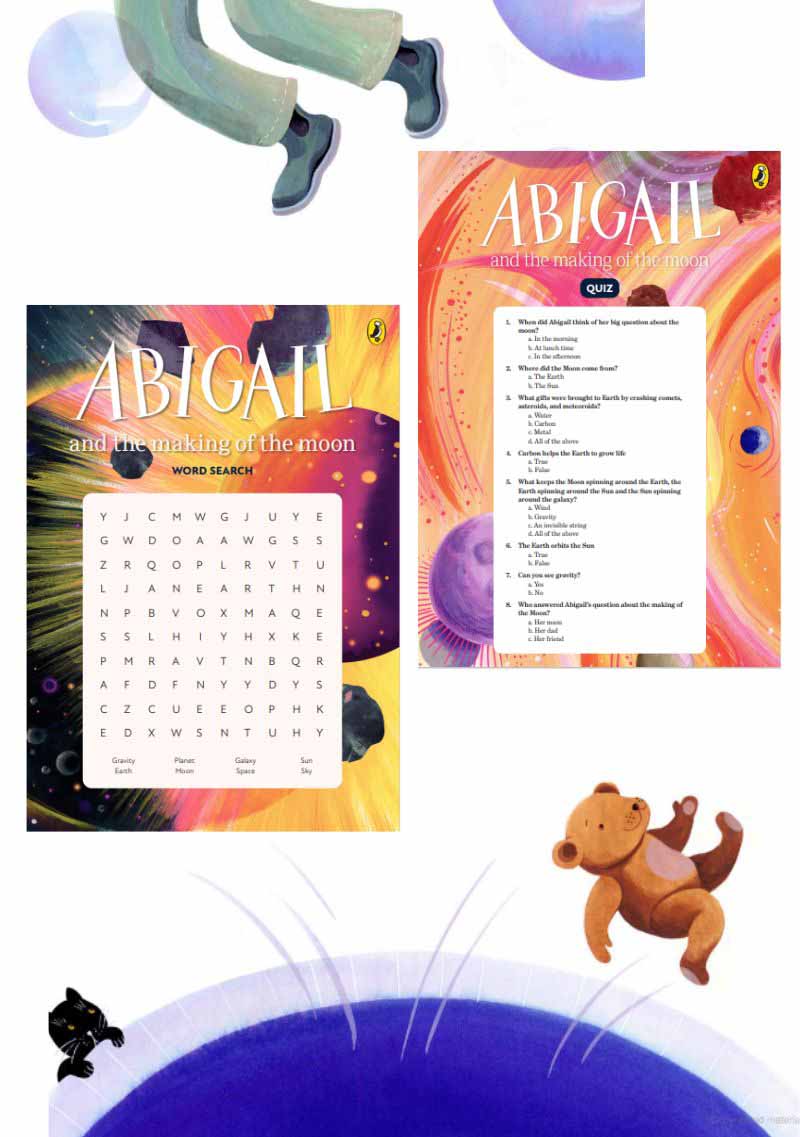
Join Abigail and find out about the making of the moon with a free printable word search and quiz – simply click on the image and download 
Don’t forget to visit Puffin Books for more great kids’ titles.
See more books:
- Willa and Woof 3: Grandparents for Hire | Book Review
- Get Outdoors: Brilliant Boredom Busters For Kiwi Kids | Book Review
- Have You Seen Tomorrow? | Book Review
- Roar Squeak Purr; A New Zealand Treasury of Animal Poems | Book Review
- Hairy Maclary and Friends How Do I Feel? | Book Review
- Pukeko Counts to 10 | Ka Tatau a Pukeko ki te 10
- The Astromancer – The Rising of Matariki | Book Review
- Goose the Artist | Book Review
- Discover, or revisit, our Puffin Books of the Month from previous years!
 20 October, 2026