The Pros And Cons Of Baby Wearing

Slings are baby carriers designed to help you carry a baby by easing the pressure on your arms and back. Find out the pros and cons of baby wearing.

What is a baby sling?

Slings are baby carriers designed to help you carry a baby by easing the pressure on your arms and back. While there are many different kinds of baby carriers on the market, what differentiates slings from other baby carriers is that slings do not have identified leg openings [1].

Carrying your baby in a baby sling is called baby-wearing, which has been practiced for centuries around the world. In the industrialised world, baby-wearing has gained popularity in recent decades, partly due to the influence of advocates of attachment parenting [2].

Below are three common varieties of baby sling:

The ring sling: This type of sling can be used from birth right through to toddlerhood – provided the baby is not premature or low birth weight. Dynamic tension is applied by using a length of cloth, with one end of the cloth is sewn to two rings [3].

The cloth wraps around the wearer’s body from shoulder to opposite hip and back up to the shoulder, and the end is threaded through the rings to create a buckle effect. Ring slings allow the wearer to carry the baby on the front, hip and on the back, but it is strongly recommend to always carry the baby in an upright position so baby can breathe easily and you can monitor her wellbeing at all times [4].

Wraps: This type of baby carrier is both simple and versatile. It requires just one long piece of fabric, between two metres and six metres in length. Be sure to choose a good quality fabric with a weave that isn’t too dense – if you hold it up to the light, some light should pass through, but not so much that it is too flimsy. Natural fibres like cotton, linen and hemp are best because of their breathability. You can make your own wrap from a suitable fabric, or scarves, sheets, blankets, etc, but there are also specific products available [5].

Wraps can be used in an array of different ways, which makes them easily customisable and adjustable for comfort and support. Check out this video for ideas on how to use different wraps[6].

Pouches: These slings are generally formed by a wide piece of fabric sewn into a tubular shape and generally don’t have rings or straps, although some do. The wearer slips the pouch over the head and one shoulder, sash-style, creating a pocket or seat to hold the baby in. Many paediatricians and baby-wearing experts do not recommend pouch slings because babies can suffocate when held incorrectly [7].

Consumer Affairs NZ warns against using bag slings or slings that allow the baby’s spine to curve.

Baby slings throughout history

Baby carriers have been around for thousands of years. Prior to the early 1900s, parents worldwide used a variety of long cloths, shawls, scarves and even bedsheets to snuggle up their babies and get the chores done. Baby-wearing wasn’t something “special” or different, as it is perceived today in the Western world; it was a necessity. Mum had to work incredibly hard and didn’t have time to stop and entertain baby, so baby just came along for the ride. Even today, many traditional types of carrier are still used in developing countries, although this is usually restricted to indigenous communities where baby-wearing is totally normal, a necessity and way of life [8].

In his book, The Artificial Ape, British pre-historian Timothy Taylor, from Bradford University, claims that increased brain size was made possible by the invention of the baby sling. He says the baby sling was a development that enabled slower growing, physically and mentally immature offspring to survive and flourish. In other words, he determines that the task of building a large brain retards physical growth [9].

Before the invention of the baby sling, dated by Dr Taylor to at least 2.2 million years ago, when human ancestor head size suddenly began to increase, physically mature infants were more likely to survive because caring for slower-developing, immature babies was difficult, uneconomic and often dangerous. Mothers holding their infants were more vulnerable to attack from predators or other humans than those using baby slings [10].

The pros and cons of carrying baby in a sling

The pros for wearing a sling [11]:

1. Access

With a baby sling, there’s no need to use the elevator or ramp. And hiking trails, crowded shops, and public transport are all easy to navigate.

2. Expense

Prams aren’t cheap – even a second-hand one may be more expensive than the cost of one of the pricier slings.

3. Space

Prams take up a heap of room in the back of the car and in the home. A sling, on the other hand, will fit into a small bag and you can easily carry it until you need it.

4. Skin-to-skin contact

In a sling, a baby is next to your chest all the time, snuggled in and secure. This promotes bonding and breastfeeding. Most babies will fall asleep easily in a sling with the motion of walking or rocking.

5. Communication

Being so close to you in a sling, babies can advance developmentally; by watching you they learn language and non-verbal cues.

6. Hands-free

Everyday tasks, such as housework, are easy to do with your baby in a sling. As you go about your chores, baby happily snuggles into you, either sleeping or watching her surroundings.

7. Fitness

Carrying a baby long distances is a great workout. Carrying any extra weight while walking adds to the benefit of a workout.

The cons (and there are some) for wearing a baby sling [12]:

1. Difficulty

Some slings, especially the woven wraps, can be a little tricky to master. But practice makes perfect and these days there are dozens of videos on the internet demonstrating the various carries.

2. Choice

There are so many sling options out there that it can be daunting for a beginner. Finding one that suits you will depend on recommendations from other mums and just trying each variety out to see how it fits.

3. Bags

Slings are not so great if you have a lot of heavy shopping to carry, and it’s here where a pram would be more useful. The extra weight of shopping bags pulling on your shoulders when you are wearing your baby can put strain on your neck.

4. Weather

In hot weather, carrying your baby can be hard work. But using a light-weight sling and dressing your baby minimally helps. In rain you can just use a large umbrella to cover you both.

5. Multiples

A sling is great if you have one baby, but what about multiple babies? There are actually slings available for carrying twins, and you can tie certain wraps so they will hold twins.

6. Containment

A drawback of using a sling over a pram is there is nowhere to securely put your baby down if you need a break for a while (though it is possible to sit down whilst wearing a sling).

7. Safety

Carrying your baby on your body is always going to be more risky than carrying them in a pram. You could fall, slip, or simply catch their leg or head on something. Keep your hands free if possible to catch yourself if you do fall. And if you feel dizzy or tired, don’t use the sling until you are more steady.

Controversy surrounding baby slings

Parents and carers should take care when using slings and pouches to carry babies. Babies have suffocated while using slings. They are at risk if placed incorrectly in a sling because they do not have the physical capacity to move out of dangerous positions that block their airways. Babies who are under four months old, premature, low birth weight or having breathing difficulties appear to be at greatest risk. Two positions in particular present significant danger [13]:

  1. Lying with a curved back, with the chin resting on the chest.
  2. Lying with the face pressed against the fabric of the sling or the wearer’s body.

Dr Kirsten Vallmuur, from QUT’s Centre for Accident Research & Road Safety – Queensland (CARRS-Q), says that since 2010 there have been three deaths in Australia as a result of suffocation in a baby sling, and at least 14 deaths in the USA over the past two decades. Dr Vallmurr headed significant research on the dangers of baby slings, published this year, and she and her team and the Office of Fair Trading surveyed almost 800 parents across Australia to better understand parents’ views of the risks and benefits of baby slings and how they use them [14].

The study found that there were almost one in 20 infant injuries or narrow misses. It also revealed that of the 95 percent of parents surveyed who said they used or intended to use a baby sling, the majority considered it safe to use the sling from when the baby is a newborn. This is concerning because product safety experts don’t recommend baby slings for premature or low birth weight babies [15].

The research determined that the most common non-fatal injuries involved the baby slipping out of the sling and falling, the parent falling, and the baby being injured while being positioned or removed from the carrier [16].

Baby sling safety guidelines

Here are some simple steps for parents to keep their children safe in slings [17]:

  • Keep the child’s face, especially nose and mouth, uncovered at all times;
  • Avoid the child being curled into the ‘C’ position where the child’s chin touches the chest and blocks the airways;
  • Show caution and seek medical advice for using baby sling carriers for premature, low weight or sick infants;
  • Consumer Affairs NZ recommends holding your baby in an upright position if they are showing signs of illness;
  • Regularly check the child to ensure she has not slipped into the pouch (if the sling is a pouch type), covering her nose and mouth;
  • Reposition the child after breastfeeding to keep the nose and mouth clear; and
  • Acknowledge that some slings may be a safer option than others, such as those that carry the child in the vertical position.

Choose the right sling for your baby by[18]:

  • Take your baby with you when buying a sling;
  • Ask for a demonstration; and
  • Never using products with the descriptions “womb-like” or a “cocoon”.

Wear your sling correctly by:

  • following instructions for safe use;
  • having someone assist you the first time;
  • lying your baby in a flat position with a straight back to ensure the baby’s chin does not rest on his or her chest; and
  • ensuring you can see your baby’s face at all times and the face remains uncovered by the sling on your body.

Use your sling safely by:

  • holding your baby with at least one arm;
  • regularly checking your baby for any signs of discomfort;
  • being alert to your own safety, as slings can affect the way you move; and
  • being alert for things that may fall on your baby (e.g. hot drinks).

Do your research when it comes to choosing the safest possible baby sling. A correct fit is vital, not just for baby but also for parents, so both of you are comfortable, safe and secure. That means both parents need to try the sling on, too. In a 2012 CHOICE Australia survey involving 1006 parents, 23 percent of dads reported noticeable discomfort, the baby almost falling out or even injury to the baby when wearing a carrier or sling. So, if Dad is going to wear the carrier or sling, it needs to be adjustable in order to fit both parents [19].

In addition, The Office of Fair Trading cautions that many of the babies who have died in slings were either born prematurely, of low birth weight or had breathing issues such as a cold. It is important for parents of these babies to talk to their doctor as to the suitability of these products before using them [20].

Babes in Arms, a distribution company specialising in baby slings and carriers across Australia and New Zealand, suggests parents use the acronym CARRY to keep their baby safe while wearing them. The letters stand for [21]:

Careful – don’t do anything while baby wearing that you wouldn’t do while pregnant.
Airway – ensure you can see your baby’s face without moving the fabric and make sure the chin is not against the chest, which may restrict breathing.
Ride high – make sure your baby is high and tight against your chest.
Right fit – not all carriers are the same. Ensure you read the instructions that come with the carrier (better yet, watch the videos that many brands make available). The carrier or sling you use should be suitable for your baby’s age and weight, as well as suitable for your body shape.
Your instinct – trust your instincts. As a parent, you know your baby best, but keep the connection strong by ensuring you can always see your baby’s face. You should be able to make eye contact at all times and you should try to ensure that, when your baby is in the sling, he is in a position that mimics how you would normally carry him.

The T.I.C.K.S approach

T.I.C.K.S. is an acronym created by a UK consortium of sling manufacturers and retailers[22]. It stands for:

Tight

Make sure the sling is tight, with your baby in a high and upright position, with good head support.

In view at all times

You should be able to see your baby’s face simply by looking down. Ensure your baby’s face, nose and mouth remain uncovered by both the sling and your body.

Close enough to kiss

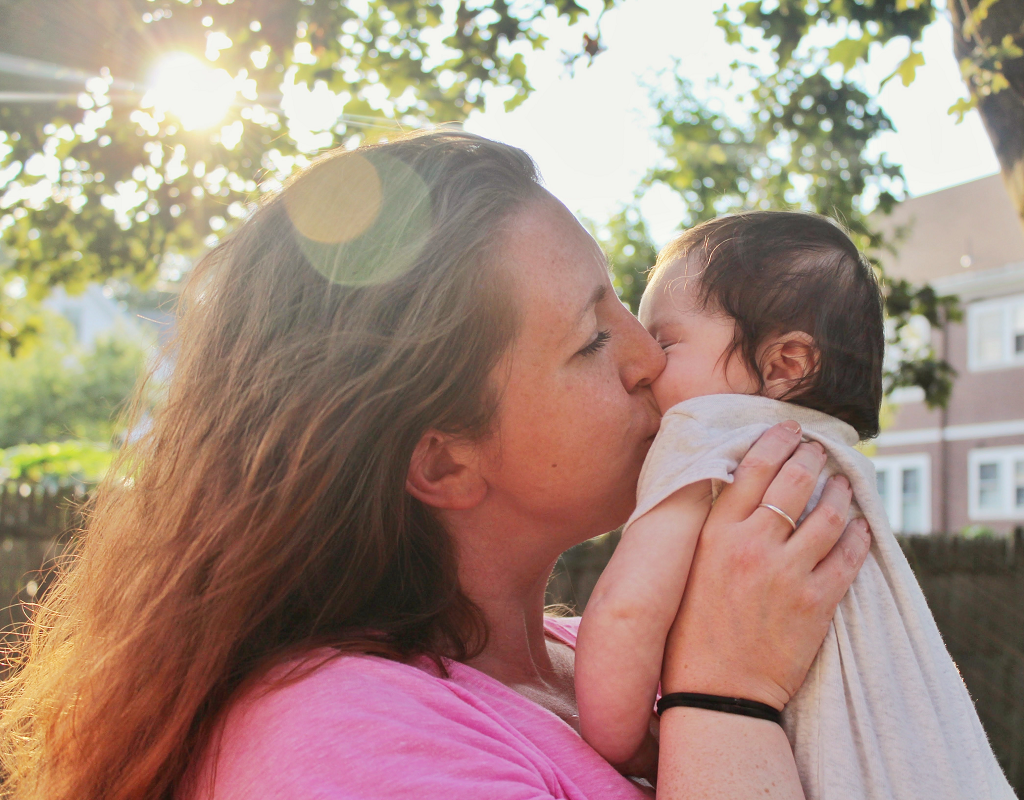
Following on from the recommendation to keep your baby positioned high, this section of the recommendations suggests that you should easily be able to kiss the top of your baby’s head just by tipping your head forward.

Keep chin off the chest

Keep your baby’s chin away from their body, and never curled/forced onto his chest, as it can restrict breathing. You should also regularly check on your baby, because they can become distressed without making any noise or movement.

Supported back

A sling should support baby’s back, with his tummy and chest against you. When bending down, do so from the knees, and use one hand to support your baby’s back while you do.

Written by Kidspot Australia

Benefits of babywearing

The three golden rules of baby sleep

Sleep, baby, sleep

You can support your baby to develop healthy sleep habits in three key steps, as author Rowena Bennett explains.

If you’re reading this article, odds are you’re a sleep-deprived parent looking for a solution to those endless, sleepless nights.

I meet many parents who complain that their baby is a ‘poor sleeper’. They recognise that their baby’s brief daytime naps and frequent nighttime awakenings are causing sleep deprivation for baby and themselves. They have tried many strategies in the past, which unfortunately failed to improve the situation. What these parents are missing is an understanding of the ways in which they can support their baby to develop and maintain healthy sleep habits.

Recognising and accurately interpreting your baby’s early signs of tiredness, and then providing him with an opportunity to sleep, are important ways to help your baby to get the sleep he needs. But equally important is where your baby settles to sleep and the way he falls asleep.

The essence of a ‘good sleeper’ is the ability to self-regulate his sleeping patterns. Some babies naturally achieve this. However many require guidance and support from parents. There are three key elements involved in supporting a baby to self-regulate his sleeping patterns. I call these the golden rules of infant sleep self-regulation. A number of my clients refer to these as ‘Rowena’s Golden Rules’.

Golden rule #1 – Provide baby with a suitable and consistent sleeping environment

A suitable environment is safe for your baby to sleep in and is also conducive to sleep. This means it’s a low stimulus environment, quiet, darken and with low noise levels. Think about the type of environment in which you prefer to sleep. A consistent sleeping environment is one that does not change. Your baby gets to fall asleep in the place where you want him to sleep.

If you’re expecting your baby to fall asleep anywhere, anytime he’s tired, don’t. Would you fall asleep anywhere, simply because you’re tired? If the environment is unfamiliar or too stimulating your baby may remain awake despite his fatigue. This could last until such time as he becomes so exhausted he can’t keep his eyes open a moment longer. By then he may have missed out on some of the sleep he would have otherwise received, causing fussiness at the time and/or distress towards the end of the day owing to overtiredness.

During our sleep we will shift from light to deep sleep and back again many times. Between sleep cycles we have arousals. During light sleep, even without fully waking, we have the ability to sense any significant change in our immediate surroundings. If your baby’s sleeping environment changes, he may notice the change while in a light sleep stage or when rousing. This can happen if you settle him to sleep in one place and then move him to another once asleep. As a result, instead of moving into the next sleep cycle he may wake prematurely from his sleep. This too can result in overtiredness.

By providing your baby with a suitable and consistent sleeping environment the risk of him waking too soon due to a change in his surroundings, or as a result of environmental noise, bright lights or visual stimulation is reduced. To achieve this, place your baby into bed while his eyes are still open, each time he needs to sleep, where possible, and encourage him to fall asleep while he’s in his bed.

Golden rule #2 – Withhold any unreliable props or aids at sleep time

An unreliable prop or aid is anything that your baby relies on to fall asleep that could later change. For example, a pacifier that falls out, or rocking/musical device that stops.

Because unreliable props and aids do not remain consistent the entire time your baby needs to sleep, he may recognise the change the next time he arouses between sleep cycles and wake fully and cry to have the prop or aid returned so that he can return to sleep. The problem is, once he has woken crying he might have become too upset to return to sleep. The missed sleep may make him upset either at the time or later in the day owing to overtiredness.

By withholding unreliable props or aids at sleep time your baby gets the chance to learn to sleep without them. The loss of the props or aids will then no longer disrupt his sleep.

Golden rule #3 – Promote independent settling

Babies are able to self-settle (go from a quiet state to asleep unaided) at the time of their birth, but as parents and caregivers we can accidentally teach them to depend our help to fall asleep and thus they can lose their willingness to fall asleep independently within a matter of days or weeks.

If your baby has learned to rely on your help to fall asleep this means he may also rely on your help to remain asleep and return to sleep if he wakes too soon. If so, it means he’s dependent on you to regulate his sleeping patterns. Depending on his temperament (inborn personality traits), your health and other commitments, the responsibility to regulate his sleeping patterns 24 hours a day for an indefinite period of time could be a task you will find burdensome.

By withholding your help at the moment your baby falls asleep, he gets the chance to re- learn how to fall asleep without your help. He will then be less inclined to wake fully during arousals, a time he may have otherwise woken as a result of recognising the help you provide is missing. At times when he does wake, he will be able to settle back to sleep without your help.

This doesn’t mean you must leave him cry. Very young babies have a limited ability to self- soothe (go from a crying state to calm independently). You can encourage your baby to fall asleep independently while soothing him as often as you feel is necessary. Just aim to cease soothing once he’s quiet so he can go from a quiet state to asleep unaided. It’s a fine line between drowsy and asleep. If you soothe him to a drowsy state it’s easy to cross the line and therefore not encourage independent settling, so stop soothing once he is calm.

You can achieve all three of the golden rules at the same time for a quick resolution to your baby’s sleep issues, or one at a time, which will obviously take longer but may minimise any upset your baby is likely to experience. By achieving the Three Golden Rules, you will support your baby to self-regulate his sleeping patterns. He will still wake for his physical needs, but you reduce the risk of waking every time he notices a change in sleeping conditions. This means he’s more likely to get the amount of sleep he needs. It also means more sleep for you.

What to expect

Your baby will only get the chance to learn new sleep habits if you provide him with opportunities to sleep in a new way. To change your baby’s sleep habits you must first change your infant settling practices. None of us like change. Not even when we know it will be good for us. Babies and children don’t like change either, so when you make changes to the way you settle your baby to sleep, you must expect some upset on your baby’s part until the new way of falling asleep becomes familiar to him. He will probably fuss or cry and take longer to fall asleep initially.

To support him to self-regulate his sleeping pattern you must be persistent and consistent in following the golden rules at sleep time. Babies don’t learn or forget sleep habits in a day. It could take days or weeks for him to learn to sleep in a new way depending on how soon you are able to achieve all three golden rules on a consistent basis. The long-term benefits of improved sleep for the whole family will far outweigh a few days of upset.

Oral health from 0 to two years

Fluoridated toothpaste

Yes, you need to brush your baby’s teeth with toothpaste that has fluoride in it. Fluoride works by attaching itself to the tooth surface and then becoming a part of the enamel. This outer fluoride-rich layer of enamel is much stronger than regular enamel and helps prevent cavities.

How much toothpaste?

Simply use a smear – the size of a grain of rice. Rub the toothpaste into the bristles so you can get it onto the teeth before your baby sucks it off. Your baby will swallow all of this toothpaste. This is OK and will NOT hurt them.

Brushing

Your baby cannot brush on his or her own. Children need help until they can tie their own shoes, around 7-8 years old. You can let your baby play with the brush (without toothpaste and hopefully without them throwing it on the floor). and then when you are ready, get down to it!

Positioning your child for brushing (with help)

Some babies don’t mind parents brushing their teeth, and for others it is a huge struggle.

Ideally there are two adults at home to help. Let’s say mum and dad are both home. Sit on chairs facing each other with your knees touching. Your upper legs have now created a ‘bed’ for your child.

Mum (in this example) picks up her baby and holds him facing her with the baby’s legs wrapped around her waist. Mum then leans her baby down onto Dad’s lap while then keeping the baby’s legs still using her elbows and holding the baby’s hands down with her hands. Now that Mum is controlling the baby’s body and hands, Dad can brush! At the dental office, this is how many pediatric dentists do their exam on young and/or uncooperative children. You may need to use one hand to move the lips aside or place the fingers on the inside of the cheek for better access. If you really cannot get them to open their mouth or they keep biting the toothbrush and don’t let go, sometimes it helps to use something soft, even the handle of another toothbrush, to place on one side between the teeth while this now props the mouth open enough to brush the other side.

Positioning your child for brushing (by yourself)

If you are on your own with your child and do not have another adult to help, it is harder but possible.

One technique is to sit on the floor and position your child’s head in your lap with their legs in the same direction as yours. Then wrap your legs around your child’s arms and legs so they cannot kick you or grab the toothbrush from your hand. You may also ‘wrap’ them in a blanket to limit their mobility and make it easier for you to brush.

A third option is to sit in a chair and have your child sit on your lap, not facing you. Use one arm to keep their hands down and the other hand to brush their teeth. I understand that this is not easy and your child will likely scream and cry, but you are NOT hurting them and are a GOOD parent for taking care of their teeth. Your baby does not know what is best for them, but you do. The good news is that this rarely gets harder as time goes by – they will grow out of struggling over a toothbrush.

Brushing techniques

Depending on what positioning method you chose, brushing certain surfaces of your baby’s teeth will be easier or more difficult. If your baby doesn’t struggle at all, lucky you! The most common areas that are missed are along the gums, especially along the molars. When brushing the sides of the back teeth and the front of the front teeth, try to angle the toothbrush 45 degrees into the gums and use circular motions or small back-and-forth motions. Guidelines state that everyone should brush for two full minutes. Brush your baby’s teeth twice a day – morning and night.

Flossing

You need to floss every day between any of your baby’s teeth that are ‘tight.’ If they have teeth that are touching so that you cannot see between the teeth, these areas need to be flossed. Even with a good diet and daily brushing, very young children can get cavities between their teeth without flossing. You must do the flossing for them.

Rinsing

This is not necessary. Your baby does not need a mouth wash, and they do not need to try to rinse out the toothpaste. It is best for the toothpaste to stay on the surface of their teeth as long as possible. Put them right to bed after brushing at night so that all night long a thin layer of fluoride is strengthening their teeth.

Breastfeeding

Breastfeed as long as you would like. To keep the teeth healthy, you must brush their teeth after you are done breastfeeding. If you let your child go to sleep after breastfeeding without cleaning their teeth, the sugar (lactose) in your breastmilk sits on their teeth throughout the night and can lead to cavities.

Dental professionals also advise against ad libitum “at will” breastfeeding. This is particularly a problem at night when the baby is allowed to breastfeed whenever they like, often leaving milk (lactose) on the teeth for prolonged periods of time and increasing their risk for decay.

Bottles at night

Do not ever let your baby go to sleep at night with a bottle in their mouth or next to them. Unless there is pure water in that bottle, there is sugar present which will lead to cavities. You must clean your baby’s teeth before they go to bed and do not give them anything afterwards with sugar in it, watered down or not.

So many cases were seen of severe decay on infant’s teeth who were put to bed with a bottle, it was given the name of “baby bottle caries.” Please do not let this happen to your child, and break the habit as soon as possible.

Sippy cups

Pediatric dentists never recommend these. The biggest problem is similar to the “bottle at night” problem. Often parents do not put water in these cups, so now the child has access to sugar constantly. Whether it is milk or watered down juice or all-natural fruit juice, there is still sugar present. Sugar in liquid form is much more likely to cause cavities than in solid form because it coats the entire mouth. Try to transition your baby straight from a bottle to a cup. Another benefit of giving your child water, is that it is not such a big deal when they spill!

Water versus juice

Once you are no longer breastfeeding or using formula, your baby needs to drink water more than any other liquid. Ideally, your child would only drink water and would get all their other nutrients from the food they are eating. Realistically, try to limit juice to 4-6 ounces per day and only with meals, never as a snack. For children older than 6 months, fruit juice offers no nutritional benefits over whole fruits. Whole fruits also provide fiber and other nutrients.

Teething

Some babies go through teething around 4-7 months when the first teeth, usually the bottom two front teeth, break through the gums. Signs of teething include discomfort on the gums, irritability, and excessive saliva/drooling. Try cold items first (cooled in the fridge, never frozen). Examples: teething rings, pacifiers, or clean wet washcloths. Do not use topical anaesthetics such as a teething gel – they do not stay in place and your baby may accidentally swallow too much.

If pain medication is needed, use “systemic” pain medication that your child drinks, ie paracetamol. Always determine dose based on your baby’s weight, not age. You must know the weight of your child before giving them any pain medication to be sure you do not accidentally overdose your child. (Editor’s Note: Always read the label of any medicines, follow the instructions and ensure that the correct dosage is administered. Consult a doctor before giving medicines to children under 12 months of age.)

Pacifiers/dummies and finger-sucking

These habits are considered normal in infants and young children. If the habit persists after your child turns 4 years old and the sucking is forceful and frequent, this may result in long-term dental problems. A child’s teeth may become improperly aligned (malocclusion) or pushed outward, sometimes malforming the roof (upper palate) of the mouth. Malocclusion usually corrects itself when the child stops thumb-sucking or the dummy habit. The longer the habit continues, the more likely it is that orthodontic treatment will be needed.

First dental visit

Every baby should receive a dental exam by 12 months of age. This initial visit should include a medical and dental history, a thorough oral exam, an age-appropriate demonstration of brushing technique, a cleaning (prophy) and fluoride treatment if indicated. This is a great opportunity to have your questions answered and to have a discussion with your dentist about what you may be doing right, and what you may be able to improve upon to keep your baby’s teeth healthy.

With regular dental exams every 6 months, problems can be caught and corrected early. You never want to wait until your child has a cavity or pain to bring them to the dentist. Prevention is key!

Mum and Dad’s oral health

Did you know that if Mum and Dad have untreated cavities, your children are more likely to get cavities? If Mum gets her cavities fixed, she can decrease the numbers of cariogenic “bad, decay-causing” bacteria in her mouth. It’s then less likely that these bacteria get transferred to her baby, decreasing the baby’s chance of getting cavities.

Exciting new research of xylitol suggests that the use of xylitol chewing gum at least 2-3 times per day by Mum when pregnant and after delivery also decreases the transfer of bacteria to her baby.

Got a crying baby? First, take a deep breath…

Why new parents could do with some mindfulness …

All parents experience some level of worry after the birth of a baby. In the first 16 weeks, your baby’s crying is at its peak. This puts your poor nervous system into involuntary overdrive. When we hear a cry, our heart beats faster, our blood pressure rises and our breathing quickens. If we then struggle to soothe the crying infant, we can start feeling desperate.

For many parents things can seem overwhelming. The mind thinks unhappy thoughts like “I’m a failure” or “I’m obviously not doing this right” or “My baby isn’t getting enough sleep and this is going to harm us both”. Psychologists call this ‘negative self-talk’.

The power of positive thinking

Sometimes, challenging these negative stories and replacing them with positive ones might help. Deliberately cultivating gratitude is another popular strategy that is worthwhile practising. For example, you might tell yourself:

  • “I may not feel terrific, but I still have good days and I love my baby. I will get through this.”
  • “The more I strive for better sleep, the worse my sleep will be, so I’m letting go. Enough sleep is not about the number of hours I’ve had.”
  • “The baby’s crying really isn’t doing harm and will pass in 16 weeks.”
  • “I have a loving partner, I have a sister who cares about me. I’m lucky to have four months’ paid maternity leave. When I was working I longed to be able to spend days at home like this!”

These psychological approaches try to get rid of upset stories and feelings by disputing them or replacing them and, if that works for you, great! If you’ve already tried positive thinking but still feel overwhelmed and out of control, this is quite normal. Very often, these techniques simply won’t stop the brain churning.

How mindfulness might help

Fortunately, there are some powerful new techniques to help us when we are faced with the painful gap between what we had hoped life with the baby would be like and what it has turned out to be. These skills come from a modern form of cognitive behavioural therapy (CBT) called acceptance and commitment therapy (ACT). ACT is proving to be very effective for a whole range of mental health issues, including anxiety and depression.

What is acceptance and commitment therapy?

ACT argues that mental health problems often arise, paradoxically, out of the frantic attempt to eliminate negative thoughts and feelings (either by internal struggle or by engaging in distractions and addictions). If we fight with our frightened and despairing thoughts and our miserable, exhausted feelings, the struggle itself consumes us. We panic because the baby is distressed, and then we panic about our panicking. It’s the struggle itself that places us at psychological risk.

The best way to change our relationship with anxious thoughts is to practice a set of skills called mindfulness. To be mindful is to pay attention to and be curious about the moment in which you find yourself. Research shows that to be most effective in improving our mental health, mindfulness needs three equally important steps.

Step 1: Becoming aware of our unhelpful thoughts and feelings

Stand back and ‘watch’ the memories, imaginings and stories that play through your head. Pay attention to the emotions, urges and sensations that rise and fall through your body without panicking or trying to push them away. In the crying period of a baby’s first four months, a story that plays endlessly through your mind might be true (‘I am bone tired’) or it might be false (‘My baby will be psychologically scarred by the crying’). It’s not the veracity of the story that matters – it’s whether or not the story helps you live a satisfying and meaningful life.

Step 2: Defusing from our unhelpful thoughts and feelings

Awareness alone is not enough to get you through. It’s also vital to know how to stop being pushed around by these unhelpful thoughts and feelings. To ‘defuse’ from our thoughts, we might imagine they are playing in the background like a radio or traffic. We might allow our distressed feelings to come and go like the weather. The simple act of slow, deep breathing is a surprisingly powerful way of turning down your sympathetic nervous system. More than that, deep breathing anchors us in our bodies, regardless of the feelings raging inside us. As we breathe, we might imagine that our breath is surrounding the painful feelings and permeating them and quietly making space around them. They may not go away, but our breath makes the space for them to simply sit alongside the many other sensations available to us in that moment.

Step 3: Expanding our attention

A powerful way to help defuse from our unhelpful thoughts is to expand our awareness by directing our attention to the many other things that are going on in the present moment. Switch off the struggle switch and watch your emotions and thoughts ebb and flow. Expand your attention to other pleasant feelings, like the breeze on your face, the aroma of coffee, the sound of a kookaburra laughing or a car passing by. Baby-time is a rare and precious opportunity to unplug, to ground yourself in sensation, to return to the landscape of the body. Baby-time won’t last long. By the end of 16 weeks, the most intense first immersion in baby physicality is over; by the end of the first year, everything has changed.

We have only the briefest of opportunities in the span of our lives to come home to our bodies in quite this way, to immerse ourselves in physicality, to give the abstract realm of the brain a break. We can let this embodied attention to the new child become its own rare kind of physical joy, we can cultivate the pleasure of it, we can deliberately seek it out, we can revel in it whenever the opportunity opens up.

When your baby cries, bravely practice mindfulness – noticing your thoughts and feelings as you do what you can, knowing that this is not a catastrophe. Gently bring your attention back into the present moment, over and over. Expand your attention from those painful thoughts and your baby’s distress to notice the environment around you. Notice your thoughts and feelings as you wait and hold, wait and hold, allowing a deep kindness to yourself.

As ever, please talk to your GP or other health professional if you feel like your anxiety or depression is overwhelming you. There are plenty of wonderful resources available to you so please don’t struggle along alone.

Age and stage guide to baby sleep

Baby sleep is definitely one of the major obsessions for new parents. If settled babies = sane mothers, then there must be a whole lot of crazy mummies out there. Nearly every baby and toddler will go through periods – sometimes very long ones – of being unsettled when they’re meant to be sleeping.

“Sleeping through the night” is a quest that for some parents can seem totally unachievable. Other mums and dads dream of a baby or toddler that habitually goes down for daytime sleeps.

There is a lot of information – sometimes quite contradictory – about how to settle your bub. Some experts are big supporters of strict routines, others recommend opting for a more flexible structure.

We know that sleepless times are desperate times so we have sifted through the many theories and tips to bring you a comprehensive “ages and stages” guide to your baby’s sleep.

0-3 months: It’s all about the “tired signs”

The word “routine” is bandied around a lot when talking about sleep – yet if newborns are following a routine, for most new parents it’s a completely bizarre one.

It’s true – most newborns will spend about two-thirds of their time asleep during those first few weeks. But their wakeful, unsettled hours may be during the night when you’re trying to sleep, yet they sleep solidly throughout the day. Many babies find it difficult to distinguish between night and day at the start.

The key, whether you’ve adopted a flexible routine (a strict one is not usually recommended for those first weeks) or are following your baby’s lead, is to be able to spot the “tired signs”.

Once you’ve sighted one of these, it’s time to wind down the stimulation immediately and get her to bed before overtiredness sets in. Some experts say that you have just 10 minutes maximum to settle your baby once you’ve spotted a tired sign. [Remember to ensure your baby’s sleep environment is safe.]

Here are your cues to get baby to bed ASAP:

  • jerky arm and leg movements
  • yawning
  • glazed stare or even a cross-eyed look
  • arching backwards
  • sucking on fingers (this could be a sign your baby is trying to self-settle)
  • pulling at her ears
  • clenching her fists

The overall consensus (excluding the full-on ‘routine-at-any-cost’ proponents) is to spend those first weeks listening to your baby and working in with her sleep, feed and play needs. You’ll very likely be able to adopt a flexible regimen that suits both you and your bub.

NOTE!
Like you, just-hatched babies are flying a little blind so don’t leave them to cry for too long. If they’re over-tired and unsettled they may need your help to get sleep – and that’s absolutely okay!

3-6 months: Civilised sleeping patterns are possible!

At this age, your little one’s sleep patterns can start to make sense. You’re probably still too sleep-deprived to understand anything but it’s at around 4 months old, according to many sleep experts, that babies own natural circadian rhythms kick in.

What’s that? In simple terms, circadian rhythm refers to a 24-hour natural clock that influences the behaviour of humans, in fact all living organisms. The rhythm runs an intricate system of actions and responses within the body.

Science aside, it basically means that babies are now capable of distinguishing the difference between night and day – HOORAY! They move into what will become normal sleep cycles – i.e. active sleep (like an adult REM sleep in which they may twitch and their eyelids may flutter) and quiet sleep (usually the deeper sleep). These sleep cycles last about 40-50 minutes.

Does this mean my baby will wake every 50 minutes, you ask? Quite possibly, but in an ideal world she will only stir and then resettle for another 50 minutes. What all this means is that you can now start helping your baby establish civilised sleeping patterns. These tips may help you bring some order back into your life (but remember, many babies can take a long time to start sleeping the way you want them to).

Set bed and nap times

Your baby will probably have set these herself. Just take note of when she’s settling at night, and what her optimum nap times are during the day (there’ll be 2 or 3 naps each day) and try to stick to these times. The main thing is as long as she’s getting enough sleep.

Start a bedtime routine

This is a good time to get a bedtime ritual happening. Helps your poor sleep-starved brain know what to do next, as well as giving your bub all the cues she needs to know that it’s bedtime. This could include bath time, quiet cuddles, a lullaby, a wrapping baby ritual and a kiss goodnight.

Keep night-time wakings quiet and dark

You won’t need to change nappies at every feed now, nor should you be turning on lights and talking to your bub when she wakes at night. It’s night time and her circadian rhythms are kicking in to tell her it’s sleeping time (not playing and feeding time). So help her develop these. You will probably be able to drop to one feed a night during this period.

6-9 months: It’s all gone pear-shaped!

You were so proud. Your little bub finally started putting in a regular 6-8 hour stretch of uninterrupted sleeping and you thought you’d turned a corner. You even started using the term “sleeping through”. Suddenly he’s waking again – and, worse still, taking an hour or more to re-settle.

What causes this middle-of-the-night horror?

  • Major milestones: here’s the silver lining to your sleep-deprived cloud – when previously good-sleeping babies start waking in the middle of the night it’s often associated with their development. At 2am, he thinks it’s a good idea to practice a bit of rolling, or some commando crawling in his cot.
  • Separation anxiety: around this age babies can become quite attached to their mums and they start to realise that sometimes Mummy’s not around. When they wake up at night and find you not there, they can become distressed.
  • Uncomfortable gums: teething is blamed for way too much but around this age, teeth will start to cut through the gums and it could be a little uncomfortable.

What to do?

In all cases, you will need to quietly (no lights, no loud noise) soothe, comfort and resettle your youngster and try to encourage the good sleep habits you know he has. For many babies who’ve already mastered self-settling before this annoying interlude, they will return to sleeping well within a few days or weeks.

9-12 months: Still not sleeping through?

Are you starting to despair that your baby will never sleep through? Think you’re raising some creature of the night? Don’t worry, according to all the experts, while babies CAN sleep through by this age, many are not.

When your bub is over 6 months old you can start “sleep training”. But it’s not going to happen overnight. Changing sleep habits can take anywhere from 3 nights to 2 weeks. So steel yourself for what can at times seem a little harrowing as you help your baby, and your family, get a good night’s sleep.

If you want to follow a tried-and-tested approach to getting your bub to sleep, here are two approaches favoured by the experts.

  • Controlled comforting/crying: this is a hotly debated method but many parents and experts sing its praises. In highly simplified terms, it’s a process of gradually reducing your attention to crying and calling out. It can be a heart-wrenching experience for parents as there can be a lot of crying, so steel yourself for some tricky nights and make sure your partner is on side. This process can take a bit longer.
  • Camping out: this is when parents stay in the room with their fussing baby to provide reassurance, gradually reducing the amount of help they give they baby to settle. Some incorporate a “camp bed” on the floor for parents, which over time is slowly moved out of the room. Research suggests that the process involves less crying than the controlled comforting.

For some tips of getting your baby to sleep click here.

12-24 months: Dishing up on daytime naps

Sleep begets sleep. Seriously, the better (not necessarily the longer) your tot sleeps during the day, the more settled he will be at night.

In his second year, he still needs his daytimes nap/s – probably around 15-18 months he may cut back to one super sleep day in the early afternoon. But he really, really needs that one sleep, although he may not know it.

Without it, he will become over-tired, fractious and unhappy. He will be more difficult to settle at night and may wake during the night more often.

So what to do if your toddler refuses daytime downtime? Here are 4 must-read tips:

  1. Have a naptime routine – it might be a shortened version of your night-time one but your toddler will know that this means sleep.
    2. Limit distractions. Darken his room and limit noises which may keep him awake.
    3. Provide incentives – tell your tot about that after he has a nap, you’ll do something fun like go to the playground.
    4. If all else fails, make sure your little one at least has quiet time, leaving him in there for at least an hour.

2-3 years: Bedtime battles

Here’s a comforting fact for all parents of poor sleeping toddlers – more than 40% of young children between 2 and 3 years, will still wake once or twice a night, with a smaller percentage waking more often than that.

Okay, here’s another fact, not so comforting – by the age of 2, toddlers may not be able to “grow out” of sleeping problems without your help.

  • Overtired = over-wired!

    Skipping needed naps or staying up later will not make your toddler easier to settle. When these little people become overtired, they can become over-stimulated and find it impossible to wind down. They are also more likely to have an unsettled sleep and wake several times during the night. Make sure they don’t get overtired and if they need a nap during the day, make sure they get it. Put them to bed at a reasonable hour (for example if your toddler gets up at 6am they should be going to bed around 7.30pm).

  • Internal clocks matter

    Your toddler is a creature of habit. Put them to bed at the same time every night and you’ll find that is when they get tired. As with all ages, following a routine which shows them it’s bedtime is crucial.

  • Falling asleep independently

    Turn off the main lights and leave the room while your toddler is still awake. That way, if she wakes in the middle of the night she won’t be surprised by the darkness, or her surroundings, and will self settle.

Find out how much sleep your tot needs here.

Cry it out approach to baby sleep

The phrase ‘cry it out’ is the most well known sleep-training tactic, but is often misunderstood.  Those that follow this method aren’t leaving their babies to cry alone in a dark room all night.  Instead, the idea is that babies can cry for short, calculated intervals before mummy or daddy checks in to reassure them that everything is okay.

The most famous ‘cry it out’ approach is from Pediatrician Richard Ferber, author of Solve Your Child’s Sleep Problems.  If you’re interested in trying this method, here’s some general advice below. But remember, you really have to stick it out, and it’s tough – so be prepared.

To try this method:

Put your baby in her cot or bassinet when she is drowsy, but not fully asleep. Lovingly say goodnight and leave the room – prepare yourself for tears.

After three minutes of crying (or however much you’re comfortable with – just stick to a regular schedule), go in and quietly reassure your baby with a few pats and shushes, but don’t pick her up. Quickly leave the room again, even if your baby is still crying.

Five minutes later (or any amount of time longer than the previous waiting period), repeat the same routine.  From that point on, wait 10 minutes to check in until the baby is finally asleep.  It’s not uncommon for the first night or two to take up to an hour.

The most important part of this approach is to be consistent.  Caving in and rocking your baby every now and then will only confuse her, which is counterproductive to your training.

Most experts promise that after three or four nights of hellish torture for the parents, the majority of babies will fall asleep without a peep.  For some it might take up to a week, but the process has an extremely high success rate.

Tips and advice:

There’s not a doubt that this method of sleep training is absolute torture for the parents helplessly listening to their little baby’s cries.  It’s best to have a partner, friend or family member around for support and distraction.

If you’re on the fence about abandoning your efforts, give it a good solid two weeks before throwing in the towel, only because all of your efforts (and your baby’s tears) will have been a waste.  While it might be excruciating to endure, the ultimate goal is more restful sleep for everyone involved so keep that in mind.

Also realise that there will ultimately be circumstances that set back your efforts, like teething, illness, traveling, moving and developmental milestones like rolling, sitting and crawling. You very well might have to start over from the beginning.

Skeptics accuse this method of being cruel, unnatural and betraying of your baby’s budding trust. Remember, even ‘cry it out’ experts do not support long bouts of crying without any kind of parental comfort. If done consistently, this is one of the fastest-working approaches without any substantial evidence that it could be damaging.

Not comfortable with this logic? Don’t ever do something that clashes with your parental instincts.

When to call the doctor

Even experienced parents might have an “Is this normal?” adjustment period to their new baby, and question whether something needs their doctor’s attention or will clear up in a day or so.

If you see any of the following, give your doctor a call:

  • Blue lips. Call 111 immediately
  • Blue, yellow or pale skin
  • Yellow eyes
  • Patches of white in the baby’s mouth (most likely a contagious fungal infection called thrush)
  • Redness, pus, or an odour around her umbilical cord stump
  • A  temperature of more than 37.5ºC. (Keep in mind that our bodies naturally have higher temperatures in the late evening and night)
  • No stool for 48 hours
  • Any sign of dehydration, including fewer than six wet nappies a day; dark, concentrated, strong-smelling urine; dry lips; unusual lethargy; sunken eyes and cold, splotch hands and feet (which warrants an immediate trip to casualty)
  • Frequent bowel movements, especially with liquid or mucus
  • Bloody stools
  • Repeated vomiting
  • Vomit containing green bile, which could indicate an intestinal blockage
  • Several refusals to feed in a row
  • Excessive sleepiness or any other drastic behavioural change.
  • Any sign that your baby is wheezing or gasping for breath.
  • If your baby is distressed and pulling at her ears

Rashes should always be checked out (unless it’s nappy rash and, even then, if it’s severe). Rashes such as Parvovirus B19 (Fifth Disease) can be passed from mother to unborn baby – this is not particularly serious for the baby, but can cause miscarriage in other pregnant women who may be exposed to the baby.

Other rashes, such as meningitis, can have fatal consequences so it’s best to play it safe  – If you’re worried and it’s the middle of the night, a service such as Healthline might be able to help you decide if a trip to Hospital is necessary, or give you advice on what to do at home. Healthline is designed to offer 24-hour access to trained medical assistance. Call 0800 611 116.

Jaundice in babies

What is jaundice?

Around 60 per cent of full-term babies (born after 38 weeks of pregnancy) exhibit signs of jaundice. Jaundice can be more likely in premature or sick babies.

Jaundice comes from high levels of a chemical called bilirubin in your baby’s body. Even before she is born, her body is busy making red blood cells, which then break down into smaller chemicals, including bilirubin (this happens continually throughout our lives).

Before she’s born, the placenta carries the bilirubin out of your baby (and into your own blood). Once she’s with you in the world, however, her liver has to take over the job of getting rid of bilirubin. Often, however, her liver isn’t completely up and running just yet, so the skin has to store the excess bilirubin until her liver can break it down – usually within the first week. The result is that almost-orange hue to her skin.

Jaundice first appears on the face and head. As bilirubin levels increase, it will show on the body and then on the palms of hands and soles of feet. If you think your baby is jaundiced, make sure she is checked by a GP or health care worker. A blood test can work out the level of bilirubin.

Should I worry?

  • If your baby has a moderate level of bilirubin, she may be sleepy and may not feed well. Encouraging her to breastfeed more often will often help to keep the bilirubin levels down.
  • Doctors will watch your baby’s bilirubin levels carefully because too much (an extremely high level) can damage parts of the brain, including those that affect hearing, vision and control of movement.
  • The level of bilirubin that may be harmful depends on the baby’s health and maturity. A large, fullterm baby can have a higher level without problems than can a sick or premature baby. The majority of jaundice newborns will be completely fine sooner rather than later.

How do you treat jaundice?

If your baby is well and only has mild jaundice, treatment is probably not necessary. As the liver matures, it will break up the bilirubin into other chemicals, which are passed out through the gut.

Phototherapy –  or light therapy may be used for babies whose bilirubin levels are increasing. The light energy helps to change the bilirubin into a different chemical, which is more easily excreted. Therapy is simply a matter of exposing the naked baby to light, in a warm, covered cot, with her eyes protected by shields. Your baby may need this therapy for several days.

On rare occasions, the levels of bilirubin are so high that the baby may require exchange transfusion, where her blood is replaced with other blood, sometimes from her mother.

Growth spurts

Your baby will experience occasional growth spurts and will want to feed more often, and may appear unsettled. You can expect the first growth spurt at around seven to 10 days. Another one may come around three to six weeks and then again at three to six months. During this phase it’s important to listen to your baby’s needs. Feed your baby as often, and for as long, as she or he wants.

Don’t worry, your breast milk supply will adjust itself to how often your baby is feeding so your baby will be getting enough milk to satisfy his or her needs.

After a few days your baby will return to their normal feeding and your milk supply will readjust again – until your baby’s next growth spurt!

Growth spurts can affect mums just as much as babies. Your body will be working harder to produce the extra milk so make sure you give yourself plenty of rest. It’s also important to stay hydrated and keep up a healthy breastfeeding diet. You will have to adjust your feeding routine for the few days around a growth spurt as well.

Bathing your newborn

Bathing your baby can be a soothing, loving way to bond. To clean your baby from top-to-toe here’s our guide to making it a safe, happy experience for both of you.

What you need

  • A baby bath tub with a sling or mat to prevent the baby from being immersed in water. (Not necessary for sponge bathing, but useful.)
  • A baby bath towel washed in gentle baby detergent.
  • Sterile cotton balls to clean your baby’s eyes.
  • Two soft washcloths, one for soaping and one for rinsing.
  • Gentle baby body soap.
  • Baby shampoo.
  • Fresh nappies and ointment for nappy rash and/or circumcision if necessary.
  • Rubbing alcohol and cotton swabs if needed for umbilical cord
  • Access to warm water or a filled bucket.
  • Clean clothes.

How to sponge bathe your baby

Sponge bathe your newborn for the first couple of weeks until the umbilical cord and possible circumcision has healed. While newborns only need to be cleaned three or four times a week (really, how dirty can they possibly get?), a nighttime bath is a good bedtime ritual to start.

Place the baby’s bathtub anywhere that’s convenient for you (and especially somewhere that’s draft free), whether that’s on the countertop in the kitchen, the baby’s changing table, or even your bed. Keep the height at a comfortable angle to help protect your back – you don’t want to do too much bending. If you choose to not use a tub, simply lay out a towel for the baby on a comfortable surface.

Have all you need to bathe and dress baby ready and within arms reach. Keep the baby in their nappy (especially boys who are known to shoot urine well across the room when uncovered) until you’re ready to wash that area. If the room is chilly, keep the baby covered in a towel and only expose the body parts one at a time as you wash.

Start with the face. First, use one sterile cotton ball for each eye, gently wiping from the inner eye outward. For the rest of the face, wash clean with just water. Then move to the chest and neck, where you can continue to use only water unless the baby is particularly dirty for some reason. Do the same for the arms, legs and back. Make sure you clean in all of those adorable folds. The hands and feet will need a small dab of baby soap, but make sure to rinse thoroughly as they’ll most likely be in your baby’s mouth in no time. Lastly, wash the baby’s genitals.

No special care is needed for boys unless they are circumcised. Wash the outside with soap and water and do not try to clean under the foreskin. For girls, wash front to back with soap and water. You might notice a normal vaginal discharge.

To wash the hair, wrap your baby in a dry towel and hold him in a football hold over a sink. Use a cup to pour warm water over the scalp, and then wash the hair with a small amount of shampoo. Dry the baby well and apply any needed ointment before putting on a clean nappy, clothing and swaddling.

How to bathe in a baby tub

If your baby’s umbilical cord has fallen off and healed, it’s time to move things over to a baby bath tub. Don’t freak if your baby hates being in the water – it’s normal. If it makes you more comfortable, continue sponge bathing for a few days and try again. Still, make sure you’re offering lots of comfort and security, firmly holding the baby so he or she knows it’s okay.

Place the baby’s bathtub anywhere that’s convenient for you (and especially somewhere that’s draft-free), whether that’s on the countertop in the kitchen, the baby’s changing table, or even inside the regular tub.

Make sure you have all your bathing needs nearby before filling the tub. Fill the tub with a small amount of warm water, only enough to keep your baby warm, but not so much to submerge the baby. Do not fill with the baby inside the tub because a sudden surge of hot water might be scalding. Test the water to make sure it’s not too hot or too cold. Now undress the baby.

Slowly lower your baby into the tub, talking calmly and holding firmly but gently. If your tub has a newborn sling or attachment, using it can provide better support. If your tub doesn’t have one, make sure you support the head and neck with one hand while you wash with the other. Be careful not to let your baby slip (wet wiggly babies aren’t easy to handle!), as it can be extremely scary – for both of you.

Like sponge-bathing, start with the face. First, use one sterile cotton ball or a clean washcloth to gently wipe from the inner eye outward. For the rest of the face, wash clean using just water. Then move to the chest and neck, where you can continue to use only water unless the baby is particularly dirty for some reason. Do the same for the arms, legs and back. Make sure you clean in all of those adorable folds. The hands and feet will need a small dab of baby soap, but make sure to rinse thoroughly as they’ll most likely be in your baby’s mouth in no time. Lastly, wash the baby’s genitals.

Wash your baby’s hair once or twice a week, unless a condition like cradle cap requires it more frequently. This is a hit or miss when it comes to babies – some are perfectly content, while others scream and flail. To prevent shampoo phobia, use a gentle baby shampoo and avoid getting it (or even too much water) in their eyes.

Happy Bath time Tips

  • If you’re washing baby in the kitchen, a sink hose works great for hair washing. If not, using a cup is fine.
  • Use only a small drop of shampoo, as too much can be drying and a pain to wash out.
  • Rinse thoroughly with clean water, protecting their eyes from the soapy stream.
  • If your baby thoroughly protests having water poured over his or her head, try wiping the scalp with a washcloth.
  • Rinse baby’s body off with a new washcloth.
  • Snuggle in a towel and dress in a warm area.
  • If your baby’s skin looks dry, apply some unscented baby lotion.

Tips for having a successful bathing experience:

If using the bathroom, try steaming it first if your house is too chilly for a naked baby. Cover your baby’s exposed body parts with a warm washcloth. Use a bath thermometer to ensure a safe temperature of around 36 degrees. Most importantly: Never leave your baby unattended, even for a second. They can drown in less than an inch of water in a matter of seconds.

  • This article was written for Kidspot, New Zealand’s leading pregnancy and parenting resource.

What is botulism

What is botulism

Botulism is a rare but serious illness. A bacterium called Clostridium botulinum – which naturally occurs in soil – creates the toxin that causes botulism.

There are several kinds of botulism:

  • Foodborne botulism comes from eating foods contaminated with the toxin.
  • Wound botulism happens when a wound infected with the bacteria makes the toxin.
  • Infant botulism happens when a baby consumes the spores of the bacteria from soil or honey. [1]
  • Adult infectious botulism is similar to infant botulism and may happen after stomach surgery.
  • Inadvertent botulism may happen following a botox injection [2]

All forms can be deadly and are medical emergencies.

Symptoms of botulism include blurred vision, drooping eyelids, slurred speech, difficulty swallowing, dry mouth, and muscle weakness.

Infant botulism: what parents should know

Infant botulism was only recognised in 1976, [3] though it has probably been in existence for longer. The United States, Argentina, Australia, Canada, Italy, and Japan have reported the largest volume of cases of infant botulism, though researchers suspect the condition may often go undiagnosed and under-reported.

Eating honey before the age of 12 months can be a risk factor for infant botulism. [4]

Infant botulism signs and symptoms may include:

  • Constipation (first sign)
  • Bad temper
  • Excessive drooling when feeding
  • Eyelids sag
  • Facial expression is flat
  • Lethargy, listlessness
  • Respiratory difficulties
  • Slow or improper reflexes
  • The baby cries weakly
  • The child feels floppy
  • The infant does not gag
  • Unfocused eyes
  • Weak sucking [5]

Prevention strategies of infant botulism include:

  • Avoid giving honey to babies under 12 months of age.
  • Keep newborn babies away from soil until their umbilical stumps have dropped off and the navel has completely healed.
  • Take care when preparing, handling and storing solid foods for babies. [6]

Food safety and botulism

Botulism can be found in soil, water, on plants, and in the intestinal tracts of animals and fish. [7]

Foodborne botulism is most often from home-canned foods with low acid content, such as asparagus, green beans and corn. It is usually due to a failure to follow proper canning methods. Botulism has also been associated with vegetables in oil, chopped garlic in oil, canned cheese sauce, tomatoes, carrot juice, and baked potatoes wrapped in foil. [8] You should throw out all raw or canned food that shows any sign of being spoiled.

When canning or preserving foods at home, pay particular attention to hygiene, cooking time, pressure, temperature, refrigeration and storage. You should use a pressure cooker for preserving foods such as meat, poultry, seafood and most vegetables.

Make sure you use the correct equipment, properly sterilise containers and always follow the manufacturer’s instructions for your equipment. Use only recipes with tested proportions of ingredients and be sure to follow recommendations for time, pressure and safe preserving methods.

Don’t taste food from swollen containers, food that is ‘foamy’ or has a bad odour. Don’t rely on smells or ‘blown’ containers alone – it is not always possible to detect Clostridium botulinum bacterium in this way. When in doubt, throw it out. [9]

Botulism scare in New Zealand

Botulism is extremely rare in New Zealand – the last scare was in 2013. Food giant Fonterra issued a botulism warning when testing revealed that some of its whey powder may have been contaminated with clostridium botulinum. [10]

Fonterra and New Zealand authorities recalled batches of whey product used to form 870 tonnes of products sold in a variety of markets including Australia, China, Malaysia, Saudi Arabia, Thailand and Vietnam. [11]


Understanding baby wind

Baby wind refers to the small amounts of air your baby swallows as she feeds. This air is often brought up later in the form of a burp. If you don’t bring the swallowed air back up, most babies will become uncomfortable very shortly after a feed. This is where the art of burping is important to know, because  no wind usually equals more rest.

When does my baby need burping?

  • Not all babies need burping. In fact, most of those who need burping as newborns will grow out of it within months of birth.
  • Breastfed babies generally need less burping than bottle fed babies.
  • Discomfort from wind will usually become obvious if your baby lies down or falls asleep shortly after feeding. Withing minutes of lying down, your baby will begin to squirm and grunt and perhaps cry until you hold him upright to burp him.
  • If wind is the problem, your baby should settle quickly again after burping.

How to burp your baby

While many people associate baby wind with the air that is passed from both ends – bottom and mouth – these airs are quite different! Wind from the bottom, also called a fart, is a by-product of the digestion of milk being absorbed in his bowel – this air has not been swallowed.

Farts can cause your baby to feel suddenly uncomfortable for a minute or two, become red in the face, squirm, grunt and cry before passing the wind – and perhaps a bowel motion as well!

For some parents, getting the elusive burp after every feeds can become a little obsesive! Generally, if your baby is going to burp, he will do it in the first couple of minutes after feeding. Sitting him upright, or placing him over your shoulder while gently stroking or patting his back should get results – if there are any results to be had!

However, if your baby remains irritable, unsettled and cries, then it is unlikely due to ‘wind’, just probably the normal fussy behaviour that is common for most newborn babies from about 2 to 12 weeks of age, or perhaps due to reflux. If your baby remains unsettled, even after he burps, then his behaviour is likely to be for the same reasons.

Do baby wind drops work?

Some parents will purchase wind drop products. These products contain a medication called simethicone in drop form that is given before a feed (but no more than 12 times a day), and works to collect up the small bubbles of air to make bigger bubbles which may help your baby to burp more easily. Some parents are big fans of these drops, while others don’t think they work at all.

Burping tips

If you want to ‘wind’ your baby, or help him to burp, you will usually need to place him in an upright position by:

  • Sitting him up after a feed for a few minutes and gently patting or rubbing him on the back. You will need to support his head while burping.
  • Placing your baby over your shoulder, rubbing his back, or moving him slightly back and forth. It is a good idea to put a cloth nappy or fabric square on your shoulder in case your baby vomits while burping.

Calculating your pregnancy weeks and trimesters

Calculating how many weeks pregnant you are and working out exactly when the trimesters change can be confusing especially as technically for the first 2 weeks of this 40 weeks you are not even pregnant yet!

Number of weeks in a pregnancy

It is generally understood that a pregnancy is 40 weeks long. Your due date is calculated as 40 weeks (or 280 days) from the first day of your last period. If you have a regular 28 day cycle this can be very accurate however if you have irregular periods the date can be more difficult to pinpoint. Often a ‘dating scan’ is used to determine the baby’s gestation.

Number of months in a pregnancy

9 months is generally the duration of a pregnancy but 9 months doesn’t divide equally into 40 weeks so in reality a pregnancy month is approximately 4.3 months.

Number of weeks in a trimester

Again, the 40 weeks don’t go neatly into the three trimesters. It is generally accepted that the trimesters can be dividied as follows:

First trimester (Weeks 1 to 13)

  • Month 1 covers weeks 1 to 4
  • Month 2 covers weeks 5 to 8
  • Month 3 covers weeks 9 to 13

Second trimester (Weeks 13 to 27)

  • Month 4 covers weeks 14 to 17
  • Month 5 covers weeks 18 to 22
  • Month 6 covers weeks 33 to 27

Third trimester (Weeks 28 to 40)

  • Month 7 covers weeks 28 to 31
  • Month 8 covers weeks 32 to 35
  • Month 9 covers weeks 36 to 40

So what week am I ?

The terminology gets very confusing here!

The best way to understand this is to think about your birthday. When you are under one year old you are never called one – not until you actually celebrate your birthday. It is the same with weeks pregnant. You are not actually, for example, 10 weeks pregnant technically until you reach week 11 you can be called 10 weeks or 11 weeks! So, at the other end of the pregnancy, you are really only 40 weeks at the end of the 40th week, not the beginning. So don’t get your due date and 40 weeks confused!

Baby play development

Baby play development is controlled by her movements. It’s not until she’s about 6 weeks old that she can begin to move her arms and legs with purpose and purposefully reach out to touch an object.

Baby play activities won’t begin until after those first definite jerky movements settle. It will take a lot of practice before she develops more refined movements such as grasping; which are required for baby to play with toys or books.

Your baby’s rate of growth and development will be unique to her. While she will most likely go through developmental milestones in the same order as other babies, she may reach them faster or slower than her contemporaries.

The reflexes your baby has at birth (and the couple of reflexes that appear within the first few months after birth) are vital for:

  • Survival (Sucking and Rooting reflexes for feeding)
  • Development of posture (Moro and Tonic Neck reflexes for protecting the body)
  • Development of muscles (the Plantar and Stepping reflexes for moving the feet and practicing weight bearing)

Baby play stages

Through play your baby will learn about the world she lives in and the people who live in it. Play will help to stimulate her senses and she’ll also have lots of opportunities to practice new skills.

REMEMBER!

Play should always be fun, and at the same time allow your child to practice and master various skills which will assist in her growth and development.

This article was written by Ella Walsh for Kidspot – New Zealand’s parenting resource for newborns and baby.

When will my baby start crawling?

Baby’s early movements are all part of motor development – of the baby learning to control their arms, legs and body. It’s worth remembering that, while the information below is a general guideline, every child develops at a different rate. While most babies do start crawling, there are bubs that go straight from sitting to pulling up and then cruising, and everything else in between. If you’re concerned that your child doesn’t follow this general style of development, it can be useful to have your child assessed to see if there’s problem.

At 5 to 7 months, your baby might…

  1. Sometimes, as early as 4 months, a baby will ‘accidentally’ roll from their tummy to their back when propped up on their arms and lifting their head.
  2. Work out how to move their arms so that they can roll onto their tummy.
  3. Be able to sit up straight with a little support from pillows. About a month later they may support themselves with their arms.
  4. By about 5 to 6 months they may lift their head right up so that they’re facing forwards, and taking their weight on their forearms.
  5. By 5 to 6 months, some babies will take some of their weight on their legs if they are held upright. Some may make ‘dancing’ movements, while other babies just aren’t interested in getting their groove on!

At 6 to 9 months, your baby might…

  1. Roll over, front to back and back to front
  2. Sit alone for a few moments
  3. Do push ups when on their tummy, lifting their head and chest off the floor and supporting on outstretched arms
  4. Start to move while on their tummy, first commando-style, or pulling herself along on their arms, then crawling on all fours

At 9 months to one year, your baby might…

  • Start crawling or shuffling
  • Start pulling to standing and supporting their weight by holding onto you or furniture
  • Some babies walk by themselves during these months, although many won’t walk for some months yet

Signs that suggest a developmental problem in a 6 to 9-month-old…

  • If they’re not sitting by 9 to 10 months of age
  • If they’re not starting to move around by any means

Signs that suggest a developmental problem in a 1-2 year old…

  • Not yet walking
  • Not walking steadily, especially if there is a limp

Note!

Premature babies generally reach milestones closer to their adjusted age – the age they would be if they had been born full-term.

This article was written by Joanna Bounds for Kidspot, New Zealand’s best resource for pregnancy and parenting.

Your pregnancy at week 14

Welcome to your week 14 pregnancy update where we outline the changes you and your baby are experiencing.

Your Baby

Your little womb tenant is now around the size of a lemon (between 8.3 and 9cm long) and could well be making his own sour facial expressions as he is now capable of squinting and frowning .

He is also starting to develop the ability to move their eyes this week, although his eyelids will remain fused shut for another three months. Thanks to brain impulses, his facial muscles are getting a workout as his tiny features form one expression after another. He’s definitely his own unique little person, and now comes complete with finger prints and toe prints on the end of his digits.

Baby’s skeleton is becoming harder and more defined as the bones continue to ossify, and his arms have grown enough to be in proportion with the rest of his body. His legs have a bit more growing to do, but he’s having a happy little time inside your belly. Between weeks 13 and weeks 17, your baby is practising his full range of movements, which may occur in bursts that last for around 1-2 minutes but have been studied as lasting up to 7 minutes.

Baby may be developing his own favourite resting place in the amniotic sac, where he will retreat after one of his aerobic workouts. While there is still plenty of room, this is often in the lowest part of the amniotic sac.Lanugo, the fine, short hairs that help keep the body heat inside your baby, will form now and grow to cover his entire body. Baby’s skin is very thin and fat won’t develop for several weeks, so he needs extra help in staying warm. The lanugo will cover your baby for several months and won’t be shed until there is enough fat to keep him warm. When the fat is thick under the skin, the lanugo will fall off and end up in the baby’s intestines as meconium.

Your baby’s placenta is now fully functional but remains larger than the baby (until about 16 weeks). The placenta supplies your baby with oxygen, fats, proteins, vitamins and minerals as well as removing carbon dioxide and waste materials, by filtering them through the placental tissues attached to the uterus. This intricate process of diffusion makes these exchanges possible because the tiny blood vessels of mother and baby are incredibly close together, yet remarkably always separate. The placenta is not a barrier, as once thought. It allows most substances in the mother’s blood stream to cross over into the baby’s blood stream. These include alcohol, nicotine, caffeine, natural remedies, medications, drugs and viruses, possibly affecting the baby’s growth and development (depending on what stage the pregnancy is at).

Just like adults, all babies are different and develop at varying rates in the womb. This information gives a general idea of your baby’s development and progress.

The Mum Update

Congratulations! This week you are exiting the first trimester and beginning the second trimester! One third of your pregnancy journey is completed.

By now, pregnancy hormones are leveling off. This means less nausea, less frequent urination and less exhaustion. What a relief! However, you may be experiencing some constipation since those darned hormones have relaxed your bowel muscles causing them to work slower and less efficiently. Your uterus is also pressing on your bowel. Be sure to increase the fibre in your diet if constipation becomes a problem.

Purchasing maternity clothes is probably becoming unavoidable by now. You have probably been employing some cunning ‘make-do’ tactics such as not buttoning or zipping your pants all the way or by using rubber bands or safety pins to increase the size of their waistbands or wearing your partner’s clothing but now even these are not working so well!

Finding relief from colic

If you’re a new parent feeling exhausted and frustrated because your baby won’t stop crying, you’re not alone. Colic is a common and challenging condition that affects many infants during their first few months of life. In this article, we’ll dive into possible remedies and strategies to help soothe your little one.

Before dismissing your baby’s behaviour as a result of colic, take baby for a check-up with your GP.

Finding colic relief

  • Try gripe water for babies with colic, gastrointestinal discomfort, teething pain, reflux, and other stomach ailments. It’s available from the chemist.
  • Get ready for the colicky period of the day – if you can avoid it, don’t try to get chores done while baby cries.
  • If you can, carry your baby around in a baby sling while you do chores.
  • Try to figure out what sometimes seems to work to soothe your baby. If you can identify one or two things, try them one by one when baby is crying.
  • Get help. Try to get someone to share some time with you during this period – if nothing else, the adult company may restore a little bit of sanity to your day.
  • If you can’t find anything that works, just hold baby. The crying does tend to come down a notch if baby is in your arms.
  • If baby’s crying is really upsetting you, put them down somewhere safe and take a break nearby. Take some deep breaths before you pick them up again.
  • Change the scenery – sometimes just taking your baby outside will quieten them a little.
  • Don’t change your diet – your breast milk is rarely to blame for colic; though you may consider reducing the amount of caffeine you are having as this can be unsettling for young babies.
  • If you do truly believe that your baby’s unsettled behaviour is due to a lactose intolerance or cow’s milk allergy, get advice from your GP as to the best way to investigate this.

Your pregnancy at week 13

Welcome to your week 13 pregnancy update where we outline the changes you and your baby are experiencing.

Your Baby

Baby continues her growth spurt. She is 7.4cm long from crown to rump and weighs 23 grams. Baby’s head is still about half the size of her her length but her  but from this point, baby’s body starts growing to catch up with that big head. Baby is likely to be around 7cm to 9cm, weighs 23 grams, and is enjoying sloshing around in 100mls or so of amniotic fluid.

Her nose and chin are now well-defined and bones like the ribs are forming. Baby’s hands can now start wandering and studies have shown babies like to explore and touch their own face. Some babies suck their thumb in the womb, and others just make a sucking action with their mouth. Your baby now has a gag reflex, too. Your baby can move in a jerky fashion, flexing the arms and kicking the legs. In fact, if you prod your abdomen, your baby will squirm in response, although you won’t be able to feel it just yet.

The first three months from conception were period of rapid development, and the ensuing three months will be a period of rapid growth for your baby. Her skin is paper-thin and rather see-through, and if you could see her inside you, you could even get a glimpse through her skin of her functioning and still-developing organs.

Baby’s sense of taste and smell are more developed and her intestines will emerge from the umbilical cord and shift into her stomach cavity. Her intestines won’t be in their proper place for a few more weeks, but they are getting there! When they do move into the correct position, they will remain fairly empty until the end of the pregnancy. Fluid will flow through her system and be filtered through the kidneys and bladder as urine.

Just like adults, all babies are different and develop at varying rates in the womb. This information gives a general idea of your baby’s development and progress.

The Mum Update

Your uterus has grown quite a bit. You can probably feel its upper edge above the pubic bone in the lowest part of your abdomen, about 10cm below your belly button. At 12 – 13 weeks, your uterus fills your pelvis and starts growing upwards into your abdomen. It feels like a soft smooth ball.

You have probably gained some weight by now. If morning sickness has been a problem and you have had a hard time eating, you may not have gained much weight. As you feel better and as your baby rapidly starts to gain weight, you’ll also gain weight.

Having pains in your abdomen this week may be common. Your abdomen will begin expanding, and when it does, the muscles, tissues and ligaments need to stretch too. This stretching may occur quickly and cause you some pain, especially if this is your first pregnancy. To prevent sharp pains across your lower belly, move more slowly and reduce your physical activity until they have stretched comfortably. You should avoid sit-ups during exercise for the duration of your pregnancy.

You may find your vaginal discharge increases with pregnancy. This is partly due to an increase in estrogen production and greater blood flow to the vaginal area. Wearing panty liners may help to make you feel more comfortable.

All about crawling

After months of lying and then learning to sit, your baby’s life – and your own! – will become a whole lot more interactive when he learns to coordinate arms and legs enough to propel him along the floor. However he does it- whether it’s the classic hand-and-knee crawl, the bum-shuffle or the commando crawl – crawling is his first step towards mobility and your life, and his, will never be the same again!

Start baby-proofing your house now because you will be surprised how fast your crawling baby can get into mischief.

How crawling develops

Crawling usually begins around six to ten months. Your baby needs to have a good amount of time on his tummy to develop head control and arm strength. Your young baby may not love tummy time, but it will help him learn to roll from front to back. He’ll also learn how to prop himself up on his forearms, as well as lift his head up. You may find your baby rocking gently on his belly with his arms and legs held straight out.

Crawling usually develops after your baby can sit without needing any support. In this position, his back, leg and arm muscles are strong enough to support his weight.

From a sitting position, your baby may begin to stretch out for objects beyond his reach and in doing so become strong enough to support his weight on his arms. From here, he may find himself slipping from a sitting to a prone position, which can result in him getting ‘stuck’ while he learns how to control his body’s transition from sitting to lying.

It is common for babies to adopt the crawling position before they learn how to get moving. Pre-crawlers often spend a lot of time rocking back and forth on their hands and knees without going anywhere – which can be frustrating for baby and mum. But persistence usually means that in a short time, your baby will work out how to coordinate his hands, knees, back and head in a way that they start moving together. And then there’s no stopping him!

Body control

To be able to become a crawler, your baby needs to be able to:

  • Have neck and head control. Plenty of tummy time will help strengthen your baby’s head and neck muscles. He needs to have good head control to be able to look up to see where he is going as he crawls.
  • Sit unassisted. Being able to sit without help means your baby has developed strong back muscles. He needs strong back muscles so he can support his own weight as he begins to crawl.
  • Co-ordinate the left and right sides of his body. Early crawlers often adopt the crawling position but are unable to get moving because of the inability to coordinate both sides of his body. This can be the cause of great frustration but is usually a temporary phase.

Crawling and developmental milestones

Learning to crawl is considered an optional skill and as such, it is not included in assessments of your baby’s overall development. While most babies do learn to crawl, there are some that never crawl and experts have long believed that as long as other physical developmental milestones are met on time – sitting, cruising, walking – it is of no particular developmental significance if your baby doesn’t ever learn to crawl.

Developmentally, your baby:

  • Strengthens arm, leg, hands and feet muscles.
  • Develops hand/eye coordination – which will benefit him as he learns to read and write, as well as tackle physical activities like kicking a ball or jumping a rope.
  • Develops visual skills – as he learns to navigate the space around him, his depth of field increases as his eyes learn to switch between foreground and distance quickly.
  • Encourages the communication of the left and right sides of his brain. Through crawling, the brain is stimulated to process movement and thinking at once.
  • Improves his balance – crawling stimulates the inner ear as hundreds of touch and position messages are signalled to the brain.
  • Learns how to work for things out of his reach. This develops problem-solving skills.

How can I help my baby learn to crawl?

Once your baby has the physical skills to crawl, the best way you can encourage him to get moving is move toys just out of reach so that he has to work to get them.

You can also encourage crawling by getting down on the floor with your baby and propping him into position by supporting him around his belly and then ‘crawling’ his hands and knees to show him how it’s done!

Types of crawling

Most babies master the hand-and-knee method of crawling from the outset, but others develop alternative styles of crawling that work well enough for them that they never progress to hand-and-knee crawling.

No matter what method your baby adopts, remember that the important thing is that he is showing a desire to move independently – not the method that he uses.

Commando crawling, or creeping

This style of crawling involves using the forearms to drag the body across the floor – the legs don’t come up under the body. This can be an efficient way of moving around but it will play havoc with clean clothes!

Crawling backwards

Hand-and-knee crawling that actually goes backwards not forwards usually occurs when baby is just learning to crawl. While he is mastering the co-ordination of arms and legs in a forward motion, the stronger arms can start him moving backwards. This phase usually doesn’t last longer than a week or two.

Bum shuffling

Some babies never get the idea of getting on their hands and knees and learn instead to ‘crawl’ in the sitting position. By shuffling along on their bottom, they get where they need to go. Bum shufflers will never be as fast as hand-and-knee crawlers but they get the job done. Bum shufflers are also often babies who have really resisted tummy time. Mums of bum shufflers have to be prepared for a lot of wear and tear on pants – and nappies!

Rolling not crawling

While not strictly crawling at all, some babies become so efficient at rolling that they never really develop the crawling stance because they simply roll over and over until they get to their destination. While rolling in the home environment is completely acceptable, rolling instead of crawling can be more difficult to manage outdoors.

We’re crawling – now what?

Crawling really is the first step to independent movement. After your baby has mastered crawling, you can expect to see the following steps in the coming months:

  • Crawling
  • Sitting back on knees
  • Pulling up on furniture
  • Cruising around furniture
  • Standing unassisted
  • First steps
  • Walking
  • Running

My baby isn’t crawling – is there a problem?

About 10% of babies will never crawl but go directly from sitting to walking. As crawling is not considered a developmental milestone, the fact that your baby has not learnt to crawl should not be of great concern, as long as he continues to reach developmental milestones such as sitting, standing and walking.

Some experts, however, disagree. They believe that crawling is a critical milestone for motor development and point to evidence that education and developmental problems such as ADHD and dyslexia have been linked to babies who never crawled or crawled for only a short time before walking.

However, crawling is not a skill babies universally learn. While we all expect our babies to crawl, there are plenty of cultures around the world where babies never crawl. Because of hygiene issues, babies are continually carried until they begin to walk to keep them of a floor that is unclean and unsafe for babies.

Without question, crawling improves the coordination and muscle tone of babies – but what this means for the physical development of your child over the long-term is unclear.

Routine for a seven to 12 month old

Expect two sleeps a day at six months, continuing to a baby’s first birthday, when one snooze may soon become enough. By six months about 50 per cent of babies are ‘sleeping through the night’ (or sleeping about five hours or more – yay!), although many still wake once, twice, or several times during the night. At six months, your baby may stay awake for two to three hours at a time during the daytime – meaning more time to establish a routine and for mum & baby to get out and have fun together!

A day in the life…

For a structured approach to your day, here’s Gina Ford’s morning routine for a baby at six to nine months.

  • 7am: Baby should be awake, nappy changed and feeding no later than 7am. Full bottle or breast-feed followed by breakfast cereal and fruit.
  • 8am: Kick on the play mat for 20 to 30 minutes. Wash and dress baby.
  • 9am: Settle the drowsy baby in his sleeping bag in the dark with the door shut and no later than 9am.
  • 9.30/9.45am: Open the curtains and undo his sleeping bag so that he can wake up naturally.
  • 10am: Encourage him to have a good kick on his play gym or take him on an outing.
  • 11.45am: He should be given most of his solids before being offered a drink of water, then alternate between solids and a drink.
  • 12.20pm: Change his nappy, close the curtains and settle the drowsy baby in his sleeping bag in the dark with the door shut and no later than 12.30pm.

How to help your baby to sleep

  • During the day, spend time with your baby playing, walking, shopping or visiting friends. Babies need attention and may wake for it at night if they do not get enough during the day.
  • On the flip-side, if your day is too hectic, your baby may not sleep so well at night.
  • Don’t let your bub become overtired – missing out on a day sleep does not usually help the night sleep.
  • Encourage your baby to eat and drink well during the day, so that he does not need a night-time feed. If you cut down night feeds, your baby’s daytime appetite will increase.

Why night-time rituals help

Babies often find comfort and security in night-time rituals, or special things you do only at bedtime:

  • Keep to a regular bedtime routine – bath, quiet play or story, cuddle, dummy, if they use one, then bed.
  • Put your baby into their cot awake, to help them go to sleep in their own bed. Patting, rocking, playing relaxing music or singing a lullaby may also help.
  • If your baby cries when you leave, they will feel more secure if you stay until they are calm. If you try to sneak out, it can make a baby anxious, and may stay awake for longer.

Important!

It’s worth bearing in mind that routines are easy for some babies to pick up, and not so easy for others, so these are only suggestions and guidelines.

This article was written by Joanna Bounds for Kidspot – New Zealand’s parenting resource for babies, toddlers and pre-schoolers. Sources include SA Government’s Parenting and Child Health

How to wrap your baby

Some babies adore sleeping in a firm wrap or swaddle because it reminds them of the womb. It is also helpful to stop your baby startling herself when her newborn startle reflex kicks in. Other babies, however, like their newfound freedom and will resist being restrained in a wrap. It’s all a matter of trial and error to see how your baby likes to settle.

How to wrap your baby

We’re starting with baby’s right hand but you may be more comfortable starting with the left.

  • Lay the blanket flat on a bed or other safe, flat surface in a diamond shape. Fold the top corner down about 15 centimetres.
  • Place the baby on her back, so her head is above the fold.
  • Holding your baby’s right arm to her side, pull the left corner across her body and then tuck it under the right side of her back.
  • Pull the bottom corner up over her feet and tuck into the fabric stretched across her chest. Make sure her legs are not bound tightly. Baby’s need to be able to move their legs freely to avoid developing hip problems.
  • Holding your baby’s left arm to her side, bring the last corner across your baby’s body and tuck under the left side.

Your baby might prefer one or both of their arms wrapped with their hand closer to their shoulder. Find out what works and is most comfortable for your baby.

When to stop wrapping your baby

As soon as your baby’s strong enough to start rolling over you need to stop wrapping. Start by loosening the wrap before removing it all together. If your baby is attached to the wrap, you might consider using the wrap instead of a top sheet until she’s ready to give it up.

Speech and language development: nine to 12 months

Don’t worry, no one expects your nine to 12-month-old to be reciting the alphabet just yet! Your child’s speech and language development starts with the nonsensical babble that you hear everyday, as well as other forms of communication.

Developmental milestones include:

  • He is stringing a range of babbling sounds together to makes a ‘sentence’
  • By 10 months, he can shake his head to indicate ‘no’
  • He understands a couple of words including his own name
  • He can copy sounds that he hears

What can I do to encourage his speech and language development?

  • Spend time with him showing him how to clap his hands, point and wave good-bye.
  • Accompany these hand gestures with simple words or sounds.
  • Babble with him using a range of tone and volume.
  • Sing songs with him and bounce him on your knee so he gets to enjoy your singing and the rhythm!
  • Repeat simple phrases – ‘look at the cat. Can you see the cat? Where’s the cat?’
  • Play a simple form of hide-and-seek. Hide behind the couch and say ‘Where’s mummy?’ ‘Here I am!’
  • Share picture books with simple, clear illustrations

Signs that suggest a developmental problem:

  • His babbling hasn’t developed and he doesn’t hold ‘conversations’ with you

All children are different and develop at different rates, so don’t be overly concerned if your baby is acquiring new skills at a different rate to those around her. But if you are worried about her development, talk to a health professional for a little reassurance.


This article was written by Ella Walsh for Kidspot. Sources include SA Government’s Parenting & Child Health and Raising Children Network.

Social and emotional development: nine to 12 months

By nine to 12 months, your child will start learning how to express themselves and their emotions, as well as establish positive relationships with those around them. This is considered part of their social and emotional development.

Developmental milestones include:

  • He is aware of strangers and tends to pull away from them, preferring instead to stay with familiar people
  • He may develop separation anxiety. Leaving you, even for a familiar family member, may cause him to get upset
  • By 10 months, he can hug you
  • He can play peek-a-boo

What can I do to encourage his social and emotional development?

  • Stay calm in the face of his separation anxiety. When you do need to leave him with another carer, show him that you are confident that he will be OK – don’t draw out the good-byes and don’t go back once you’ve left
  • Enjoy all the cuddles you get!

Signs that suggest a developmental problem:

  • He doesn’t show any preference for, or pleasure when he sees, familiar people
  • He doesn’t show any anxiety when he is separated from you

All children are different and develop at different rates, so don’t be overly concerned if your baby is acquiring new skills at a different rate to those around her. But if you are worried about her development, talk to a health professional for a little reassurance.


This article was written by Ella Walsh for Kidspot. Sources include SA Government’s Parenting and Child Health and Raising Children Network.

Nappy Bag Checklist

There is nothing worse than being 20 minutes from home with smelly baby and realising you’ve left the vital baby wipes on the change table, or worse, the dreaded poonami explosion has happened, and you don’t have all you need to deal with it.

The safest solution is to have a dedicated bag for when you head out and about.  Here is our definitive list of what should go in the it.

  • Nappies. Pack as many as you think you’ll need and then add three more. Running short of clean nappies leads to unhappy moments for your little one and you.
  • Storage bags. Pop a few compostable or reused plastic bags in for dirty nappies when you’re out. They also come in handy for stowing anything mucky – clothes, shoes, toys – until you get home.
  • Baby wipes. You can buy ‘travel packs’, but even more handy – and cheaper – is decanting some of your home supply into a suitable plastic container.
  • Tissues or small cloth wipes. A small packet for everything you don’t want to use a baby wipe on.
  • Nappy/ Barrier cream. Buy a second tube and keep it in the bag. You know what your baby’s bottom likes so don’t leave home without it.
  • Baby food. Keep a bottle of emergency baby food and a couple of dry biscuits (sealed in a zip lock bag) in the nappy bag plus some spare spoons. Don’t forget to throw away any opened but uneaten jars of food.
  • Baby change mat. If you have a purpose designed nappy bag it will probably  have a change mat. If your doesn’t, a cloth nappy or hand towel does the trick.
  • Hat. Keep both a beanie and a sunhat to cover all weather options.
  • Spare change of clothes. Or two if there’s toilet-training going on! There are so many ways that a small child can go through a set of clothes, you’d be a fool not to take spares.
  • Sunscreen. Keep a roll-on infant sunscreen in the bag at all times. The roll-on’s won’t leak and you can spread it across his skin with your hand for complete coverage.
  • Small toy and book. Hand these out when you’ve exhausted all your own methods of keeping your baby entertained and you’ve still got twenty minutes in heavy traffic to get through.
  • Bottle feeding paraphernalia. You can’t go far without everything you need to feed your baby. So if you bottle feed, make sure you’ve got formula, sterilised bottles, boiled water and some method to heat the bottle. Most cafes are happy to help.
  • A cloth nappy. So handy for all sorts of situations. Keep one rolled up and tucked away for when it’s needed.
  • A spare dummy and/or cuddly. Small people who need dummies are inconsolable if they lose them, so keep a spare or two, in the bag at all time.
  • Parent must-haves. Pack a snack for when exhaustion sets in and the blood-sugar levels suddenly drops, and a bottle of water, because lugging your baby and the nappy bag around all day is thirsty work.

REMEMBER!

Try to keep your (as opposed to the baby’s) possessions separate. Don’t be tempted to use the nappy bag as an additional handbag because the day you lose your car keys in the depths of the bag, will be the day it begins to hail while your arms are full of howling child.

This article was written by Ella Walsh for Kidspot.

Sleep apnoea in babies and children

New parents all know that moment; watching your angel sleeping in her crib so soundly, you begin to wonder if she is actually breathing.  While it is common and normal for babies to have short breaks from breathing as they sleep, your baby may actually have sleep apnoea.

What is sleep apnoea?

Sleep apnoea is a potentially serious sleep disorder caused by abnormal pauses in breathing during sleep. There are two types of sleep apnoea:

  • Central apnoea – this occurs when there are problems in the mechanisms in the brain that control breathing.
  • Obstructive sleep apnoea – this occurs when the airway passage is restricted.

Sleep apnoea in babies

Central apnoea is almost exclusively a condition found in babies under 12 months old. While any baby can have sleep apnoea, premature babies are more likely to have the condition. Experts agree that the immaturity of the central nervous system is usually the cause, although it can signal other more serious health problems such as a respiratory disease, bleeding on the brain and problems with heart and blood vessels.

Periodic breathing in babies

It is common for babies under 6 months to have periodic breaks in their breathing as they sleep anything up to 20 seconds at a time is not uncommon. But when your baby stops breathing for more than 20 seconds and then gasps or gags as she commences breathing again, it is likely that she has sleep apnoea.

What are the dangers of sleep apnoea in babies?

Sleep apnoea should not be confused with SIDS – but it can be just as dangerous. When your baby suffers from sleep apnoea, with each break in her breathing, the oxygen levels in her blood can drop, which means conversely the carbon dioxide levels can rise to dangerous levels, which can become fatal.

Obstructive sleep apnoea

The more common form of sleep apnoea is Obstructive Sleep Apnoea (OSA), which is estimated to affect 1-2% of children over 12 months.  Childhood obstructive sleep apnoea (OSA) is characterised by repeated episodes of partial or complete upper airway obstruction during sleep which disrupts normal breathing and sleep patterns.

Signs and symptoms of obstructive sleep apnoea

Because OSA can disrupt good sleep patterns, and therefore cause behaviour problems during the day, sometimes the symptoms of OSA can be confused with conditions such as Attention Deficit Hyperactivity Disorder (ADHD) but with close monitoring, the symptoms of Obstructive sleep apnoea become easy to identify.  The most common symptoms are:

Night time symptoms:

  • Snoring
  • Breathing through the mouth
  • Pauses in breathing
  • Frequent urination at night or bedwetting

Daytime symptoms:

  • Excessive sleepiness
  • Learning problems
  • Behavioural issues including problems paying attention , being aggressive and hyperactive
  • Failure to thrive

Diagnosing OSA

The most common reason children develop OSA is because of enlarged tonsils or adenoids. Another risk factor for developing OSA is obesity. If your doctor suspects that your child may be suffering from OSA due to enlarged tonsils and adenoids, they may refer you to a ear, nose and throat specialist or a paediatrician. They may suggest a sleep study.

A sleep study, officially called Polysomnography, involves wiring your child up to computers that measure chest movement, oxygen levels, REM, leg movement, brain and heart activity while she sleeps. Older children are usually studies overnight, and babies during the day. The measurements are non-invasive and parents are welcome to stay with their children the whole time.

Treatment options

If sleep studies show that your child has sleep apnoea, there are a couple of different treatment options available:

Surgery

For children who have enlarged tonsils or adenoids, surgery may be recommended to remove them. The surgery, called Adenotonsillectomy has a success rate of about 80% in curing OSA. In some circumstances, the tonsils and adenoids can grow back, which then increases the chances of OSA returning and therefore the need for more surgery.

Continuous Positive Airway Pressure (CPAP) mask

Your doctor or specialist may recommend a CPAP mask if your child’s obstructive sleep apnoea is severe and surgery is not plausible. A pump continuously blows air through the mask and into your child’s nose. The continuous pressure from the air prevents the collapse of the upper airway, thus reducing the symptoms of OSA. However, this form of treatment doesn’t cure OSA – it merely reduces the symptoms while the mask is worn.

Lifestyle changes

Certain lifestyle factors may increase OSA. These include:

  • Obesity – if your child has a weight problem, your doctor may suggest that she goes on a weight management program.
  • Sleeping on her back because sleeping on her back may be causing her airway to collapse during sleep, you may find that your child symptoms improve if she sleeps on her side.
  • Poor sleeping habits- Irregular bedtime and waking times can affect the overall quality of sleep and severity of OSA, so a good sleep routine should put in place.

Supplementary products and therapies

New products and therapies are under review to improve OSA, with two of the most promising being:

  • An oral appliance like a dental plate. This is designed to move the lower jaw down and forward slightly to open up the airway.  Many paediatric dentists are now offering this therapy for kids with OSA.  However, like CPAP, it only reduces the symptoms while the plate is in use.
  • Nasal steroid sprays may be effective in treating mild OSA in children, with a Cochrane review suggesting that these anti-inflammatory drugs may reduce the symptoms of the condition.

Childcare options for newborns

If you haven’t yet arranged for daycare for your child, it’s time to look into your options.

A family member or friend:

While this isn’t always an option, it’s always best to find a generous family member or friend who has a flexible uni schedule, is a stay-at-home parent or is retired. They tend to be more affordable than a nanny or daycare, plus you’ll feel comfortable calling for the billionth time to see how your little baby is pooping. (A constant stream of mobile pictures and Facebook videos are always a plus, too.)

One of the hardest tasks of finding childcare is to trust the person you’re handing your newborn to. Relying on someone you know and love can set your mind at ease. Another perk of this arrangement is that you might be able to negotiate paying them with food or chores.

In-home care from a nanny or babysitter

Most experts agree that it’s nice to have the baby be in a familiar surrounding for comfort and germ-prevention. Keep in mind that this might be the most expensive option (especially if hiring professionals). On the plus side, you’ll know that baby is getting personalised, one-on-one attention and affection. However, you may struggle to find a backup if the nanny is sick, on vacation or unexpectedly quits. For recommendations, talk to people in your community. Ask your pediatrician, neighborhood parents and local teachers, then scour bulletin boards, read local newspaper ads and research babysitting or au pair services.

Thoroughly interview candidates before you hire them, asking them everything from their personal philosophies to their available schedules. Get a feel for their personality, how they interact with your baby and what your intuition is telling you. Make sure they’re first aid certified with some basic knowledge of baby first aid, and then give them a trial run.

Centre based care

There are a lot of positive aspects of choosing a group day, such as well-trained staff that understand your baby’s developmental needs; back-up teachers in case one is sick or away; a more affordable price tag than in-home care (although still not cheap). They are also well regulated.

The disadvantages, however, are also numerous: A higher chance of exchanging germs, less individualised care and holiday closings that might not coincide with your schedule. There are definitely good daycare facilities around but finding them may take some time. You’ll most likely see a number of different establishments before deciding on one that you’re comfortable with.

While on your search, look for:

  • Proper licensing and experience – Most states require accredited facilities to be checked for sanitation and safety, and the workers should be trained in at least CPR and first aid. It’s beneficial to have the head teachers certified in early childhood education, but look around at the other workers as well. Are they all fresh out of high school? Do they have any prior experience with infants?
  • A low teacher-to-baby ratio – A good ratio is one teacher to three or four infants so they can tend to all crying babies.
  • A separate room for infants –  For many reasons, ranging from health to development, you will want your infant in a room exclusively for those under a year old.
  • Security –  Did you have to sign in when you came to visit? Show ID? Are the doors locked? Make sure that the teachers have a strict pick-up policy, in that they follow a specified list of people whom they ID.
  • Sanitation and Safety – Take a look around: Is the nappy changing section separate from the food area? Are there dirty nappies lying around? Does each baby have a personal cot? Do they have a sick policy? With so many infants in one room, you want to make sure they take as many precautions as possible, especially at this young age.
  • The atmosphere –  Talk with the teachers about their personal philosophies, daily routines, and professional and personal experiences. Is the infant room stimulating and comfortable? Do they play with books, music and the outdoors? At the end of the visit, you have to be comfortable with the place your baby will be spending so much time.

Home based care

Some parents feel that a daycare in a person’s house is more personal and comfortable than a larger establishment. It also helps if you know this person, or if other people in the community recommend him or her. This option is usually less expensive than a day-care center and the number of children is usually fewer as well. There also might be room for a flexible half-day schedule rather than a flat rate per day.

  • Ensure that if the caregiver is unwell, there is a back up option. You should also check what kind or support network the carer herself has.
  • Because he or she might not have the educational training of a teacher, make sure your parenting philosophies are similar.

Baby nose care

The inside of the nose is self-cleaning and needs no special care. If your baby has any discharge, wipe it from the outside, but resist using cotton balls or your fingernail to try to remove it from the nostril – you might damage the nasal membranes.

Newborns often have snuffly breathing because their nasal passages are very narrow. Frequent sneezing will help your baby to clear any blockages from his nasal cavity.

Colds and nasal congestion:

  • Your baby is naturally inclined to breathe through his nose – even if he can’t because of congestion. Congestion may disrupt feeding, sleeping and our baby’s overall temperament.
  • If your baby has nasal congestion, try to keep it cleared so he’ll be as comfortable as he can be.
  • While having a cold can be miserable, they usually don’t pose a serious health threat. However, a young child with a cold needs to be watched as his cold could lead to more serious conditions including ear infections, influenza and pneumonia.

Helping my baby with a cold or nasal congestion:

It’s true – there is still no cure for the common cold, but there are some simple steps you can take to make your baby comfortable – and lessen the likelihood that it will become something more serious – while he rides out the storm.

  • Make sure that he rests
  • Offer him extra fluids (in the form or water or extra breast feeds) to replace the lost fluids
  • Use saline drops to help clear his stuffy nose

This article was written by Ella Walsh for Kidspot. Sources include Parenting and Child Health

Baby ear care

The first thing to remember when it comes to ear care is ‘less is more’. Don’t go poking around in your child’s ears as you may do serious harm to the ear drum. The ear is naturally self-cleaning, and trying to remove wax by probing may only force it further into the ear. It turns out that the old adage ‘Never put anything smaller than your elbow in your ears’ is true!

For general baby ear care, you should:

  • Wipe behind your baby’s ears (which can become quite crusty due to milk that overflows from her mouth which then runs across her cheeks and down towards her ears) and around the outside of each ear.
  • Be careful not to stick anything inside her ear, as it’s very easy to do damage.

Ear infections:

Ear infections are among the most common illnesses in babies and young children. And while not serious as a one-off illness, repeated ear infections can cause hearing problems. Ear infections can also make kids absolutely miserable as they can be very painful.

  • Most ear infections are middle ear infections (otitis media). Otitis media is caused by a bacterial or viral infection behind the eardrum. Two-thirds of all ear infections are caused by bacteria.
  • Young children are more prone to bacterial ear infections because the Eustachian tubes, which connect the throat to the middle ear, are shorter and so allow bacteria easier access to the middle ear.
  • Middle ear infections are more likely to occur in winter – they may cause fever and pain but usually respond quickly to treatment. Generally there are no long-term consequences.
  • Some children do suffer from recurring ear infections, and these may lead to ‘glue ear’ and possible hearing loss.
  • If you suspect that your child has an ear infection, you should have a diagnosis confirmed by your GP.
  • ‘Glue ear’ is a condition where there is constantly a thick, glue-like secretion in the middle ear. ‘Glue ear’ often occurs in those who have repeated middle ear infections that are difficult to resolve.
  • If you notice any discharge (including blood) coming for the ear, you need to seek medical advice immediately, as this discharge may be the result of a perforated eardrum.

What are the symptoms of an ear infection?

Depending on the age of your child, symptoms may include:

  • fever
  • irritability
  • drowsiness
  • loss of appetite
  • nausea or vomiting
  • diarrhoea
  • headache

For some children, ear infections can be ‘silent’, presenting little or no pain until the problem is chronic. For most though, an ear ache is acutely uncomfortable and they will quickly complain of pain or pressure in the ear.

Young children who can’t articulate their discomfort may tug at their ears or try to put their finger inside the ear canal. They may also become difficult to settle at night, as lying down can put more pressure on the middle ear.

Occasionally the eardrum will perforate (rupture) and this will allow the discharge that has been trapped behind the middle ear to run out. This discharge will be thick and may appear bloody. A perforated eardrum will provide instant relief from the pain. The burst eardrum will usually heal naturally, but as it heals you need to take care to protect the ear canal from foreign material.

How can I help an ear infection?

  • Give a middle ear infection a chance to get better without help – they often resolve themselves within 24 hours.
  • Generally, most GPs will only administer antibiotics for an ear infection if your child is very young or particularly unwell.
  • Some people believe that decongestants help relieve an ear infections, although no there is no research to support this.
  • Paracetamol, is usually the best medicine for controlling the pain and fever associated with an ear infection.
  • Using nasal drops may help your child to feel comfortable – saline drops are the safest for babies and toddlers.
  • If your child can blow her nose, get her to do this regularly as the blowing will help equalise the ears and relieve the pressure behind the ear drums.
  • Inserting ventilating tubes (grommets) through the ear drum may be required where there are ongoing ear infections or glue ear.


This article was written by Ella Walsh for Kidspot. Sources include Raising Children Network.

Common eye problems

Blocked tear duct (sticky eye):

Sticky eye is more likely if your baby’s tear duct is narrower than normal or not fully developed. Tears are unable to drain away through the tear duct into the nose, and built up in the eye. This may cause your baby’s eye to appear constantly wet (hence the term ‘sticky eye’).

  • A blocked tear duct will naturally resolve by 12 months old in 90% of babies.
  • Occasionally the tear duct can become infected. You will notice a white or yellow discharge for the eye and perhaps swelling or redness around the tear duct. In this case, antibiotics may be advisable.
  • You can clean away excess tears and any sticky discharge with a damp cloth.
  • Massage of the tear duct does seem to help the tears to drain away, so ask your baby health nurse how to do this.
  • If the blocked tear duct hasn’t resolved itself by 12 months, your baby may be required to undergo a simple operation to open it using a fine probe.

Conjunctivitis:

  • Conjunctivitis is caused by an infection of the lining of the eyelids and of the outer protective layer of the eye (the conjunctiva). It can be caused by a bacteria or virus or by allergies.
  • Conjunctivitis will make your baby’s eyes appear red, and they will feel gritty and usually produce pus.
  • If the cause of the infection is bacteria, it’s very likely that the conjunctivitis will appear in both eyes – though, perhaps not at the same time.
  • A virus-based conjunctivitis may only appear in one eye and will cause profuse watering and itchiness of the affected eye.
  • Allergy-based conjunctivitis usually has other accompanying allergy symptoms – hay fever, itchy eyes, twitchy nose.

Baby walkers

A baby walker is a baby sling that is suspended on a rigid frame on wheels. Baby walkers allow your baby to sit in the seat and move around before he is able to move independently.

Baby walkers are generally thought of as unsafe for babies because:

  • A baby walker will enable your baby to move around quickly so that he can get into danger easily.
  • Baby’s don’t have the ability to judge what is safe and what isn’t.
  • Baby walkers pose an unusual threat to your baby’s safety if you have stairs in the house. Many children have sustained head injuries as a result of pitching down steps in a baby walker.
  • A baby who spends all his time in a baby walker will not develop the muscle control he needs to roll, sit, crawl and walk.
  • A baby walker will teach your baby to use the balls of his feet to propel him along – this can be difficult to ‘unlearn’ when he begins to walk.
  • When a baby crawls and pulls himself up while holding on to furniture he is making the muscles needed for walking stronger, and learning about balance.
  • Your baby needs to learn how to balance himself before he can learn to walk and a baby walker will slow down this process.

Sales of baby walkers:

Attempts are being made to prevent the sale of baby walkers in New Zealand because of their danger. In 2004 Canada banned the sale and importation of baby walkers. New Zealand is seeking a similar ban. Plunket discourages the use of baby walkers

Using a baby walker safely:

If you do decide to use a baby walker, make sure that:

  • The environment your baby is in is safe for him – move any furniture that may be dangerous, secure all cords and gate all stairs.
  • Choose a walker that has a wide base so that it can’t tip easily. Also check that it is lockable so that you can make the wheels rigid.
  • Always supervise your baby when he’s in a baby walker – and only allow him a small time in it each time you use it.
  • Don’t use a baby walker before your baby can sit unassisted, or after he can walk.


This article was written by Ella Walsh for Kidspot. Sources include SA Government’s Parenting and Child Health.

Join the Catch Up

Join our community of parents and let the Kidspot Catchup be your guide to creating unforgetable family moments.