



Te Wiki o te Reo Māori (Māori Language Week) is about raising awareness around one of New Zealand’s official languages (the other two being English and New Zealand Sign Language).
Te Reo Māori
The Māori language is used in many ways in New Zealand. As a nation, we have adopted many individual words and phrases into our everyday life, eg
- Kia ora (informal greeting)
- Koro (grandfather or elder male)
- Kai (food)
- Ka pai (good)
- Hangi (food cooked in the earth)
- Whanau (extended family)
- Haka (we all know this one!)
According to Te Taura Whiri i te Reo Māori, (the Māori Language Commission) about 130,000 people had conversational fluency in te reo Māori and 300,000 were learning the language at school in 2017.
Pronunciation is key
The Māori alphabet contains five vowels and ten consonants. The vowels are: a, e, i, o, u, and are pronounced quite differently to English (see below). Vowels with macrons have a longer sound: ā, ē, ī, ō, ū. The consonants are: h, k, m, n, p, r, t, w and there are two digraphs: wh, ng (two letters that combine to form one sound).
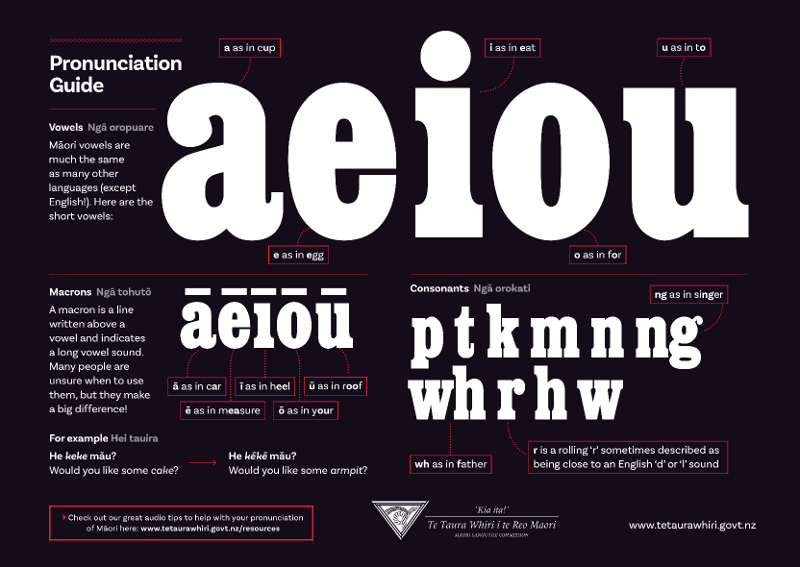
For assistance on pronunciation, visit https://www.tetaurawhiri.govt.nz/en/learn/pronunciation/
Using Te Reo Māori
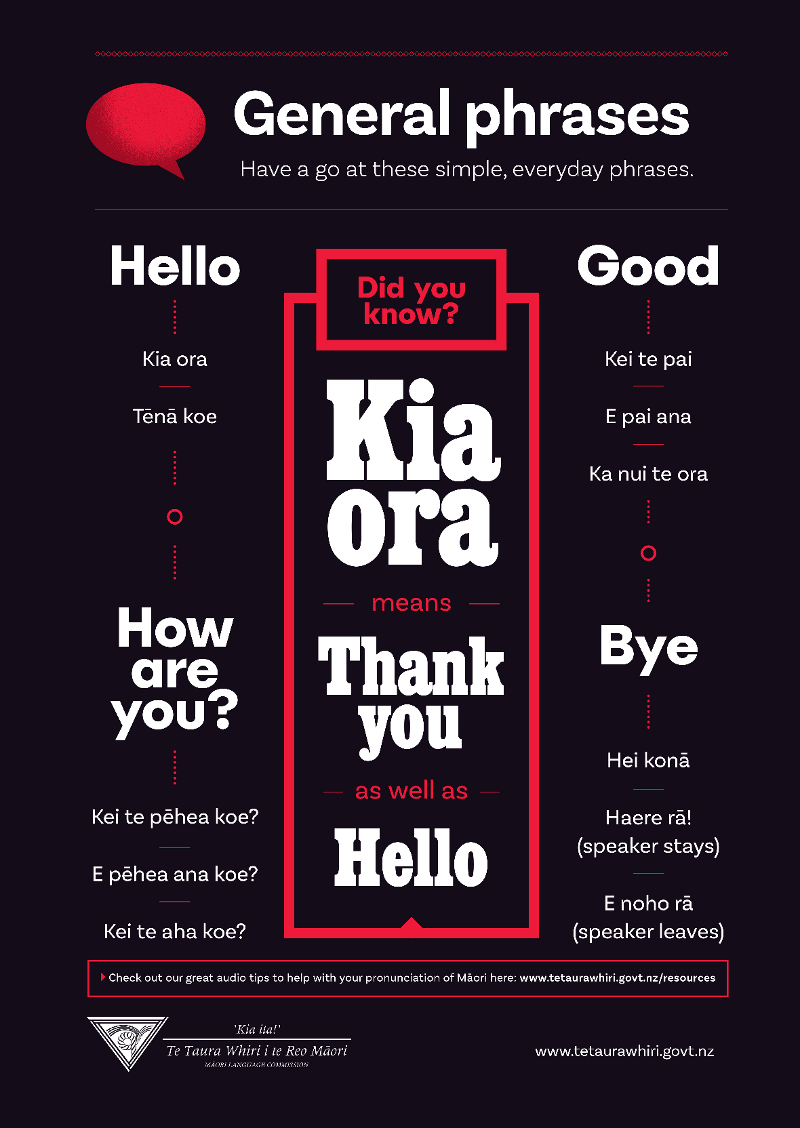
Here’s some simple words and phrases that you can use in your everyday life, and that you can teach your children.
Conversation:
- Kia ora – hi
- Haere mai – welcome / enter
- Whenua – land / homeland
- Mōrena – good morning
- E noho – sit down
- E tu – stand up
- Whakarongo – listen
- Koha – gift / present
- Aroha – compassion / love
- Iti – small, little
- Nui – large, big
- Hei aha atu – don’t worry
- Karakia – prayer
- Meri Kirihimete – Merry Christmas
- Matariki – beginning of Māori New Year
People:
- Whaea – mother
- Tamaiti – child
- Tamariki – children
- Whakapapa – genealogy / ancestors
- Kaumātua – elder or elders, senior people in a kin group
- Tama – son, young man, youth
- Tamāhine – daughter
- Tāne – man/men, husband
- Wahine – woman, wife (wāhine: women, wives)
- Kaumātua – elder of group
Days of the week:
- Rāhina / Mane – Monday
- Rātū / Tūrei – Tuesday
- Rāapa / Wenerei – Wednesday
- Rāpare / Taite – Thursday
- Rāmere / Paraire – Friday
- Rāhoroi – Saturday
- Rātapu – Sunday
(Either version is suitable)
Our body:
- Waewae – foot / feet, leg / legs
- Ringa – hand / arm
- Niho – teeth
- Māhunga / upoko – head
- Manawa – heart
- Puku – stomach / belly
Numbers:
- Tahi – one
- Rua – two
- Toru – three
- Whā – four
- Rima – five
- Ono – six
- Whitu – seven
- Waru – eight
- Iwa – nine
- Tekau – ten
Our world:
- Awa – river
- Moana – sea
- Wai – water
- Motu – island
- Maunga – mountain
- Ngahere – forest
- Āniwaniwa – rainbow
- One – sand
Sport:
- Whutupōro – rugby (union)
- Rīki – rugby league
- Whana poikiri – soccer (association football)
- Neti pōro – netball
- Pahiketepōro – basketball
Food:
- Kai – food
- E kai – command to eat
- Inu – drink
- E inu – command to drink
- Hua whenua – vegetables
- Miraka – milk
- Tīhi – cheese
- Rīwai – potatoes
- Ika – fish
- Ika me te riwai – fish and chips
- Heihei – chicken
- Āporo – apple
- Ārani – orange
- Panana – banana
- Kapu – cup
- Pune – spoon
- Pereti – plate
- Hiakai – hungry
- Kei te hiakai au – I am hungry
- Hiainu – thirsty
- Kei te hiainu au – I am thirsty
- Toa hokomaha – supermarket
- Toa hoko miraka – dairy
- Whare kīhini – kitchen
Out and about:
- Pahi – bus
- Tereina – train
- Motuka – car
- Paihikara – bicycle
- Hīkoi – walk
- Oma – run
- E oma – to run
Where you live
Ever wondered what your town or city’s name means? Check out this guide to 1,000 Māori place names: https://nzhistory.govt.nz/culture/maori-language-week/1000-maori-place-names
The first step is to have a go
Sources: http://www.tetaurawhiri.govt.nz, https://nzhistory.govt.nz/culture/maori-language-week/100-maori-words and http://www.tewikiotereomaori.co.nz/
Kupu app
The Kupu app translation app is a great place to start your te reo journey. Simply take a picture and Kupu will provide the Te Reo Māori translation for the object.
 31 August, 2026


Our kindy is introducing new Maori words regularly as the teachers learn them – they are actively doing courses on Maori language. Our children are bringing home words and using them too. I think it is good to have an understanding of another language – it broadens our learning and knowledge.
Have you guys had the Kupu app? It’s also a cool app to use and learn Te Reo too. I like this article a lot as I’ve wanted to try my hand in learning more Te Reo. Nga Mihi, Alezandra.
When I was studying at polytech my course included 2 weeks of (semi) full immersion Maori language classes. I loved the experience and found that the language came quite naturally to me, I learnt so much!! I don’t use te reo in my normal everyday life but I really must make more of an effort to!
I love our native language Te Reo Maori and often use it in daily life both when speaking with others and with my boys. I recently got a book to help learn more Maori as I would like to become fluent in the language esp as my boys a part Maori. Its such a beautiful sounding language when spoken too I wish we had Maori language month rather than just a week.
When I first began to learn Te Reo i was the only “Pakeha” in a full emersion Maori class and loved every minute of it. I remember it being so easy to learn and so fun ….no swear words except ow a days there is slang in modern Te Reo.
Fantastic resources! I am a teacher and a mother and I love to expose both my students and my own children to the language of our country. It’s great to see more New Zealanders are open to learning more about the Maori language and culture. It is becoming a more natural part of our lives 🙂
What a great resources. My children both learn Maori at school and speak it so well that it makes me feel bad. I might have to use this to study up so I can surprise them.
This is awesome with all the great informative websites to go to. We use different language like kai and the numbers in the te reo. My children love kapa haka and doing their mihi at school they are right into it. Their school teaches a lot of it which is great. I have even brought them a pipi ma doll for Christmas each to learn more of the language.
I love this! What a great resource. This is one of my favourite weeks at work, I get lots of fun language activities 😍 and I get to come home and share what I have learnt with the kids. We have been also using a app this year called Kupu? It lets you photograph something and then you can see possibly what the Maori word is for that thing. We have had lots of fun trying to photograph everything! Hehe.
Awesome, my 5 year old daughter has better pronunciation that I do haha. Her father and her are both Maori and we need to delve a bit into their ancestry. Her Koru teaches her words when we see him (he lives in another town) so it’s good learning for her. I’ve just downloaded the Kupu app on my phone which is really cool 🙂
Our kids do a little bit at school on Maori words but they probably did more at Playcentre as you have to incorporate words into learning stories for the children. Some teachers are great at teaching Maori but others not so good. This is great though it has all the basic words kids can learn for everyday items or things we do.