


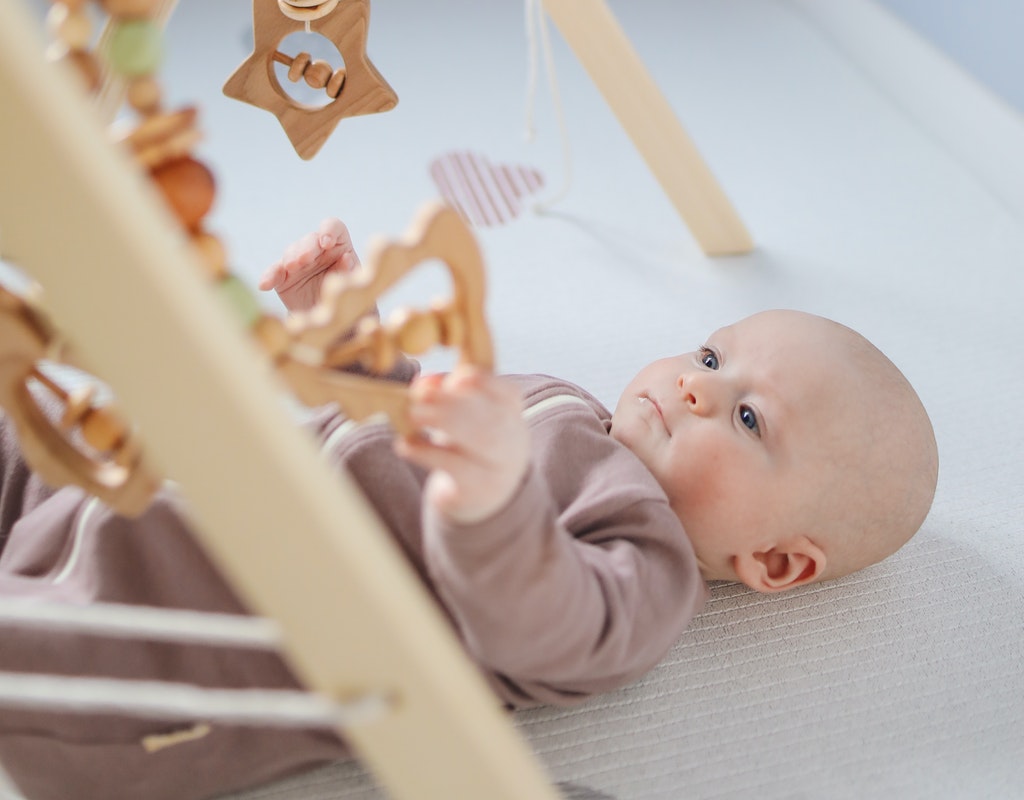
First three months developmental milestones include:
- From birth, your baby’s reflexes will allow her to turn her head to suckle when you touch her cheek
- She can flex and extend her fingers, arms and legs
- By 1 month, her eyes can follow a moving light (she may be able to do this for only a few seconds)
- Between 4 – 8 weeks, she will lift her head when put on her tummy
- By 6 weeks, her eyes can move together most of the time
- By 2 months, she will enthusiastically kick her legs
- By 2-3 months, she can watch and follow a moving face
Find more:
- Understand your baby’s reflexes
- What can your baby see?
What can I do to encourage her physical development?
- Giver her plenty of tummy time to strengthen her upper body muscles
- In the shade of a tree, let her have some nappy-free time – some babies love to wave their legs around unencumbered but others don’t like it at all.
Find more:
- The importance of probiotics for your baby’s development
Signs that suggest a developmental problem:
- She is unusually stiff or floppy
- The muscle tone differs between one side of her body and the other
- Her head control is particularly developed (her neck muscles are stiff)
- She always holds her fingers in a tight fist
- She is continuing to struggle with feeding beyond what is ‘normal’
- She cries for long periods every day and is exceptionally difficult to settle
- She rarely cries, sleeps consistently well and is unusually ‘good’
All children are different and develop at different rates, so don’t be overly concerned if your baby is acquiring new skills at a different rate to those around her. But if you are worried about her development, talk to a health professional for a little reassurance.
Find more relevant information about your baby’s development
- Find out when you will see baby’s first smile!
- Learn about your baby’s social and emotional development
- How does your baby communicate with you?
- Follow your baby’s speech and language development
This article was written by Ella Walsh for Kidspot New Zealand’s parenting resource for newborns and baby. Sources include Government’s Parenting and Child Health and Raising Children Network.
 14 July, 2026
 18
18


why is the baby written as though it’s a female. PC gone mad!
Hi Steve. The use of a female pronoun in this article is purely the writer’s choice. In other articles on our site writers will use male pronouns and in others there is a mix. By using just one pronoun it helps the article to flow better when being read, rather than clogging up the article with various mentions of “he or she” etc. This is just standard writing practice. Thank you for your query.