Adding A Splash Of Colour To Your Tot’s Room

If your little one’s room is lacking a bit of style, adding a splash of colour can freshen it up.

Painting an entire room is a big job, especially when kids outgrow the room or the colour in no time at all. But by adding splashes of colour you can easily update the decor in your tot’s room. Explore these ideas for a bedroom makeover.

Make a wall a feature

The obvious way to add colour is to break out the paint brush and get to work on those walls. While one colour all over the room is simple, you could choose to paint just one wall as a feature (less paint is good for the budget).

Alternatively, add some interest and a bit of unique styling with painted panelling.

Colour plus

Adding a colour feature is an effective way to create a unique style in a bedroom while keeping the style predominantly neutral.

There’s no need to stick to straight lines – an angled colour change across a wall can look very effective and geometric patterns are cool for kids rooms. Or if you’re feeling adventurous, create your own mural.

When you simply can’t choose a colour!

This is a neat idea from Resene to create a unique mobile for your child’s room, whether you’re still in the process of choosing a colour, or you simply want a unique decorative item!

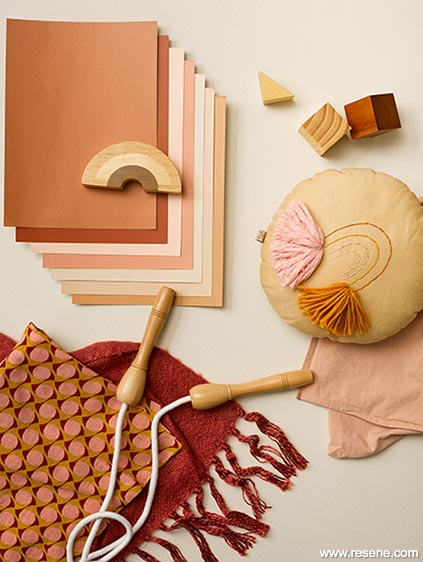
“Simply order A4 drawdown paint swatches in your favourite Resene colours, cut them into organic shapes, punch a hole and string them up – voila!”

Colourful and practical

Storage is so essential in a kids room but it doesn’t have to be boring. Think out of the box (geddit?) by upcycling storage like old toy boxes.

This stack of beautiful suitcases is ideal for storing clothes or toys.

Over the top

Ceilings don’t have to be white. Painting the ceiling of your little one’s room can add colour to a neutral palette and after all, whilst they’re little, they’re going to spend quite a bit of time staring straight up!

Accessorise

Bedcovers, pillows, baskets, picture frames, and painted furniture can all bring in splashes of colour to add warmth and interest to a room.

Try not to go too crazy with the colours – choose from a similar colour palette to create a calming aura. In this image the pretty pink polka dot paint on the walls is complimented by the sorbet orange and mustard yellow colours of the accessories.

Create your own splash

Testpots are an easy way to find that perfect shade of … whatever you choose! Here, candy colours pop off of the black background of a simple art design.

Canvas is available from craft retailers for you to easily create your own masterpiece.

Easy art

If you’re artistically challenged, choose a colourful print and pop it in a frame for instant style. Baby animals are always a hit with tots. Alternatively, use a print of a favourite family photo with plenty of colour like a beach scene or bush walk.

Paper fans, bunting, wall hangings, and dreamcatchers can be bought or homemade to add some easy personal style.

her world julieWritten by Julie Scanlon

Julie is Editor for Kidspot NZ and our MVP. Her hobbies include laughing uncontrollably at her own jokes, annoying her family by asking questions about movie plots, and never taking anything too seriously. She speaks a little Spanish and a lot of Yorkshire. 

Favourite motto to live by: “It ain’t nothing but a thing”

More Green Time, Less Screen Time

Article written by Jagrut Lallu, Optometrist and founding member of the Australia and New Zealand Child Myopia Working Group.

We have all experienced significant change to our daily life during 2020 – some change we have embraced and some has been challenging. Now we all have an opportunity to create a ‘new normal’ that works for each of us and our families.

Giving children less time on devices and more outdoor time, plus more frequent breaks from screens, is an area that we now have the opportunity to improve as we start to live in a COVID-19 environment.

An increasingly digital world

Screen time has unavoidably become a big part of everyday learning and interaction, especially during the height of the coronavirus pandemic. It has had huge benefits in helping us to communicate and stay in touch. However parents are often not aware of the association with low levels of outdoor activity1 and associated factors including low levels of light exposure2 and prolonged near tasks such as reading and screen time3 which may influence the development of myopia.

What is myopia?

Myopia is a common eye condition that causes blurred distance vision which usually starts during childhood and typically progresses until a child stops growing.

Myopia is rapidly becoming a serious public health concern in New Zealand, yet research shows that 69% of New Zealand parents (with children up to 17 years old) do not know what myopia is, and only 12% of parents recognise the eye health conditions that their children might develop later in life from child myopia. The eyes grow from birth through to adulthood. If parents can start to instill good visual habits, like they do dental habits, it may help in the long term to reduce the growing rate of myopia globally.

The importance of outdoor play

Lifestyle factors including low levels of outdoor activity4 may influence the development of myopia.

More research is needed to determine if it is to do with the intensity or brightness of the light or the distances that children focus on, but what is proven is that there is a link between outdoor time and its benefit to a child’s myopia development.

Given that outdoor play is free, “more green time less screen time” is a timely reminder for moderation in an increasingly digital world.

What can parents do to help reduce the likelihood of their child developing myopia?

There are two main factors which can mean your child is more at risk of developing myopia: lifestyle and family history.

The likelihood of developing myopia, particularly high myopia increases when one or both parents are myopic5 However, the exact link between a family history of myopia and development of childhood myopia remains uncertain6

You can’t influence genetics but parents can feel empowered when it comes to lifestyle factors.

Top Three Myopia Busting Tips:

  1. More green time less screen time!
  2. Build in regular breaks from devices – every twenty minutes remind your child to have a break for at least twenty seconds and look out a window to something at least six metres away7
  3. Talk to your local optometrist about all of the options to stop your child from having to change glasses prescriptions as frequently.

Finding balance

The world after lockdown needs to include some thought on all aspects of how we live our lives. One thing that it has taught us all is that there needs to be a balance. We have embraced technology in a huge global experiment for how we work, now is an opportunity to extend that to how we want our children to grow up. The Optometrist’s goal is to educate on a number of eye health topics. Myopia is one of these topics – if we think about how we are interacting with our environment i.e. more time outdoors less screen time we can influence the number of times glasses need to be changed in the future.

By 2050, it is estimated that more than 50% of the world’s populaton will have myopia and 10% or almost 1 billion will have high myopia8 If we all encourage daily play time outdoors we have an opportunity to halve that. Each time a prescription for short-sightedness increases in strength there is an increased association with serious eye conditions later in life, including an increased risk in permanent sight loss9. However action can be taken to manage myopia. Starting a conversation with your local optometrist is a positive first step.

To find out more visit www.childmyopia.com or download a free copy of the report The Australia and New Zealand Child Myopia Report – A Focus on Future Management.

1 He M, Xiang F, Zeng Y et al. Effect of Time Spent Outdoors at School on the Development of Myopia Among Children in China: A Randomized Clinical Trial. JAMA 2015; 314:1142-1148

2 Read SA, Collins MJ, Vincent SJ. Light Exposure and Eye Growth in Childhood. Investigative Ophthalmology and Visual Science 2015: 56(11):6779-6787

3 Ip JM, Saw SM, Rose KA, Morgan IG, Kifley A, Wang JJ, Mitchell P. Role of Near Work in Myopia: Findings in a Sample of Australian School Children. Investigative Ophthalmology and Visual Science 2008:49(7):2903-2910

4 He M, Xiang F, Zeng Y et al. Effect of Time Spent Outdoors at School on the Development of Myopia Among Children in China: A Randomized Clinical Trial. JAMA 2015; 314:1142-1148

5 Lim LT, Gong Y, Ah-Kee EY, Xiao G, Zhang X. Impact of parental history of myopia on the development of myopia in mainland China school-aged children. Ophthalmology and  Eye Disease. 2014;6:31-5

6 Ip J, Huynh S, Robaei D, Rose K, Morgan I, Smith W, Kifley A, Mitchell P. Ethnic differences in the impact of parental myopia: Findings from a population-based study of 12-year old Australian children. Investigative Ophthalmology and Visual Science. 2007:48:2520-2528

8 ibid.

9 Fricke TR, Jong M, Naidoo KS, Sankaridurg P, Naduvilath TJ, Ho Suit SM, Wong TY, Resnikoff S, Global Prevalence of Visual Impairment Associated with Myopic Macular Degeneration and Temporal Trends from 2000 through 2050: Systematic Review, Meta-Analysys and Modelling. Br. J Opthalmol, April 2018

The Australia and New Zealand Child Myopia Working Group is a collaboration of leading optometrists and ophthalmologists. The Working Group’s aim is to set a recommended standard of care for child myopia management, in order to slow progression of myopia in children.

Working Group members are: Dr Rasha Altaie, Ophthalmologist, Auckland; Luke Arundel, Chief Clinical Officer, Optometry Australia, Melbourne; Jagrut Lallu, Optometrist and Immediate Past President of the Cornea and Contact Lens Society of New Zealand (CCLSNZ), Hamilton; Margaret Lam, Optometrist and National President of the Cornea and Contact Lens Society of Australia (CCLSA), Sydney; Dr Loren Rose, Paediatric Ophthalmologist, Sydney; Andrew Sangster, Optometrist and Board Member of New Zealand Association of Optometrists, Wellington; Chair – Scientia Professor Fiona Stapleton, School of Optometry and Vision Science UNSW, Sydney.

Read more on Kidspot:

Transitioning A Kids Room From Toddler To Teen

Sponsored content provided by Resene

As your child’s personality develops, their room can become more of a reflection of their individuality and tastes. Discover how to transition their room from toddler to teen with colourful inspiration.

Themes are a really fun way to define a kid’s space. Try to pick things that they’ll likely enjoy for a few years rather than just the flavour of the month. Sometimes more generic themes will work better than ones based on pop-culture. Look beyond TV and movies to imaginative worlds of jungles, deserts, sea, space, animals or royalty for inspiration.

Toddler …

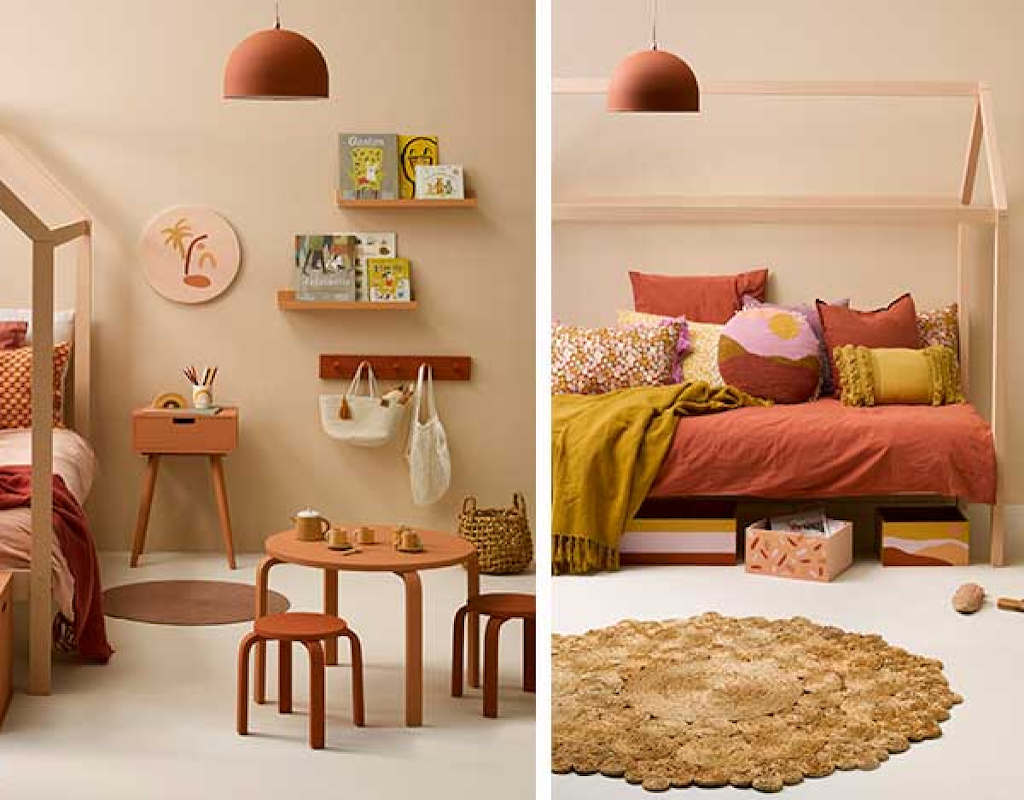
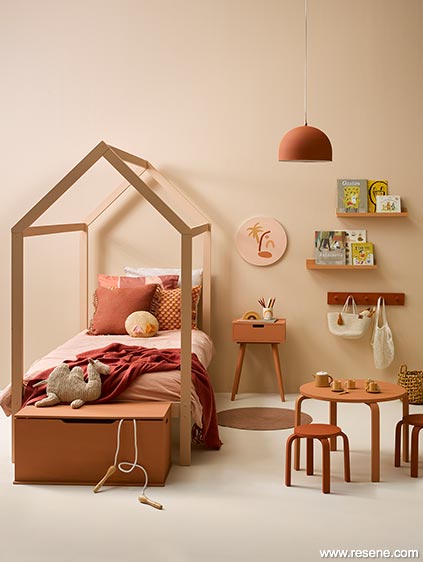
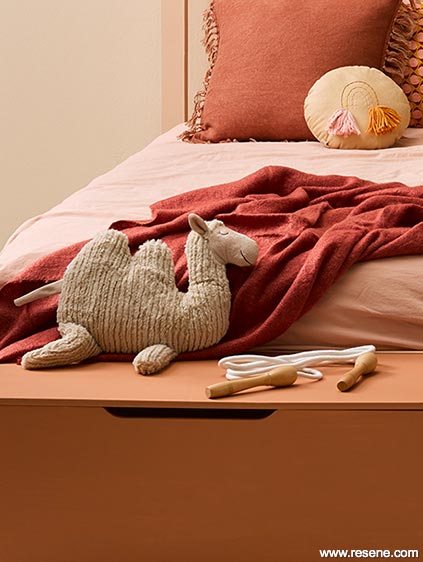
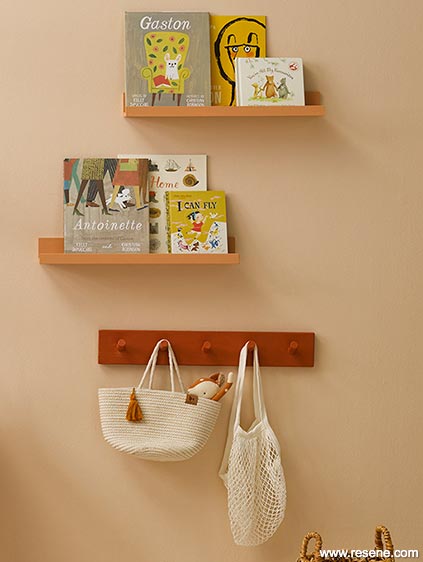
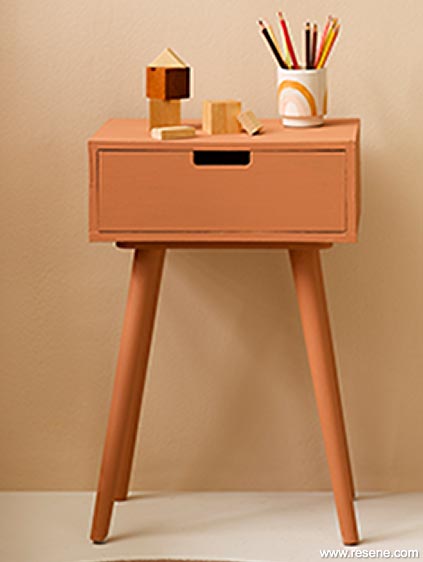
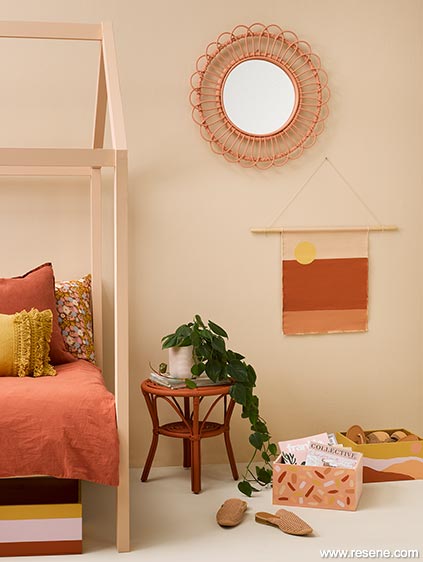
Paint: Walls in Resene Bone, Floor in Resene Blanc, Bed in Resene Cashmere, Toy Box in Resene Sante Fe, Book ledges in Resene Kalgoorie Sands, Bedside cabinet in Resene Sante Fe, Pendant light in Resene Moccasin, Kids Round table in Resene Sante Fe and stools in Resene Moccasin, Peg hook hanger in Moccasin.

Picking paint colours

Often, a second opinion is invaluable at this stage for picking the right paint colours that will change the space to make it truly theirs. It is fun to have your child’s involvement too, and taking them for a visit to a Resene ColorShop can be of great benefit. Start with small projects and look for ways your kids can help out.

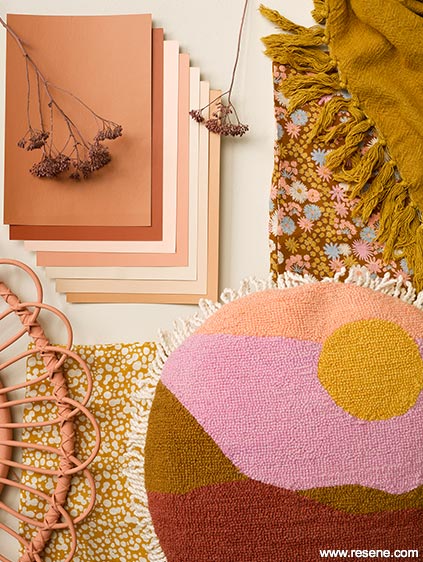
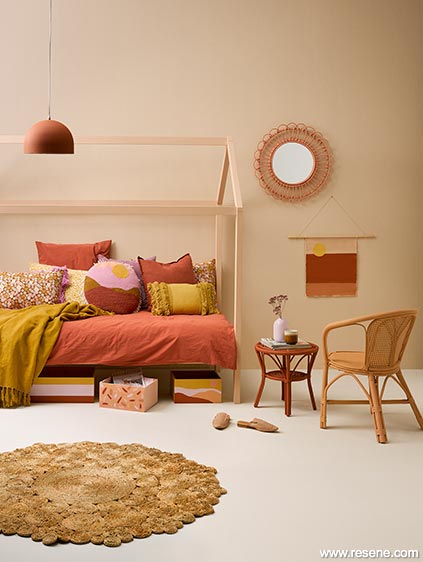
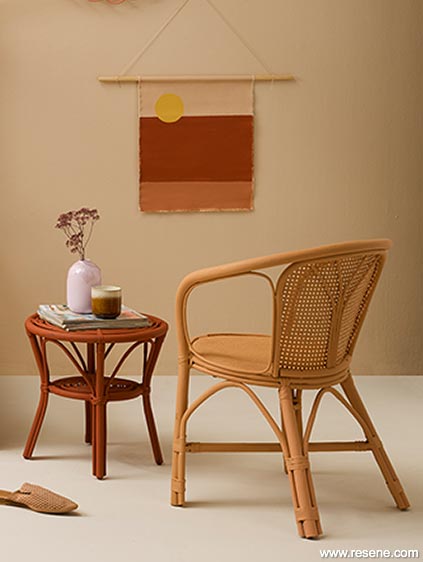
Creamy off-whites and dusty peachy pinks, while trendy, are an easy colour to use in a little girl’s room that can still be made to look cool as they get older. Walls in Resene Bone and a floor in Resene Blanc make the ideal starting point for this transitional colour scheme and a great base to start building up layers of desert and sunset-inspired hues, such as the pendant light, coat hooks and stools in Resene Moccasin and the toy box, bedside cabinet and play table in Resene Sante Fe. When the room’s owner gets a little older, you can swap out the kiddie furniture for something more mature, such as a cane mirror in Resene Just Dance, a cane chair in Resene Kalgoorie Sands and a vase painted in Resene Twilight.

Furniture that grows with them

Flexible furniture, either in its ability to transform from one thing to another or for its multi-tasking qualities, can also be a great investment during this phase. When your child has grown out of their cot, wooden bunk beds are perfect for freeing up floor space and can be painted to suit your child’s personality. As your child gets older, simply lose the bottom bunk and add a study nook underneath the top bunk.

Children love their privacy, too, and often enjoy having their own hideout. Bunks can easily convert into forts with a few blankets and boxes. And in the transition to a teenage bedroom, they will probably appreciate that privacy all the more. This unique house-shaped bedframe painted Resene Cashmere would make for the ideal fort when your child is young and can then be draped with gauzy fabrics to create a canopy as they grow.

Teen room …

Paint: Walls in Resene Bone, Floor in Resene Blanc, Bed in Resene Cashmere, Pendant light in Resene Moccasin, Cane table in Resene Moccasin, Cane mirror in Resene Just Dance, Cane chair in Resene Kalgoorie Sands, Vase painted in Resene Twilight.

Co-ordinated storage

To get your child organised, incorporate plenty of shelving and storage. Wooden crates are easy to stack and don’t take up too much room, while box or honeycomb shelves make a fun DIY painting project and can be arranged in different patterns on the wall. When your child is very young, lipped shelves in Resene Kalgoorie Sands can be used to display favourite story books. When they’re a bit older and have outgrown the traditional toybox, underbed storage boxes painted to match their colour scheme can help keep small possessions tidy and out of sight. We used Resene Moccasin, Resene Just Dance, Resene Twilight, Resene Sante Fe and Resene Apache to dress up a set of wooden boxes so they co-ordinate with the theme of the room.

Testpots to tie it all together

When you and your child have agreed on a colour scheme, pick up a few Resene testpots in colours that coordinate with their walls, floor, furnishings and bedding and let them paint up something especially for their space. The abstract ‘palm tree’ was painted onto a round canvas painted Resene Sorbet in Resene Moccasin, Resene Kalgoorie Sands, Resene Just Dance and Resene Cashmere while the sunset banner was creating using a cut piece of blank canvas painted Resene Sante Fe, Resene Moccasin, Resene Cashmere and Resene Apache stapled around wooden dowelling and hung up with a length of wool. They’re the finishing touches that tie the space together.

For more information on this activity, colour inspiration and accessories, visit Resene.co.nz

Article provided by Resene. Styling by Vanessa Nouwens. Photography by Melanie Jenkins. 2019

Read more on Kidspot:

Inspire Play With A Painted Road In A Kids Room

Sponsored content provided by Resene

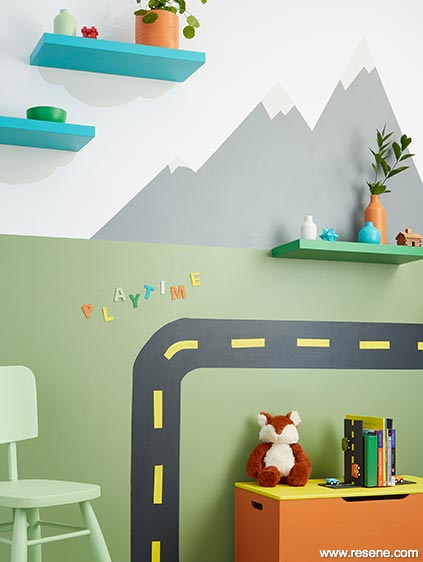
When you love playing with cars, the world is your motorway! Help pave the way for creative play by using paint and masking to turn your kid’s bedroom or playroom into a whole world for them to explore.

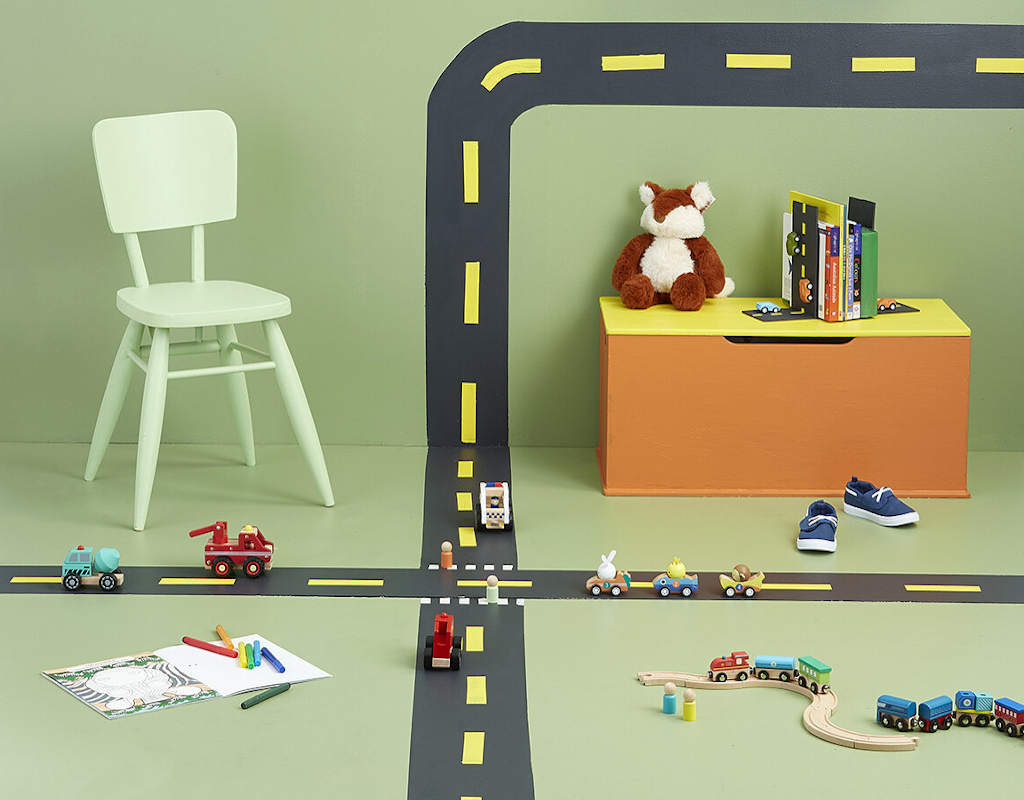
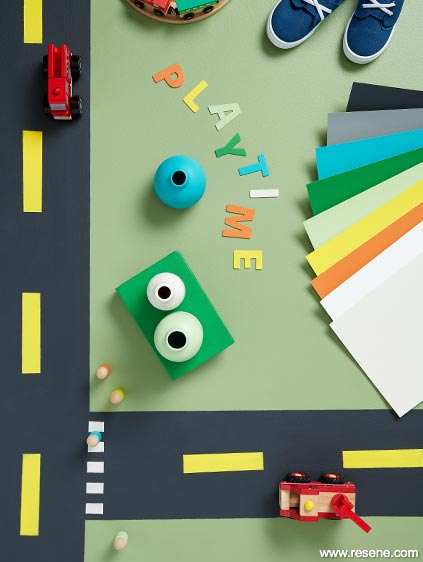
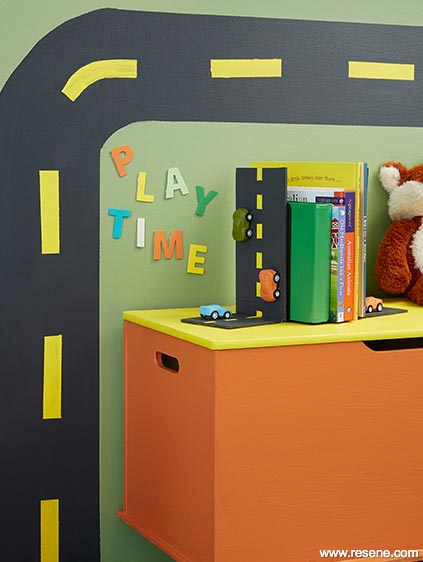
The grassy lower walls and floor in this room are painted in Resene Highland while the road is in Resene Shark with dashed lines in Resene Broom and the mountains are in Resene Trojan with snowy caps in Resene Bubble White. To keep the space feeling light, the sky is in Resene Saltpan. The upper shelves are painted Resene Java with clouds beneath in Resene Bubble White.

Add a splash of colour on shelves and accessories

The lower shelf is in Resene Japanese Laurel, the chair is in Resene Anise, the toybox is in Resene Sebedee with a lid in Resene Broom, the hooks are in Resene Broom and Resene Bubble White, and the plant pots, bowls and vases (from left to right) are in Resene Broom, Resene Shark, Resene Japanese Laurel, Resene Anise, Resene Sebedee, Resene Bubble White, Resene Java and Resene Sebedee. Even the peg pedestrians have been painted to match in Resene Sebedee, Resene Broom, Resene Japanese Laurel and Resene Java.

Magnetic magic!

To add another dimension of play, the grassy section of the wall has been given two basecoats of Resene FX Magnetic Magic. Attach strong magnets to the back of other plywood shapes or small wooden toys – cars, trees, buildings, letters and numbers – and your kids will spend countless hours playing out stories on their walls. To make things even better, if you choose Resene FX Chalkboard Paint or Resene SpaceCote Low Sheen as the base for your tinted topcoat colour then the surface also works as a chalkboard. Simply wipe it clean with a damp cloth anytime your children want a blank canvas for drawing.

Fast lane bookends

Kids have a special superpower. When they see a simple shape, they don’t just see a square, circle, rectangle or triangle – they see a robot, flower, spaceship or tree, and all they need is a bit of paint to uncover its true form. A helpful adult can help make a few simple cuts using a jigsaw, scroll saw or similar tool to create basic shapes out of plywood and help to sand down any sharp edges. Just wipe away sawdust, then the real fun can begin!

With just a couple of plywood squares and rectangles, toy cars and Resene testpots, you can put a pair of boring bookends on the highway to fun. We painted ours in two coats of Resene Shark, allowing time to dry in between. To speed things up, you can always use a hair dryer to put the drying process in the fast lane.

Once your basecoats are dry, use high quality masking tape to create the dashed centre line. Simply find the centre of your rectangle, apply strips of masking half a centimetre on either side, then use perpendicular strips of masking to create the gaps in between. We painted our dashes in Resene Broom. While your roads are drying, paint a few wooden or diecast vehicles using Resene testpots in your favourite colours. We used two coats each of Resene Sebedee, Resene Untamed and Resene Mystery for our cars.

Once everything has dried, use quick bond glue to attach your road sections to the back of your metal bookend and each other so your shapes create an ‘L’ shape. Then, glue the wheels of your vehicles onto your roadways so that they appear to be driving up and down your bookends!

For more information on this activity, colour inspiration and accessories, visit Resene.co.nz

Article provided by Resene. Styling by Laura Lynn Johnston. Photography by Bryce Carleton. 2020

Read more on Kidspot:

Setting Up Your First Family Veggie Garden

Since our first lockdown home veggie patches have really taken off! Growing your own veggies is not only a great way for the family to enjoy the outdoors together, it will also save you money, and encourage the kids to try new foods.

Setting up your first family veggie patch may seem daunting if you haven’t lifted a shovel before but it doesn’t need to be complicated.

Do some research

A little bit of planning and research before you launch into planting will help you to be more successful from the get go. Read up on what you can grow in your area (think about temperatures, frosts, and dry conditions). And consider the season that you are planting in. Our seasonal calendar of easy to grow edibles is a great place to start. Don’t forget to let the kids choose a couple of things that they would like to grow too.

Growing from scratch

The cheapest way to grow your own veggies is using seeds, even those you have cultivated yourself from the veggie scraps. However, it can be a long process to grow edibles from seed so including some already sprouted seedlings in your planting is a great way to keep the kids interested as they can see progress right from the start.

For DIY seed trays, egg cartons, eggshells, old ice cube trays, newspaper shaped to form a “cup”, toilet rolls folded at the bottom, and paper cups are just some of the things that can be used. You just need something that can allow some growth and hold the dirt in while being able to drain any excess moisture away. Be sure to poke a few holes in the base and pop a waterproof liner or container underneath then pop them in a sunny spot inside. Kids will love to see those first signs of a plant sprouting! If the seed container is compostable then all the better as you can plant your seedlings straight out into the garden without disturbing the root system. Just make sure you loosen up the base of the container to let the roots start growing straight away.

Setting up your patch

For the veggie patch, find a spot in your garden that isn’t too close to where kids or pets like to play. A sheltered area with a combination of full sun and some shadier spots is ideal. Always check the plants that you are wanting to grow for the conditions that they require. Dig up the soil to break it up – one to two spade depths is sufficient – and remove any weeds. As long as you add some good compost to the soil you don’t need to add anything extra but some potting mix or general fertiliser can help. Plants like strawberries and tomatoes will appreciate some feeding throughout the fruiting season – just check with your garden centre for what’s best.

Any patch of dirt can be turned into a veggie patch but raised beds are great backsavers if you are able to include some. They help to keep the soil contained so that little gardeners aren’t quite so messy with their weeding too! Creating paths between your veggie beds can help harvesting and weeding, allowing you to reach all the plants (and weeds). Start with a small patch and work your way up so you’re not overwhelmed.

Don’t forget that you will need a nearby water source. Be mindful of water restrictions during our Kiwi summers – a tank to collect rainwater may be ideal for your eco-friendly patch! Talk to your local council to find out more.

If you don’t have space for a garden bed, there are lots of veggies that love to be grown in pots, especially tomatoes, capsicums, and herbs.

Plants that grow tall like tomatoes and capsicums will need some staking for support. Just pop a stake in and gently tie a sturdy section of the stem to it. Remember to leave some room for growth. You can use a few garden canes and string to create a trellis for plants like beans and peas to grow up.

A low maintenance garden

Maintaining a veggie patch can be a wonderful way to spend time together with the kids, learning about growing food and discovering new tastes. It can also be hard work on those days when you just don’t have the time or energy! Here’s a few things to consider to make your veggie growing a little bit easier.

  • To help keep weeds down and retain moisture, add mulch around your plants.
  • Having newly planted seedlings kicked over by digging cats, beautiful cabbages covered in caterpillars, or delicious strawberries nicked by the birds can be frustrating. Netting can help to keep the replanting and bug picking to a minimum.
  • Slugs and snails do not care that you want your garden to be organic so unless you’re intending on watching the veggie patch constantly some form of control is required. Traps are available if you’re not keen on pest control chemicals.
  • Perpetual plants are your best friends! Plants like loose leaf lettuce, kale, spinach, herbs, capsicums, tomatoes, rhubarb, and fruits are great because you only have to plant once and then by taking just what you are using that day the plant will (most of the time) keep producing for a whole season.

Investing in a few essential tools will also make gardening more pleasurable. A child’s set for the kids will encourage them to get involved. All you need to get started is a shovel and garden fork for digging and turning soil over, a cultivator for weeding, a trowel for planting, and a watering can or hose. Garden gloves, scissors for cultivating, and a kneeling pad are also helpful. Instead of a wheelbarrow I recommend a four-wheeled garden trolley as they are easier for the kids to use. I also prefer a large bucket to put my weeds in rather than a bag that blows away in the first breath of wind!

Rotate!

Don’t be tempted to plant out two dozen of the same plants all at once – unless you REALLY like that veg! For things like cauliflower, broccoli and cabbage it’s best to plant a few at a time (mixed combos are great for this) and then a few weeks later plant again so that you have a rotation of plants that are almost ready and those that still have some growing to do.

Try and try again

Not every veggie will grow successfully in your garden, no matter how much attention you give it. Others will thrive and you will learn which do better and which are best avoided.

Have you started a veggie garden or are you looking to start one? What would you like to grow at home?

See more:

her world julieWritten by Julie Scanlon
Julie is Editor for Kidspot NZ and our MVP. Her hobbies include laughing uncontrollably at her own jokes, annoying her family by asking questions about movie plots, and never taking anything too seriously. She speaks a little Spanish and a lot of Yorkshire. 

Favourite motto to live by: “It ain’t nothing but a thing”

Your Guide to Home Composting

If you’re not already home composting then you’re missing out on great, organic fertiliser for your garden and an easy way to reduce your rubbish.

Growing our own veggies has taken off in a big way recently. And those veggie plants love nothing better than some fantastic compost to give them nutrients for healthy growth.

Starting a compost bin

To get started, there is an array of compost bins and setups that you can choose from. Your local hardware store or garden centre is a good place to check out what will work best for your needs. Choosing one with a lid can help keep the pests away and speed up the process. Alternatively, you can build your own using a large plastic bin, or create a simpler open compost “heap” with some old pallets or fence panels.

Pop your compost bin into a sunny position in the garden, preferably close to your veggie patch for convenience. You also want it to be accessible for adding in more waste.

In order for compost to be created successfully you need a blend of nitrogen, carbon, air and water. The nitrogen comes from kitchen and garden waste. The carbon often gets overlooked but can be easily added by tossing in used paper towels, shredded newspaper, or leaves and twigs. If your compost looks too dry, sprinkle on some water. And if it looks to wet, throw in some shredded newspaper.

If you want to be using your compost quite quickly, then cutting down scraps etc to smaller pieces will help the process. It’s also helpful to mix or “turn” your compost every week. Once you get that earthy smell and the compost is broken down to a dark brown colour you’re good to use it on the garden.

Having more than one compost bin lets you use the compost from one while the next load of compost is being prepared.

What goes in and what to leave out

Basically, anything organic that isn’t going to attract unwanted pests is fine to go in. Things like meat and bread are too much of an attraction to rats so it’s best to leave those out. Dairy products and oils have a tendency to become rather stinky so leave those out too so you can avoid needing a peg on your nose every time you go into the garden.

What to put in the compost

  • Vegetable and fruit peelings and scraps
  • Cut grass from the mower
  • Plant prunings
  • Cardboard and brown paper bags
  • Eggshells (not eggs though)
  • Nut shells
  • Leaves
  • Tea leaves, coffee grounds and filters
  • Clean paper, paper towels, shredded newspaper
  • Hay or straw
  • Wood chips or sawdust (as long as you know it wasn’t treated)
  • Home compostable packaging

What to leave out

  • Meat, fish, or bones
  • Dairy products
  • Eggs
  • Bread and baked goods
  • Rice or pasta
  • Oil or fat
  • Pet waste
  • Plants with disease or insects
  • Weeds
  • Any plant that has been treated with a pesticide
  • Plastic
  • Stickers from fruit
  • Glossy paper

Using the compost

For new beds, dig a 10cm layer of compost into the soil and mix well. For established beds, you can spread a 5cm layer of compost over the soil and the worms will get to work and mix it in. Always wear gloves and a dust mask when working with compost and wash hands thoroughly afterwards.

Top tips for composting

To help make your compost successful you need to get the whole family on board to help add the right scraps etc. As you know what your family usually eats or uses around the home, creating an easy to read family “cheat sheet” of what can be put in the compost can help.

Utilising a kitchen scraps bin is the easiest way to get into the habit of composting. You can purchase ones with a carbon filter to block the smell. I just use a small plastic bin with a flip lip that hides under the kitchen sink when not in use and gets emptied every other day. Putting a piece of kitchen towel in the bottom not only makes emptying the bin into the compost easier but can also help to achieve a good level of carbon without too much forethought.

Remove the stickers from your fruit peels before they go in the compost as those things never seem to break down!

her world julieWritten by Julie Scanlon
Julie is Editor for Kidspot NZ and our MVP. Her hobbies include laughing uncontrollably at her own jokes, annoying her family by asking questions about movie plots, and never taking anything too seriously. She speaks a little Spanish and a lot of Yorkshire. 

Favourite motto to live by: “It ain’t nothing but a thing”

The (Almost) Anxiety-free Guide To Leaving The House With A Newborn

Leaving the house with a newborn may sound pretty easy – until you’re handed your first precious bundle!

In the confines of your home with everything you need around you and your partner/mum/friend available for any questions/dramas/shopping needs, you may begin to relax into this parenting thing as the days since your baby’s birth tick by. But eventually, through necessity or desire, you are going to have to leave the house with your baby.

I remember the first time I took my baby out in a baby carrier. Or rather, the first time I TRIED to take my baby out. I spent two hours trying to figure out how to get baby in the carrier, only for him to need a nappy change as soon as he was in (poonamis are not good for baby carriers!), and then it was feeding time so I gave up. The next day I did manage it after creating a bullet-point plan of attack so that was a two day effort to walk two minutes down the road. Um … yeah.

Nevertheless, as with anything, you eventually do get better with good planning and practice.

Your first outing

Now, when I say outing, I mean literally the first time you step out of the house with your baby to somewhere other than the letterbox. Make the first outing a simple one.

Take a stroll around the block with baby in the pram or baby carrier. All you need to remember is your phone, your keys, and a muslin cloth. Muslin cloths are so versatile – use it for just about any eventuality including wiping up milk or sick, shielding baby from the sun or wind, or to play peekaboo. Even if your walk takes just ten minutes, you’ve done it!

The next outing

Choose a destination that you’re comfortable with for your first proper outing. Whether that’s to a friend’s house, your parent’s house, or to the local shops, or any familiar surroundings so that you haven’t got navigation issues to add to the mix.

Pack a bag with the essentials – start big and pack for every scenario but over time you will work out what you do and don’t need.

Make sure you’ve tried out your equipment beforehand. Do you know how to get your pushchair up stairs? Can you open/close the pushchair? Do you know how to fit it in the boot of your car? Do you know how your child restraint works?

Choose a time of day when baby is most settled and, if you can, feed baby before you leave to give you a bit of a headstart. If you’re worried about breastfeeding in public remember that you don’t have to but if you prefer to cover up, practise doing this before your outing. Think about what you will wear too to make breastfeeding easier.

Don’t forget personal things like a change of breastpads and a bottle of water – look after your own comfort as well as that of your baby.

A muslin cloth makes a great cover over your baby carrier or pram to keep the cheek-squeezer public at bay.

If at all possible, take someone with you for moral support (and to do the heavy lifting). However, the first time that you do the outing on your own you will feel an added sense of accomplishment.

What’s the most overwhelming thing about leaving the house with your baby?

See more:

her world julieWritten by Julie Scanlon
Julie is Editor for Kidspot NZ and our MVP. Her hobbies include laughing uncontrollably at her own jokes, annoying her family by asking questions about movie plots, and never taking anything too seriously. She speaks a little Spanish and a lot of Yorkshire. 

Favourite motto to live by: “It ain’t nothing but a thing”

What Do I Say? Ideas For Talking To Your Baby

Talking with your baby is a wonderful way to help them develop language and communication skills. But having a tiny human hanging on your every word can be a little daunting when you think you have nothing to say!

When a baby hears different words they develop their understanding of language. The more they hear, the more they understand and eventually learn to use. Language skills can then impact on reading and comprehension, setting your baby up for a great start in life.

Knowing we should talk to our bubbas is one thing. Knowing what to say is another. You may feel self-conscious about waffling away to someone who doesn’t even seem to be aware of what you’re talking about (though this does prepare you for when they become a teenager!), especially if you aren’t sure what to talk about or you’re out in public.

But talking to your baby can happen anywhere and at anytime – so we’ve put together some pointers to help you think about what you would like to talk about and how to help baby develop communication skills later on.

Talking to your bump

Before your baby has even made their way into this world, you can talk to your “bump”. The conversation is very one-sided but from around 23 weeks your baby can begin to hear sounds from outside the womb and create an attachment to the sound of your voice. It’s a beautiful way to begin the bonding process.

Talking to someone you can’t even see may feel a little odd so having a natter in the supermarket aisles or on the bus while surrounded by strangers probably isn’t the way to go. Instead choose moments like having a relaxing bath, whilst rubbing moisturiser on to your bump, or having a quiet moment with your partner.

Things to talk about:

  • Tell baby where you are and what you’re doing – ie, “We’re taking a walk through the park near our house” or ” We’re off to visit Grandma.”
  • Point out sounds and sensations – ie, “Do you hear the birds chirping?” or “Can you feel the warmth from the water?”
  • Talk about other family members – ie, “Your big brother can’t wait to meet you.”
  • Sing! You don’t need to be a diva, just sing along to your favourite songs, either with or without the music on.
  • Read to your bump. Grab a favourite book or poem and read away.

Talking to your newborn

If you’ve been chatting away to your bump for a couple of months, the next step of talking to your newborn will be a natural progression – now you finally have an audience you can see! Although it may seem you’re the only one involved in these conversations, remember that your baby is listening and learning (for at least some of the time) even if they aren’t making eye contact.

Things to talk about:

  • Carry on some of the talking points from the baby bump section including reading and singing.
  • At this age your baby is with you pretty much 24-7 so talk to them about everything that you’re doing – folding laundry, cooking dinner, etc.
  • You are your baby’s favourite play thing so if they “googoo” at you then copy them with a “googoo” back and they will love it!
  • Tell them stories about … anything! Your life experience, your family history, the plot of a movie – it’s all good and doesn’t need to come from a book. As you’re telling the story from your memory you’re able to make lots of eye contact and show more expression.
  • Point out things in the pictures in story books and talk about them.
  • Keep up conversations about other family members – ie, “What do you think Grandma would like for her birthday?”
  • Introduce sound words (easier to say than onomatopoeia!) during playtime, ie animal noises, “mwah” to throw a kiss, or “splish, splash, bang, crash!”

As your baby grows and their communication develops, they will begin to try and emulate your talking with coos, gurgles, and mouth movements as well as smiles, squeals and even grumpy faces. Respond to your baby’s noises to show that you’re listening and encourage their interaction.

Allow your baby the chance to experience conversation too. So, when you ask a question, like, “Are you hungry?” then pause for their response. They may offer nothing, they may just blow bubbles at you, but keep at it and eventually they will understand the cues for conversation, even if it’s just a chortle or a bum wiggle that is returned.

Remember that everybody needs their own personal space at times, so your baby won’t always be in the mood for listening while you talk. If they appear restless or distracted just take a break.

Talking to your older baby

Once your baby becomes more aware of their surroundings, the conversations really start to open up.

Things to talk about:

  • If your child points to something, tell them what it is and add some good detail. For example, if they point to the cat, say, “That’s Muffin the cat. He’s a very greedy cat. What sound does he make when he’s hungry?”
  • If they show interest in something, talk about it and ask questions. For instance, if they see a butterfly, say, “The butterfly has wings so it can fly. What colour is the butterfly?”
  • Talk about experiences that you have had together. For instance, “Remember the last time you went on the slide? You went whizzing all the way down.”
  • When reading together, point out words and letters. For instance, “That’s the letter A. Your name starts with A.” Also use plenty of expression and the sillier the voices, the better (just don’t go too scary!). Ask your baby what they think will happen next, or ask them to point to the cow, etc.
  • In the car, sing songs and rhymes.
  • Describe what your baby is hearing and seeing, how they are moving, the food they’re tasting, or the body part they’re wiggling.
  • As your baby’s conversation skills develop, remember to show interest in their responses even if it makes no sense.

What did/do you talk about with your bump and your baby?

See more:

her world julieWritten by Julie Scanlon

Julie is Editor for Kidspot NZ and our MVP. Her hobbies include laughing uncontrollably at her own jokes, annoying her family by asking questions about movie plots, and never taking anything too seriously. She speaks a little Spanish and a lot of Yorkshire. 

Favourite motto to live by: “It ain’t nothing but a thing”

Best Movies To Build Character

Article provided by Babysits.nz

In order to give parents actionable advice around how movies and film can impact child development, we asked our followers on Instagram to tell us what parenting struggles they dealt with.

We took the most common answers and put together this guide, focusing on how you can use kids movies to help you develop your child’s character!

Learn more about the following topics:

  • Body image
  • Confidence
  • Friendships/relationships
  • Intro/extroversion

Body image

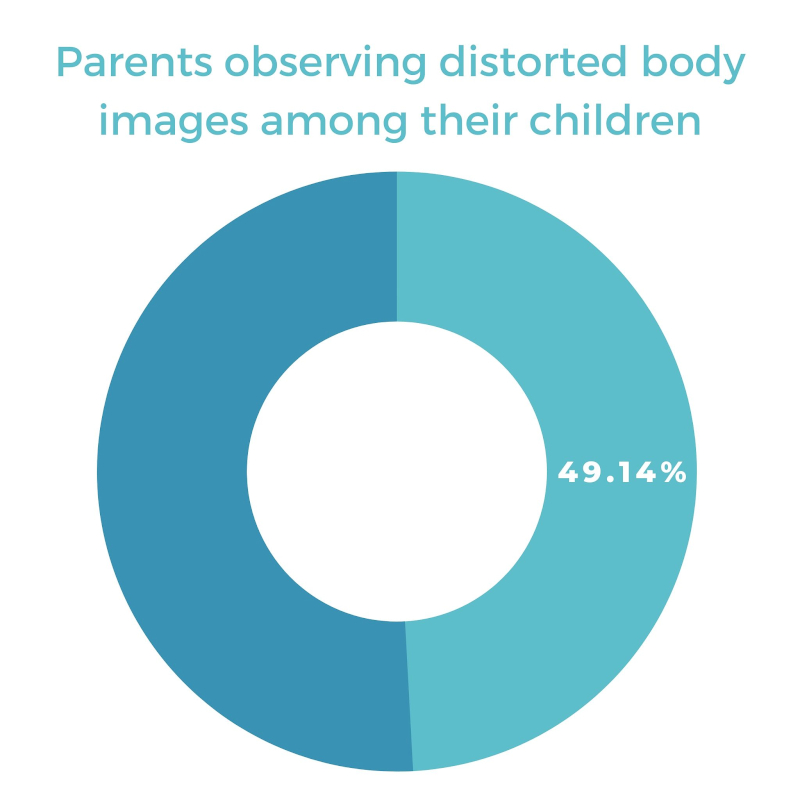
49.14% of the parents indicated that they observed their child(ren) having distorted body images.

Self-image and body positivity is a really important trait for children, and at the same time it can be something a lot of kids struggle with while growing up. Many movies idealise attractiveness, but there are some movies that can help kids understand that they don’t need to fit these expectations and help promote their own body positivity.

Now playing …

Little Miss Sunshine (2006)

While not specifically made for kids, it can still be appropriate for older children (12+), telling the story of a girl who doesn’t fit society’s standards of beauty but wins over everyone simply by being true to herself.

Mulan (1998)

While Mulan isn’t thought of as a classic example of body positivity, there are themes that help portray this. Mulan becomes the savior of China, showing kids that they aren’t defined by their gender or body. While at first, Mulan is ashamed of her body, she eventually accepts the differences and is accepted by the emperor and the people she saved for who she is.

The key to raising body positive children

One great way to promote body positivity is to lead by example. Being positive about your own body can help children understand and model similar behaviour. Another tip, although it may seem strange, but not complimenting children for their outward appearance can be beneficial. It can be positive to their own body image to focus more on their character and accomplishments as opposed to their appearance (which they may have little control over).

Confidence

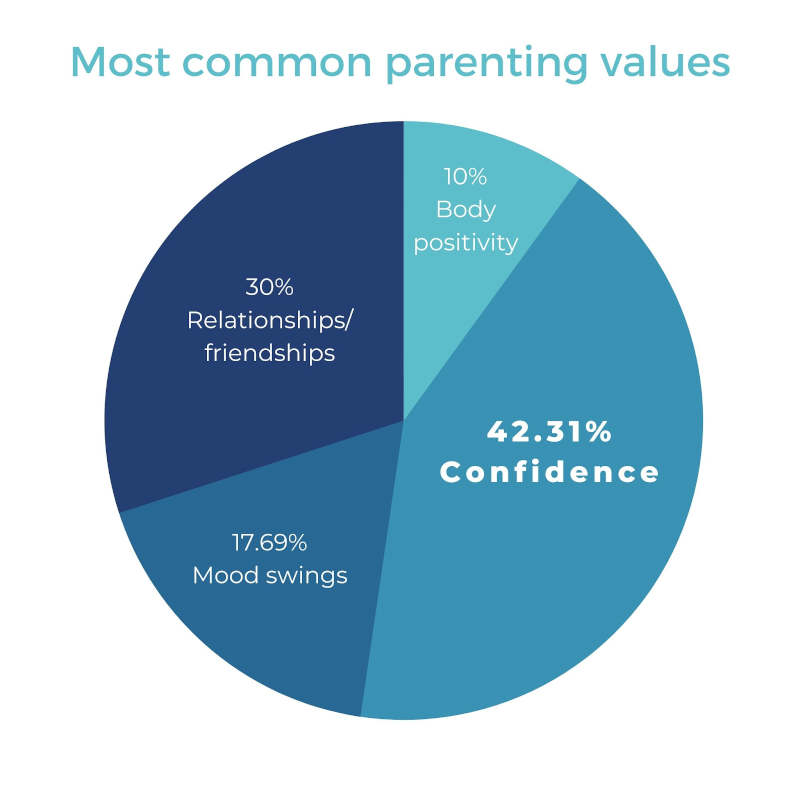
42.31% of participants stated that confidence was their most talked about parenting topic

For many children, feeling like they aren’t good enough is a common theme, and clearly it is something that parents believe is important. While growing up, kids come across plenty of challenges that may make them doubt themselves or lose confidence. Luckily, there are plenty of ways parents can help support their kids and boost their self esteem and confidence. More specifically, among these ways, movies can be used as a helpful tool to model confidence. Take a look at some kids movies that can help provide good examples of being confident with your own abilities.

Now playing …

Harry Potter (2001)

Throughout Harry Potter, Hermione demonstrates her self confidence. Although she isn’t initially accepted for it, her belief in herself and her knowledge saves the day over and over, and displays the value of confidence!

Sing (2016)

Sing! It shows a multitude of characters with different levels of confidence, at the end it shows how even the most nervous, shy characters can be confident and successful!

The key to raising self-confident children

One way to promote confidence in children is to help them actively participate in confidence building activities. This can take on many forms, but a simple and beneficial example is to encourage them to think of three compliments for themselves daily. This will push them to accept their strengths and acknowledge their own positive traits!

Children’s friendships and relationships

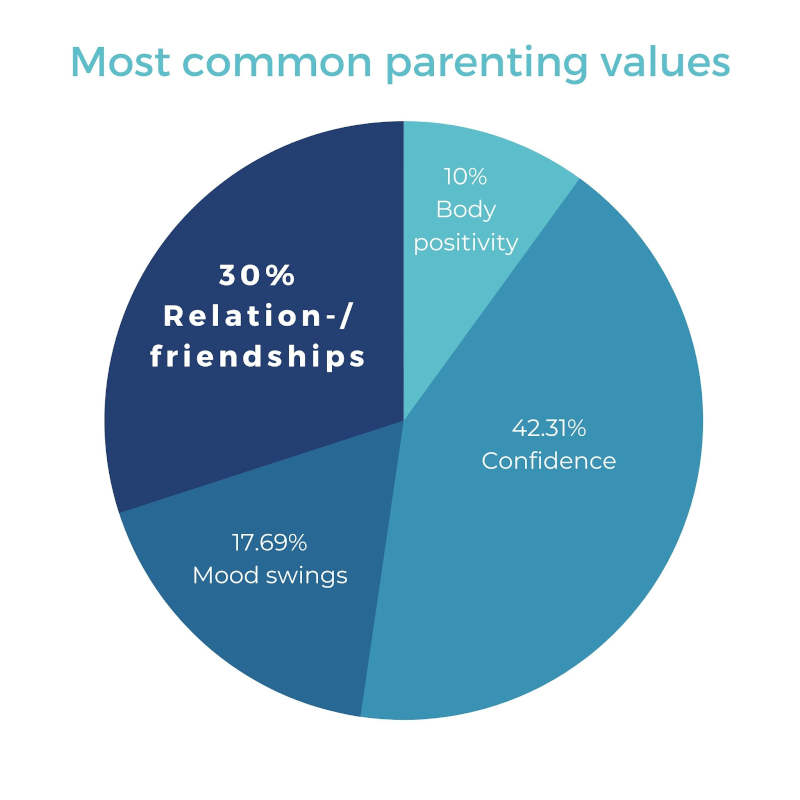
30% of parents who responded indicated that friendships and relationships were their most discussed parenting value. 

Developing and maintaining friendships and meaningful relationships is a key aspect of healthy social development for kids. Having healthy relationships helps build bonds between family and friends, especially as children grow older and friendships play an increasingly important role. Luckily, friendships play a key role in many kids movies, so there are enough examples to use to model healthy friendships and relationships for kids.

Now playing …

Charlotte’s Web (2006)

Charlotte’s Web shows the difficulties of leaving old friends and making new ones as Wilbur has to leave his old farm and adapt to a new environment, forging new friendships. It shows the value of true friendship, standing up for one another and celebrating friends.

Lion King (1994)

Simba, Timon, and Pumba! The Lion King masters a portrayal of healthy friendships, showing that people, no matter how similar or different, can be friends, work together, and support each other.

The key to building relationships

The most important tip (similar to body positivity) is to model positive, healthy friendships and relationships. By being a good friend to others, they learn that this behaviour is normal and emulate it as they grow older.

Intro/extroversion

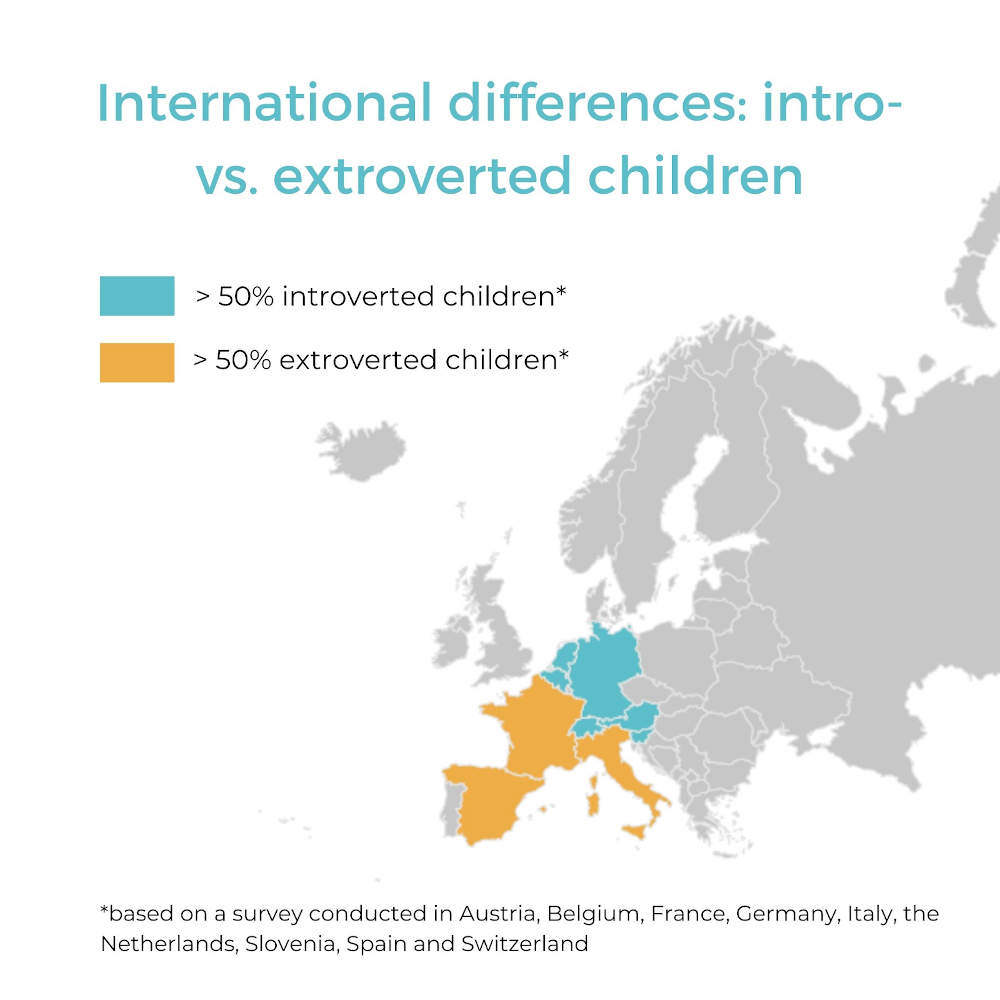
There are plenty of kids and adults who display more introverted or extroverted personality traits, and even more that fall on the spectrum between. The first thing to note is that neither trait is a good or bad thing. It is important that kids know it’s okay to be more introverted or more extroverted. Luckily, there are several movies that help portray this, focusing on being yourself above forcing yourself to be more introverted or extroverted. Here are some of the best examples.

Now playing …

How to train your dragon (2010)

How to train your dragon follows a young Viking, Hiccup, going on a quest to slay his first dragon. Instead he becomes best friends with the dragon! Hiccup’s character differs significantly from the ‘typical’, boisterous Viking portrayed in the story. He shows many introverted traits, being quiet and shy, and not so fond of battle. But at the end of the day, being his own introverted-leaning self helped Hiccup be the hero of the town!

Inside out (2015)

Inside Out is a great film to use as a tool to discuss feelings with kids. The director even struggled with emotions as a child, which resulted in him being socially isolated during his childhood. He wanted to help other kids who may have the same struggles he had, and he successfully crafted a beautiful film, which explains the impact of emotions.

The key to helping children accept their character

When thinking about whether your child is extroverted or introverted, the most important aspect of parenting is to support them and accept them as they are. Introversion shouldn’t be viewed as a problem, nor should extroversion be seen as a character asset or goal.

Hopefully you now have an idea of how to harness movies to help your kids understand some of the above topics. Interested in learning more about just how movies can impact kids? Check out this article where we asked the experts, “How movies can impact a child’s development“,

Babysits is a platform where parents and babysitters across New Zealand can get in touch and coordinate childcare. It was founded in 2008 by Peter van Soldt, who was motivated by the belief that a truly good childcare platform gives a meaningful solution which simplifies everyday struggles for parents. Babysits is dedicated to empowering communities around childcare, giving parents, babysitters and childcare providers the transparency and authority to make their own, informed decisions regarding childcare.

For more information visit Babysits.nz.

See more:

How Movies Can Impact A Child’s Development

Article provided by Babysits.nz

Ever wondered how watching different movies can affect your child? We asked some experts and reviewed academic research to see how movies can positively and negatively impact children.

Screen time is the centre of many debates nowadays, and is most commonly discussed with respect to its negative influence on children. The primary form of screen time brought up in these discussions is social media. However there is another form that is even more prevalent, particularly from younger ages – movies and television.

So, we dove into some academic studies and asked an expert in developmental psychology how movies can impact children developmentally.

What we discovered from the research

We read several studies from the American Academy of Pediatrics and other academic journals. We’ve summarized what the research showed.

The negatives

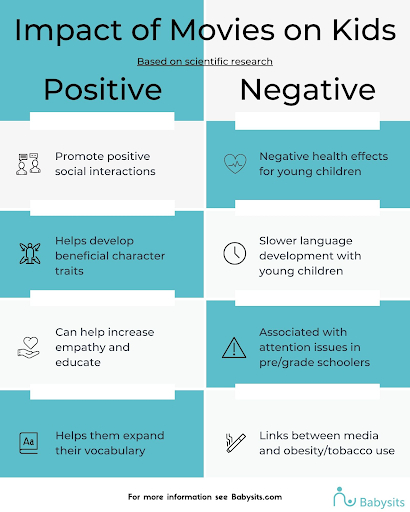
Overall, the research showed that movies and television can have negative effects on children, spanning from negative health and development effects and language development issues in children under two, to links to obesity, tobacco use, and issues with aggression and attention in older children.

Studies explained that young children’s language development is strongly influenced by and related to the amount of time parents spend speaking to them. Based on this, they proved that vocabulary growth could be interfered with in households with increased TV use. Another study regarding older children, linked media exposure (primarily movies, television, and music) to seven negative health outcomes. This included 80% of 100 studies peer-reviewed showing a statistically significant link between obesity and media exposure.

The positives

On the other hand, there are also some positive aspects of movies for children. Namely, they can provide educational resources, help develop character, expand vocabulary with older children, increase empathy, and promote positive social interaction.

Specifically, evidence shows that children can respond to positive film influence, with regard to stimulation of emotions, empathy, and positive social behaviour. Additionally, movies are an educational supplement to course material in many classrooms and can provide educational value in a historical context, in some cases. Another educational angle, language learning, can also be benefited by film. Language is learned through exposure to comprehensible input, and film provides children with various opportunities to receive this input and develop their language skills (as long as they are old enough to fully comprehend the context or subject matter).

An expert opinion

You may be wondering – why does it matter? If my child is watching children’s movies, they certainly won’t be coming across any inappropriate, development spoiling themes, right? However, many children’s movies contain themes that at second glance are quite questionable.

Take these three movies for example:

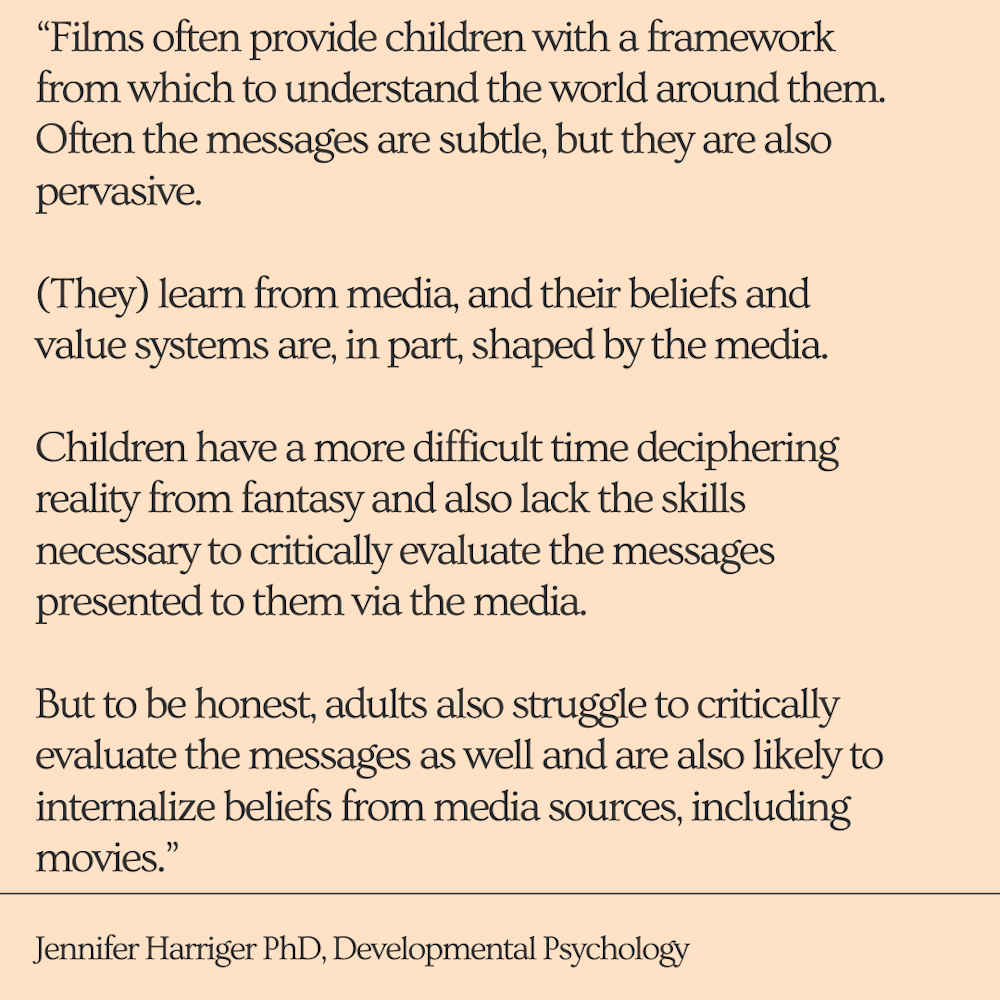
To dive deeper into how movies can impact child development, and what this means for parents, we interviewed an expert in the field. Jennifer Harriger, a PhD in developmental psychology who has written about topics such as appearance related themes in children’s animated movies. Jennifer provided some valuable feedback and insight into how children experience movies.

Here’s what she had to say:

Overarchingly, Jennifer does believe, based on her own research and that of her peers, that children can be significantly impacted by film, and it can have a real effect on how they view themselves and the world around them.

Specifically, when asked directly if she believes children are strongly influenced by movies, she answered, “I do. Children identify with and want to emulate the characters that they see on-screen; particularly the characters that they view as attractive, confident, and successful.”

What to do as a parent?

What does this mean for parents however? Do we have to screen every film for every small, implicit negative theme and censor everything that our children watch?

Luckily, the experts think that’s not necessary (or even the best solution!).

While she does believe that, “movies have the potential to shape children’s beliefs about attractiveness, gender-roles, violence, and success, Jennifer doesn’t think any one movie will be a make or break for child development. “Instead I think that it’s a cumulative effect of many messages from many sources (including movies) that influence a child and his or her perspective.”

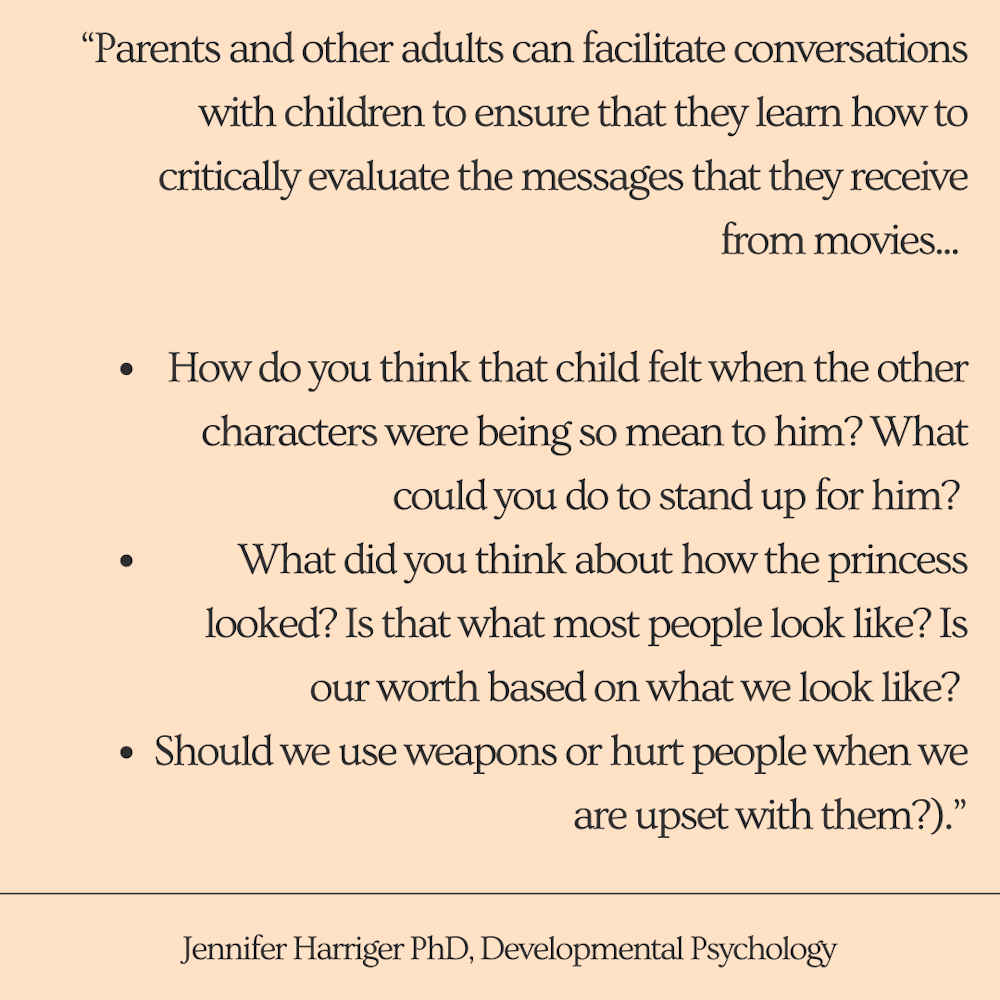
So, what should you do? How do you make sure children are getting the positive messages from movies and not internalising negative themes? It appears that simply discussing the themes in movies can be really impactful in child development!

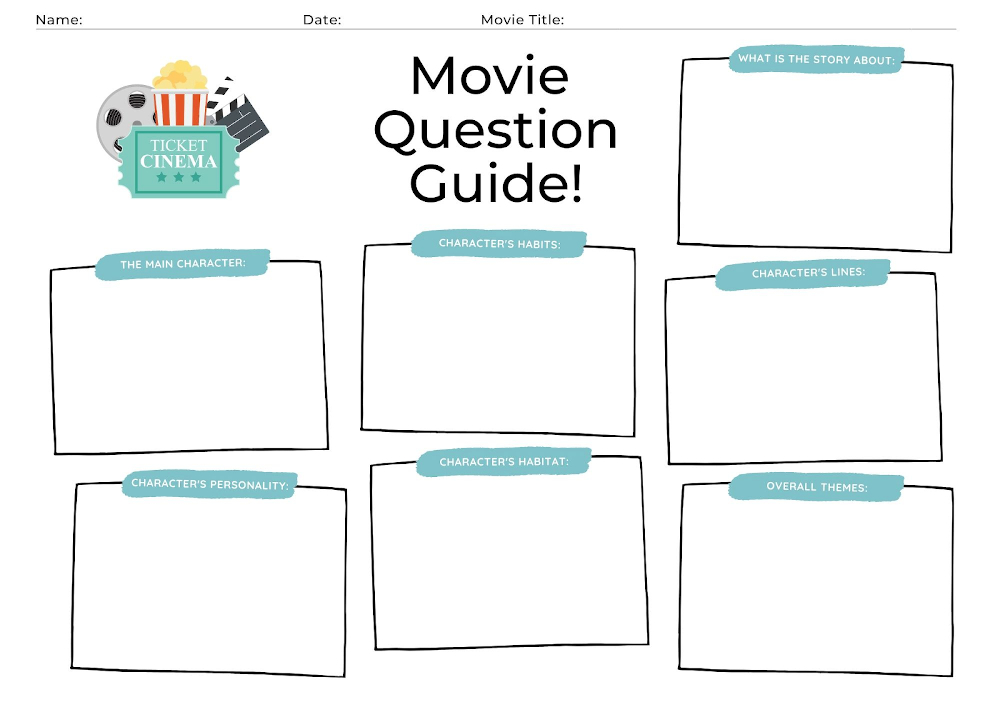
Try the movie question guide

In order to help facilitate conversations around movies, we’ve put together this movie question guide. Click on the image for a printable version.

For more information and insights on movies and child development, have a look at our article about the “Best movies to build character“.

Babysits is a platform where parents and babysitters across New Zealand can get in touch and coordinate childcare. It was founded in 2008 by Peter van Soldt, who was motivated by the belief that a truly good childcare platform gives a meaningful solution which simplifies everyday struggles for parents. Babysits is dedicated to empowering communities around childcare, giving parents, babysitters and childcare providers the transparency and authority to make their own, informed decisions regarding childcare.

For more information visit Babysits.nz.

See more:

Lee Kum Kee Slow Cook Sauce for Sweet & Spicy Beef

Sweet & Spicy Beef is a regional Chinese dish famous for its bold and exciting flavours.

With a punchy mix of sweet and spicy, this Lee Kum Kee Authentic Asian Slow Cooked meal is sure to tingle your tastebuds.

Recipe provided by Lee Kum Kee

Image is for illustration purposes only and is indicative of the product range.

See more:

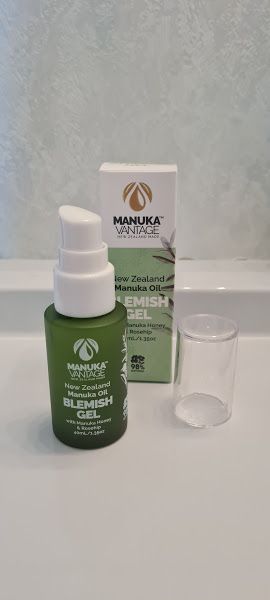
ManukaVantage

product trial4.63 out of 5 – Kidspot mums would purchase ManukaVantage again and recommend it to their friends and family.

star rating 5

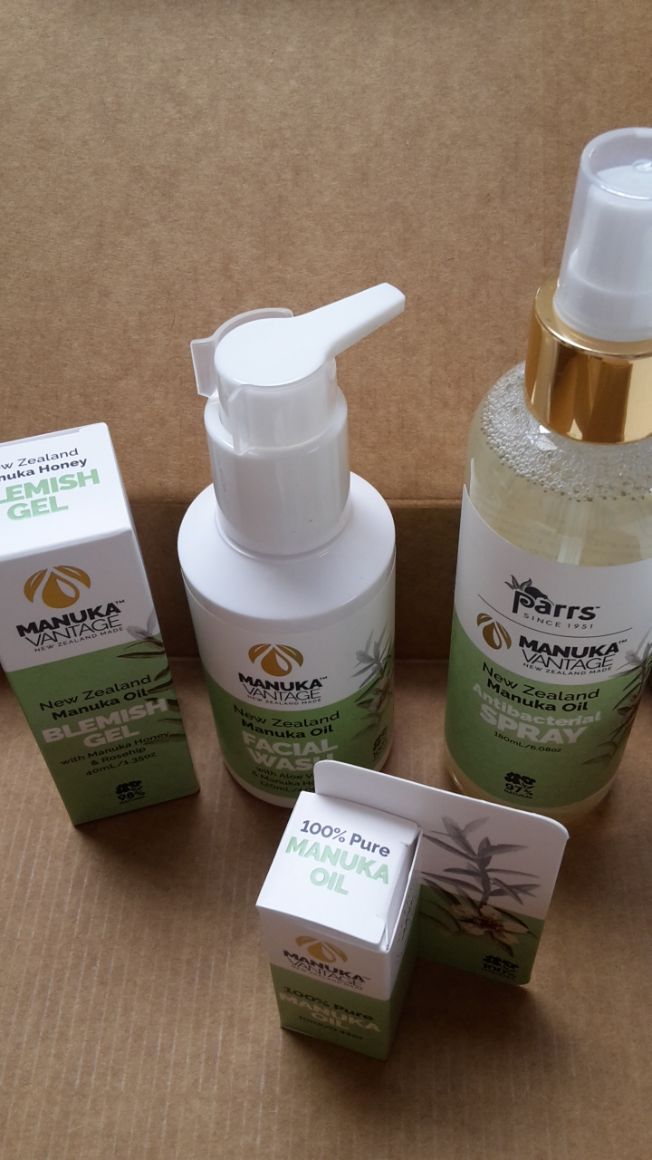
ManukaVantage is a healthcare range featuring the exceptional natural healing properties of New Zealand Manuka Oil and premium certified Manuka Honey.

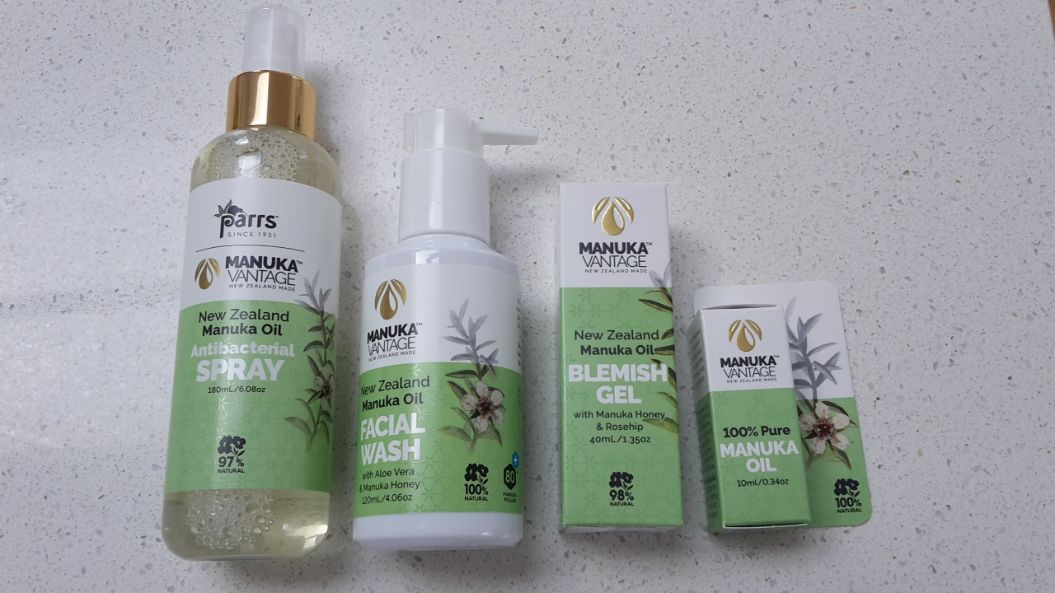
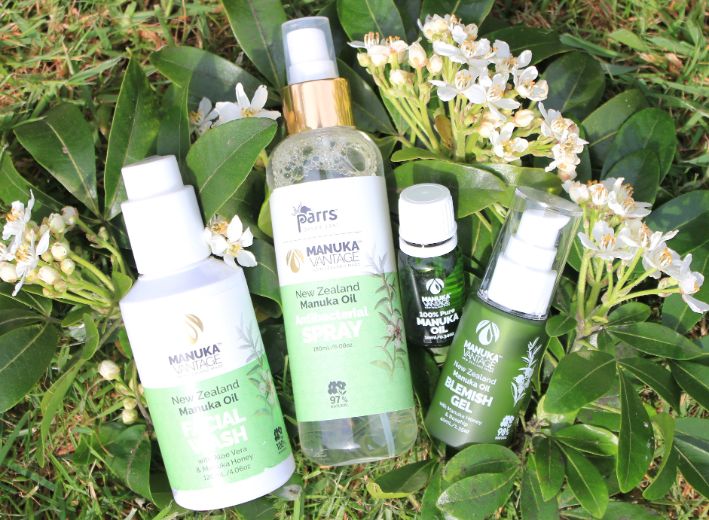
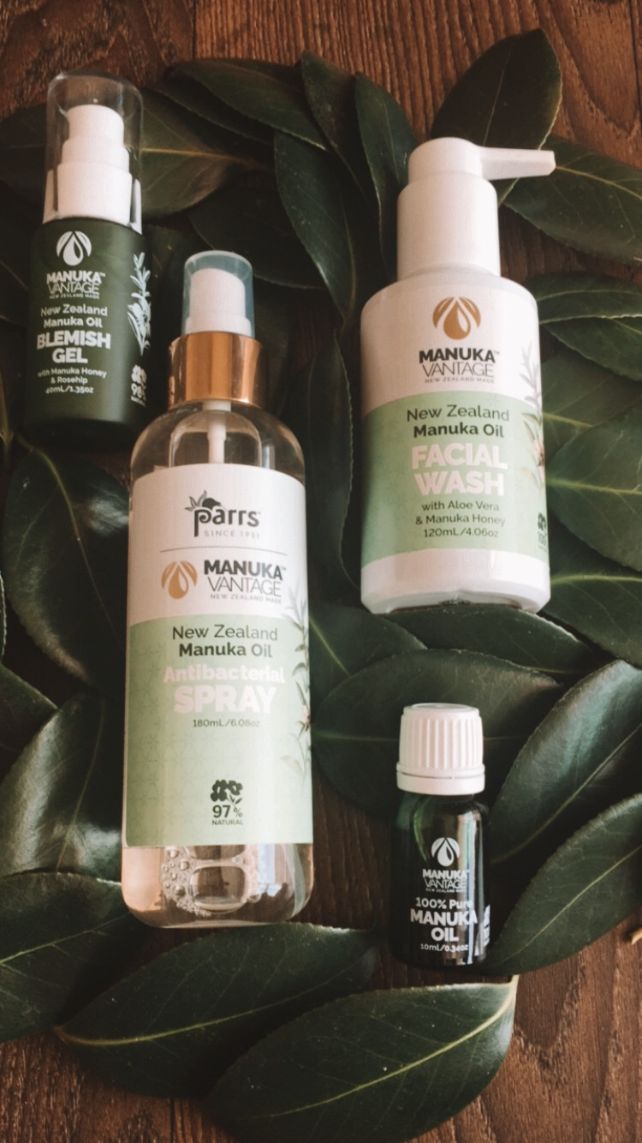
The key ingredients of ManukaVantage have very beneficial healing properties for your skin’s health and your overall wellbeing. The range includes:

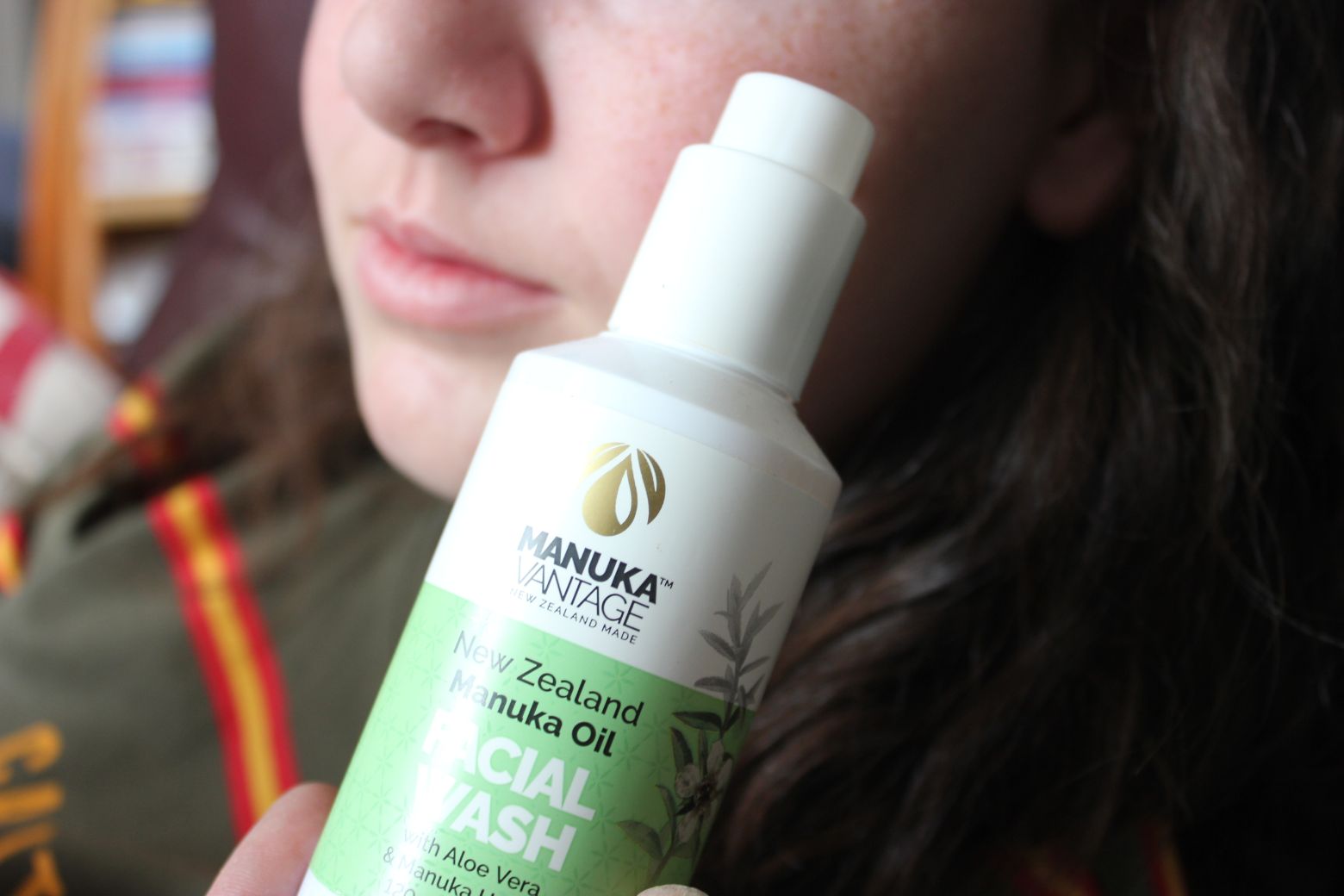
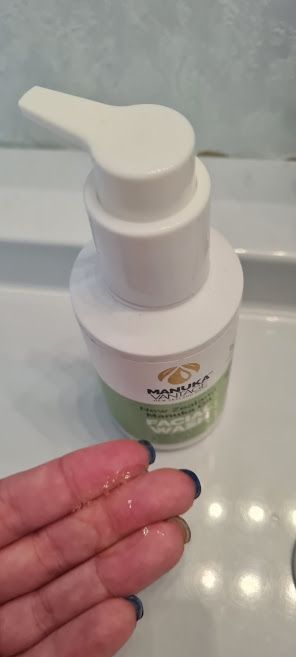
Facial Wash with Aloe Vera and Manuka Honey

Contains the combined action of anti-inflammatory Manuka Oil and the antibacterial properties of premium certified Manuka Honey that assists in improving problem skin. This gentle wash unclogs blocked pores caused by the everyday environment and helps to remove bacteria and excess oils, the most common cause of acne and blemishes.

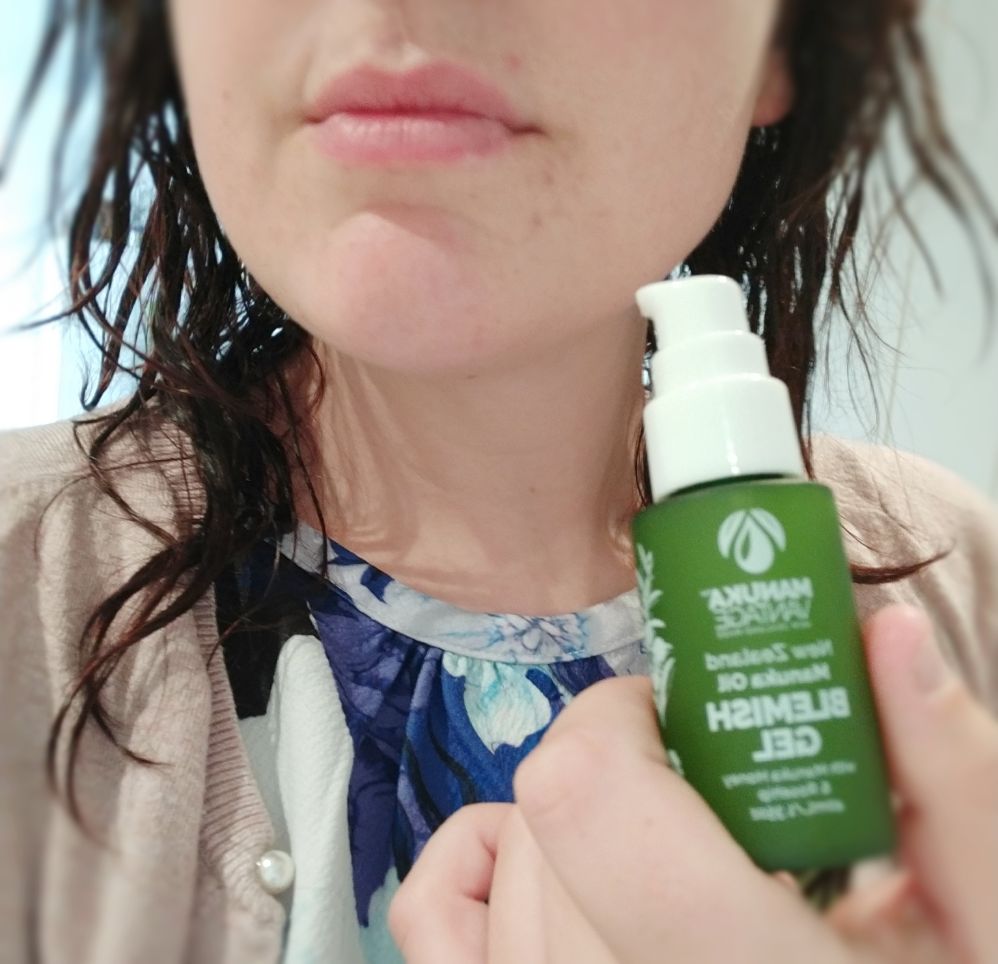
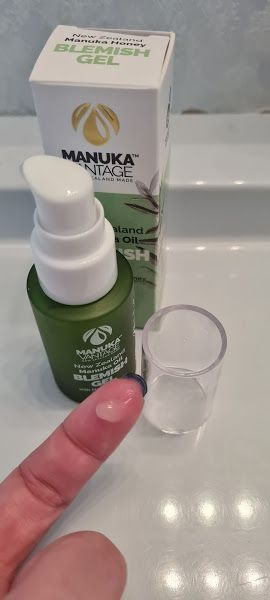
New Zealand Manuka Oil Blemish Gel with Manuka Honey 80+ and Rosehip (40ml)

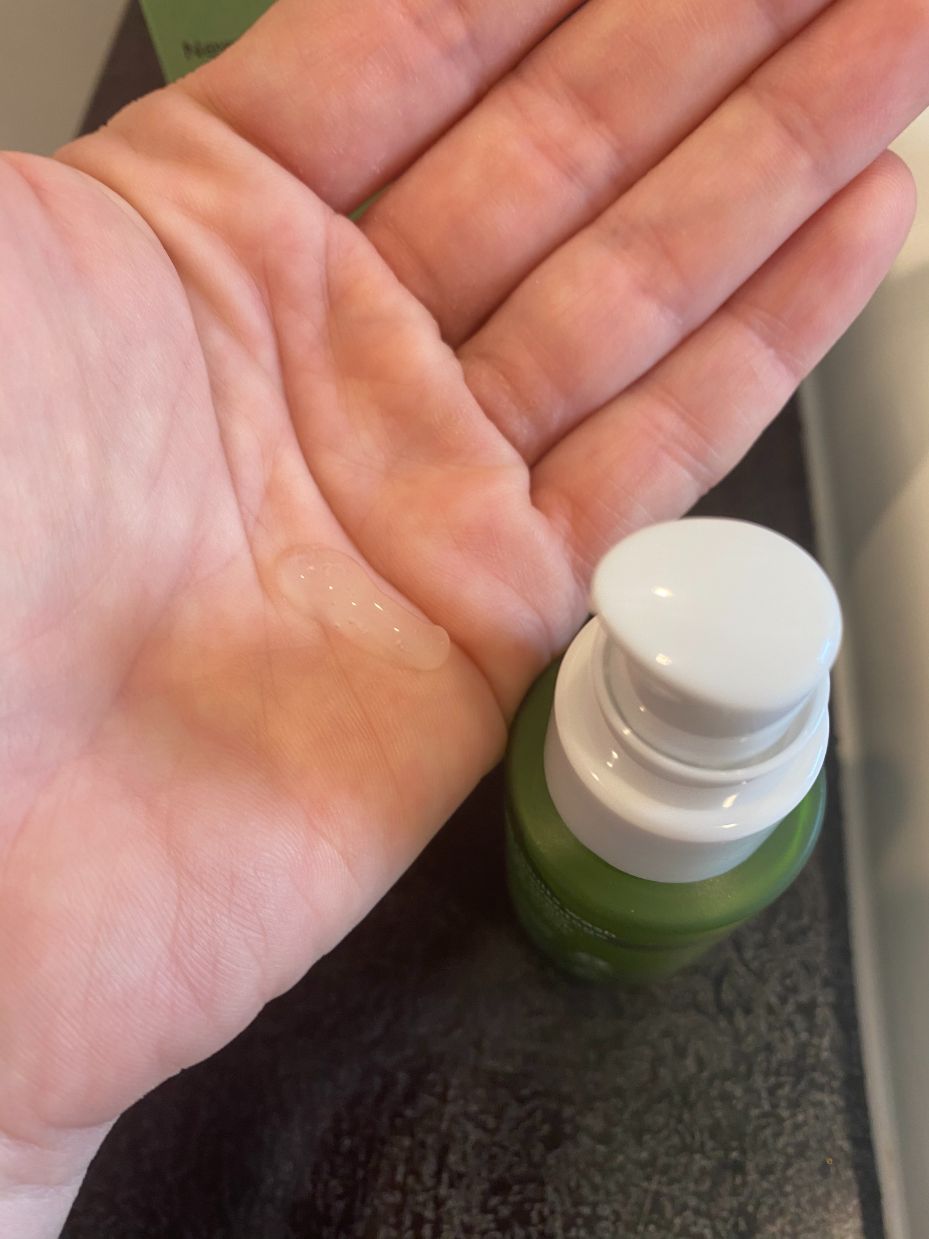
Contains the combined action of anti-inflammatory Manuka Oil and the antibacterial properties of premium certified Manuka Honey that assists in keeping the skin clear and blemish-free. This acne treatment gel penetrates deep into the pores to absorb excess oils and actively eliminates bacteria, the cause of acne and blemishes.

100% Pure Manuka Oil (10ml)

The Manuka Oil used in the ManukaVantage range has the highest level of anti-microbial activity.

This oil is for the treatment of fungal skin infections, boils, acne, insect bites, cold sores, minor cuts and burns, and is great for nasal congestion.

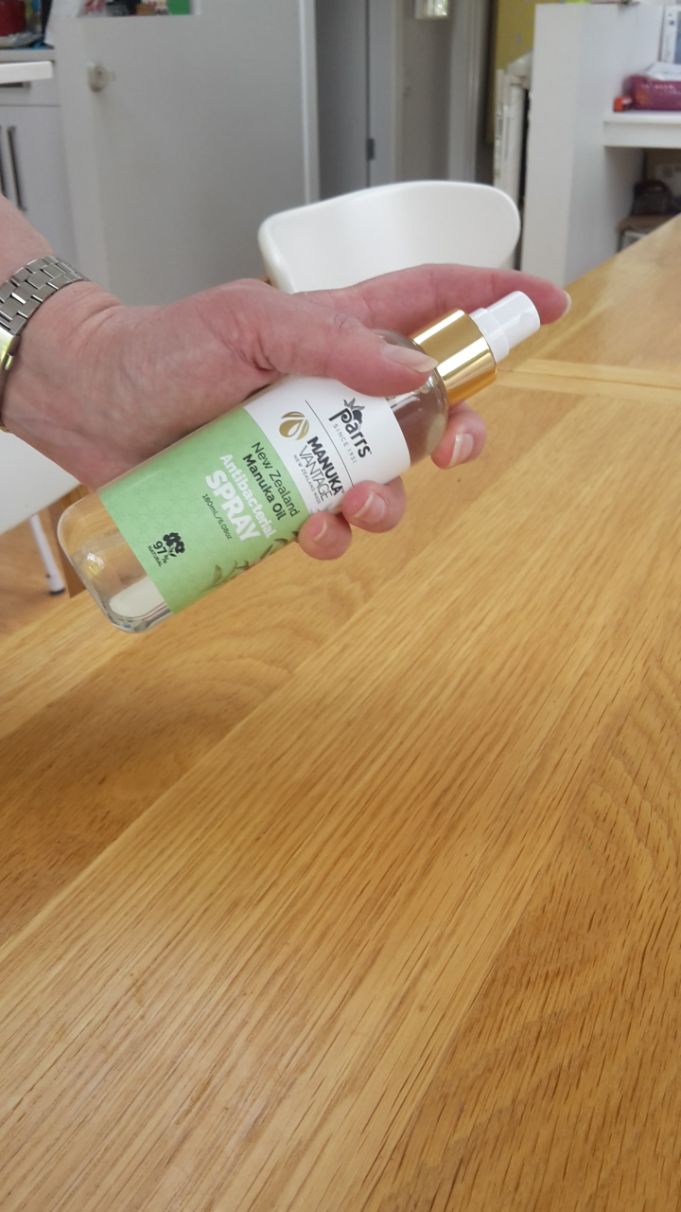
Antibacterial Spray with Manuka Oil and Manuka Honey (180ml Alcohol-free)

This antibacterial spray contains pure Manuka Oil renowned for its antibacterial and antifungal properties, combined with microbial inhibiting certified Manuka Honey 80+. It can be used on your skin, clothing and on surfaces in the home and workplace.

See more of the range at ManukaVantage.co.nz.

Read the reviews below!

We have given 15 members the chance to trial a selection of products from the ManukaVantage healthcare range.

  • If you have received product for review, please scroll to the bottom of the page and add your feedback as a comment. Upload your review photos to this Dropbox folder.
  • Each selected reviewer will receive 1 x Facial Wash, 1 x Blemish Gel, 1 x 100% Pure Manuka Oil, 1 x Antibacterial Spray as shown above.
  • JOIN the Mums Say NZ Facebook page and keep an eye out for review updates
  • PLEASE NOTE: You will be required to post photos of the products as part of your review

Please note

  • If you are selected to trial, the product will be sent to the address on your profile.
  • Please check your address now to ensure that it is up to date.
  • Not registered yet? Then sign up now.
  • Kidspot Terms and Conditions: Open to Kidspot members 18+ only. Only available for NZ residents. If you are selected, you will be required to use the product as soon as possible plus supply a review, as set out in our review instructions. Your name and postal address will be given to the supplier for the purpose of delivery of the voucher only.
  • Click here for full Terms and Conditions.

See photos from our reviewers below

Valerie Adams is Barbie’s New Role Model

Barbie has revealed the official 2020 role model for New Zealand as Dame Valerie Adams – a model of empowerment for girls.

Press release follows

Barbie, the most diverse fashion doll on the market, announced an incredible professional sportswoman as an official Role Model for 2020, to continue efforts to close the “Dream Gap”; the time when young girls start doubting their self-value and potential.

In New Zealand, Barbie is honouring four-time World champion, two-time Gold medallist and mother of two, Dame Valerie Adams for breaking the mould for women in sport. One of New Zealand’s greatest ever athletes and one of the all-time best female throwers globally, Barbie is excited to present her with a unique one of a kind doll made in her likeness, the highest honour from the Barbie brand.

Dame Valerie’s amazing achievements

Dame Valerie broke into the international scene by winning the world youth title in Hungary in 2001 and went on to win the world junior title the following year. She has been a dominant force in women’s shotput internationally since 2006.

Dame Valerie was named the World Athletics (previously IAAF) Female World Athlete of the Year in 2014, becoming New Zealand’s first and the first thrower globally for ten years to win such accolade. She currently holds the New Zealand, Oceania, Commonwealth and World Championship records with a personal best throw of 21.24 metres.

Role model

Now a mother of two, Dame Valerie was knighted and awarded a Dame Companion of Order in 2016. She is considered a leader and role model in the Pacific community and continues to compete at the top level.

“I feel very humbled to be the New Zealand Barbie Role Model for 2020. As a mum, it is my responsibility to be a positive role model for my daughter. As an athlete, throughout my career I have been able to reach more young girls all around the world, especially New Zealand – to inspire and empower them to be the best version of themselves. – Dame Valerie Adams, Barbie Shero for NZ, 2020 (She + hero = Shero)

I’m pumped to share today that I’m the New Zealand @barbie Role Model for 2020 💗 As a mum, it is my responsibility to be…

Posted by Valerie Adams on Wednesday, 15 July 2020

When asked, “With two beautiful kids, how important is it to you to show them that anything is possible?” Valerie said:

It is very important to me.  I want to show them the sky is the limit and to live their own dreams. It’s important to me that they understand in time (they’re both under 3) that whatever they decide to do I will support them unconditionally – I will support them 100%, but I want them to live their lives to the fullest and live their own dreams.” – Dame Valerie Adams

Barbie has announced over 50 Role Models since the inception of the campaign in 2015, including:

  • In 2020, Australian Para-Athlete in Wheelchair Racing, Madison De Rozario; English World Champion Sprinter, Dina Asher-Smith; German Long Jumper, Malaika Mihambo.
  • In 2019, New Zealand Sports Journalist and Presenter, Melodie Robinson; Australian Journalist and Editor, Ita Buttrose AO OBE; and American Actress, Model & Activist Yara Shahidi.

Dame Valerie’s Barbie

Dame Valerie worked closely with the Barbie Design Team – picking out each and every detail of how she wanted her Shero doll to look.

Unfortunately the doll is not for sale – the one-of-a-kind doll was gifted to Dame Valerie. However, globally, Barbie has released more than 170+ diverse and inclusive dolls over the past five years – through fashion, careers, sport and more – in different body shapes, skin tones, eye colours, hair textures etc.

The Dream Gap Project

The Barbie Dream Gap Project is a multi-year global initiative to raise awareness around limiting factors that prevent girls from reaching their full potential. Research* has identified that starting at age five many girls are less likely than boys to view their own gender as smart and begin to lose confidence in their own competence. Cultural stereotypes, implicit biases and representation in media work together to further this issue. In the United States, this has been referenced as the “Dream Gap,” but there are similar trends seen around the world.

*Study conducted by researchers at New York University, the University of Illinois and Princeton University

Follow @barbie and @barbiestyle on social media and join in the celebration using #Barbie #Barbierolemodels #moresportsrolemodels and #YouCanBeAnything.

Content provided on behalf of Mattel, a leading global children’s entertainment company that specialises in design and production of quality toys and consumer products. Mattel create innovative products and experiences that inspire, entertain and develop children through play. Visit Mattel online at www.mattel.com.

Modibodi Period and Leak-proof Underwear & Activewear

product trial5 out of 5 – Kidspot mums would purchase Modibodi Period and Leak-proof Underwear & Activewear again and recommend them to their friends and family.

star

Discover Modibodi – the original period undies

With over 3 million pairs sold, Modibodi® is the #1 selling period underwear that has you covered for periods, light bladder leaks, sweat, and other drips.

These are so much more than undies! Modibodi’s reliable protection has led the way since 2013, as a complete replacement for pads, tampons and liners – and a joy to wear everywhere. Made from high quality fabrics, the tech-savvy blend feels snug, silky and dry. So, you can ditch the disposables, feel safe, and even a little sassy for saving the planet. Join the other 9/10 women who would recommend Modibodi to a friend as the most absorbent and comfortable brand on the market!

Modibodi is available in a range of absorbencies to suit your level of protection, day or night. The range includes underwear, swimwear, activewear, as well as maternity and post birth, plus the Red by Modibodi teen range.

Modibodi period and leak-proof underwear and activewear:

  • Minimise odour
  • Anti-bacterial
  • Leak- proof
  • Wash & reuse
  • Available up to size 26

Find out more at modibodi.co.nz.

Read the reviews below!

We gave 15 members the chance to trial Modibodi Period and Leak-proof Underwear or Activewear.

  • If you have received product for review, please scroll to the bottom of the page and add your feedback as a new comment. Upload your review photos to this Dropbox folder.
  • Each selected reviewer will receive 1 x pair of Modibodi Period and Leak-proof Underwear or Activewear. Please note that it is not possible to choose a colour for this trial.
  • JOIN the Mums Say NZ Facebook page and keep an eye out for review updates
  • PLEASE NOTE: You will be required to post a photo of the product as part of your review

Please note

  • If you are selected to trial, the product will be sent to the address on your profile.
  • Please check your address now to ensure that it is up to date.
  • Not registered yet? Then sign up now.
  • Kidspot Terms and Conditions: Open to Kidspot members 18+ only. Only available for NZ residents. If you are selected, you will be required to use the product as soon as possible plus supply a review, as set out in our review instructions. Your name and postal address will be given to the supplier for the purpose of delivery of the voucher only.
  • Click here for full Terms and Conditions.

See photos from our reviewers below

How Kids Can Benefit From Superhero Play

Over the years the characters and costumes may have gotten more complex but one thing remains – kids love superhero play!

It’s almost impossible to keep kids away from the premise of superheroes. They’re on our screens, big and small; they’re on kids’ clothes; they’re even on their lunch boxes. DVDs, movies, games, and TV programmes bring these superheroes into our world and kids love to emulate their favourites.

While it can be a touch unnerving to have your six year old running around the house in a robe trying to use “the force” on anything that moves, there are important learning benefits for this type of play.

Rather than stifling this type of play, engage with your child, understand their interest, and use it as a platform for teaching them about right and wrong, good and evil, real and make-believe.

The benefits of superhero play

When kids dress up as superheroes, or play with figurines or props, they can benefit from these learning outcomes.

  • Storytelling to encourage vocabulary and learning about the world around them
  • Problem-solving
  • Extending their imagination
  • Risk assessment, ie “how can I jump off the couch safely?”
  • Teamwork – every superhero needs a sidekick!
  • Dramatic play lends itself to empowerment and confidence building
  • Empathy – the basis of a superhero is that they protect and help others

For more, visit myece.org.nz.

Which superhero does your child like to pretend to be?

See more:

her world julieWritten by Julie Scanlon

Julie is Editor for Kidspot NZ and our MVP. Her hobbies include laughing uncontrollably at her own jokes, annoying her family by asking questions about movie plots, and never taking anything too seriously. She speaks a little Spanish and a lot of Yorkshire. 

Favourite motto to live by: “It ain’t nothing but a thing”

Card Games for Kids

Card games are a wonderful way to get kids having fun whilst learning. In fact, they may be having so much fun that they don’t realise it’s educational!

Developing skills like counting, pattern-recognition, problem-solving, turn-taking, and focus can all be enhanced with a simple card game.

Here are some of our favourite card games for kids.

Go Fish

Number of players: 2+

Deck to use: Full, standard deck without the joker(s)

How to play:

The dealer hands out five cards to each player. The remaining cards are placed face down in the middle of play (the fishing pile).

If a player has two cards of the same number in their hand, they pair them up and place them face down beside them. The person to the left of the dealer then begins play. Play continues in a clockwise direction.  On their turn, a player asks any other player for a card to complete a pair in their own hand. For instance, they may have an Ace, so they ask, “Mum, do you have an Ace?”. If that person has the requested card they hand it over. The player having their turn completes a pair and places it face down beside them. They then continue to ask any other player for another card, and so on. If the person approached for a card does not have the card that was requested they say, “Go Fish!”. The player who’s turn it is then picks up a card from the fishing pile and the next player to the left begins their turn. If a player runs out of card, they can pick up a card from the fishing pile and continue their turn.

Who wins? Once all of the cards have been paired up, whoever has the most pairs wins.

War

Number of players: 2

Deck to use: Full, standard deck without the joker(s)

How to play:

The whole deck is dealt out to the two players (26 cards each). Do not look at the cards, keep them face down in your hand. Both players begin play by putting the first card from their hand face up in the middle of the table for a battle. Whoever has the highest card wins that battle. Aces are the highest, twos are the lowest, and suits don’t matter. The battle winner takes both cards and puts them at the bottom of the stack in their hand. Play continues like this. If both cards are the same (ie two eights, or two Jacks), then it’s War! Each player puts in a forfeit card (the number on the forfeit card doesn’t matter). Then each player puts down a new battle card. Whoever plays the highest battle card (after the forfeit) is the winner of that War and takes all of the cards (six of them). If the second battle cards are the same, players must forfeit another card and then battle again for the twelve cards!

Who wins? Whoever gets all of the cards in their hand is the winner. However, War can be very long to play! We tend to set a time limit and if no one has won by that time we count up the cards to see who has the most.

Memory game

Players: 1+

Deck to use: Full, standard deck excluding joker(s). For younger kids you may want to reduce the amount of cards you use – just make sure every card has a match to make a pair.

How to play:

Shuffle the cards and lay them out on the table or floor in a grid pattern. The first player turns over one card, then another card, from anywhere in the grid, leaving them face up for all players to see. If the cards are the same number, then the player takes both cards and places them face down beside them as a pair and has another turn. If the cards are different numbers, both cards are turned face down and play continues to the next player. They turn over a card anywhere in the grid. If it matches something they have seen before they can try and remember where the card was and turn over one more card. If they match they take the pair and have another turn. If the cards don’t match, both cards are turned face down and play moves to the next player

Who wins? When all cards have been matched, count up who has the most. This game can also be played solo to test memory skills (or even time it to see if they can beat their prevoius best).

Last card

Number of players: 2+

Deck to use: Usually the full, standard deck without the joker(s). However, to turn things up a notch, we use a bunch of cards made up from part-decks so you never really know how many fives you’re going to get landed with!

How to play:

Deal seven cards to each player and place the remaining cards in a pile face down in the middle of the table. Turn over the top card and place it beside the pile. The player to the left of the dealer then chooses on or more cards to put on the face up card. Cards can be played that match either the number or the suit and multiple cards of the same number can be played together. For instance, if the face up card is the Queen of Hearts, the player can play any Queen or Queens that they hold, ie Queen of Clubs and Queen of Spades could be played together. Or they could instead play any Heart card as well as any cards that match the number on that Heart card, ie Three of Hearts and the Three of Clubs. The Three of Hearts would be played first to match the suit and then any other threes in any order they wish. Play then continues around the table. If a player can not play a card to match a suit or number they pick up one card from the face down pile and they do not put down a card. Play moves to the next player. Some cards have special abilities:

  • Ace – Aces are wild cards that can be played on any suit or number (and you can play multiple Aces at a time). They can not be played on twos or fives (see below). When you play an Ace you can nominate the suit that the next player must play.
  • Two – When you play a two, say “Pick up 2” and the player to the left must pick up two cards from the face down pile as their turn – unless they can also put down a two in which case the next player must pick up four. Any number of twos can be played in sequence and more than one two can be played at a time, so whoever is at the end of the line of twos may have to pick up quite a bit.
  • Five – Fives work the same was as twos above, just say “Pick up 5”.
  • Ten – When a ten is played the next player misses their turn. If two tens are played together, two people miss their turn, etc.
  • Jack – When a jack is played, the play reverses and goes anti-clockwise. When another jack is played, it turns back to clockwise, and so on.

When a player has their turn and is left with one card in their hand (or two or more cards that are the same number), they must say, “Last Card” immediately. If play comes around and they are the first to play their Last Card(s) then they are the winner. If they failed to say “Last Card” they must pick up a card and play continues.

Pig

Number of players: 2-4

Deck to use: Full, standard deck without the joker(s) but see instructions on what to discard

How to play:

Speed

Number of players: 2

Deck to use: Full, standard deck without the joker(s)

How to play:

What are your favourite card games to play with the kids?

See more:

her world julieWritten by Julie Scanlon
Julie is Editor for Kidspot NZ and our MVP. Her hobbies include laughing uncontrollably at her own jokes, annoying her family by asking questions about movie plots, and never taking anything too seriously. She speaks a little Spanish and a lot of Yorkshire. 

Favourite motto to live by: “It ain’t nothing but a thing”

The Importance of Outdoor Play

The sight of children playing in the streets seems to be long gone in many parts of New Zealand, but the wane of outdoor play also means losing many of the learning benefits.

The great outdoors is one of the oldest play places in the world, where children play some of the most interesting games. Playing outside is less common because:

  • Children tend to spend more time indoors in front of the television or computer and be transported around in the family car
  • Parents worry about ‘stranger danger’ and playing on roads (rightly so!) and tend to prefer our kids to be supervised indoors

Some experts say this “over-sanitised” approach is leading to a rise in learning and health conditions such as dyspraxia, asthma and obesity. Parents should, of course, protect their children by teaching them about personal and road safety, but also find ways of making outdoor ‘free play’ safe.

The fun of outdoor play

Besides being out in the fresh air, one of the big benefits of outdoor play versus indoor play is being free from parental and adult constraints. One theory says all the shouting, jeers, taunts, calls, and rhymes that go on when adults aren’t around actually give children the chance to:

  • Understand complex speech and language patterns like phonology, lexis, grammar and syntax
  • Develop more complex skills around friendships and social engagement

How parents can encourage their kids to play outside

Try these ideas to encourage outdoor play:

  • Encourage young children to play outside at least once a day – even when the weather is bad. Children need to experience all types of weather, so don’t allow bad weather to stop the fun – just dress appropriately.
  • As your child gets older, teach them road safety skills and walk around your suburb with them to help them become streetwise and get to know neighbours.
  • Talk to your child about personaly safety and teach them what to do in an emergency.
  • Look for places where your child can play outside, even if you don’t have a backyard. Think about local parks, skate bowls, school grounds, etc.
  • Kids love it when the rest of the family joins in on the fun – so get involved with a kick about in the backyard or a game of cricket at the beach and they’re more likely to want to play too.
  • Share your favourite outdoor activities from when you were a kid – teach them how to play hopscotch, elastics, or the best way to climb trees.
  • When children are old enough to go out alone develop a protocol: they should always let you know where they are going and with whom; check in regularly with you or other trusted adults.
  • As children get older encourage them to go on ‘everyday adventures’ and to manage risks by practising personal safety.

Written by Kidspot.com.au and adapted for Kidspot NZ

See more:

Norton 360 Premium

product trial5 out of 5 – Kidspot reviewers would recommend Norton 360 Premium to their friends and family.

star

Norton 360 Premium – the all-in-one security suite

Online cyber threats are more prevalent than most people think and pose a real security risk for you and your family. You can help protect you, and your family’s, privacy and personal information with Norton 360 Premium, the all-in-one internet security suite.

Keeping tabs on what your kids do online requires effort – Norton 360 Premium is here to help

We all know it’s important to protect ourselves while online. But it’s tricky for parents to keep an eye on what their kids are doing on the internet 24/7 and what crazy apps they might have installed – especially when they have their own phone, tablet or laptop. Young children don’t know when they’re downloading a malicious app masquerading as a game. That’s where Norton Family comes in – it helps block bad sites while your kids are surfing the internet and lets you see what websites they’re visiting. Norton Family also lets you put time-limits in place to make sure they get their schoolwork done.

One in three New Zealanders experienced cyber-crime during 2019. That means it’s important to use good security software like Norton 360 Premium to protect your online devices. Being tricked by cyber criminals through malicious ads, emails and links can happen easily – so be safe, not sorry.

Norton 360 Premium works on up to five devices including PC, Mac, iPhone and Android, and comes with 100GB of PC cloud backup.

You can get Norton 360 Premium online at nz.norton.com ,at Harvey Norman, or any good technology retailer.

  • Real-time threat scanning – advanced security with antivirus protection
  • Secure VPN – browse anonymously and more securely
  • Parental Controls – manage your kids’ online activity
  • Password Manager – generate, store and manage passwords securely
  • SafeCam for PC – block unauthorised access to your webcam

Read the reviews below!

We have given two members the chance to trial Norton 360 Premium.

  • If you have received product for review, please scroll to the bottom of the page and add your feedback as a new comment. Upload your review photos to this Dropbox folder.
  • Each selected reviewer will receive 1 x Norton 360 Premium all-in-one security suite (boxed set)
  • JOIN the Mums Say NZ Facebook page and keep an eye out for review updates

Please note

  • If you are selected to trial, the product will be sent to the address on your profile.
  • Please check your address now to ensure that it is up to date.
  • Not registered yet? Then sign up now.
  • Kidspot Terms and Conditions: Open to Kidspot members 18+ only. Only available for NZ residents. If you are selected, you will be required to use the product as soon as possible plus supply a review, as set out in our review instructions. Your name and postal address will be given to the supplier for the purpose of delivery of the voucher only.
  • Click here for full Terms and Conditions.

Spike in Rheumatic Fever

Published 4th June 2020

Cure Kids, New Zealand’s largest charitable funder of child health research, says its new $10 million funding commitment to address the effects of social deprivation on child health illnesses is critical, and that the need for it has been reinforced by a recent increase in rheumatic fever across New Zealand.

In recent weeks, Wellington’s Regional Public Health services reported a spike in typical case numbers, with a 25% annual increase nationally (from 58 to 72 children) and nine hospitalisations in Wellington in 2020, compared to an average of one to two cases.

Cure Kids CEO Frances Benge says the charity’s increased funding for this condition is timely, with research needed to help understand risk factors, design preventative interventions, develop a diagnostic test and effective treatments for rheumatic fever, and create a vaccine for Group A Streptococcus.

“This year, Cure Kids launched a contestable funding round to help answer these questions, committing the first $3 million over the next three years. We received 17 proposals, 11 of which have made it into the final stage. In August, an Assessing Committee, including leading scientific advisors, Māori and Pacific health advisors, and international subject matter experts, will meet to decide the final successful applications,” says Benge.

She says the heightened focus on new research is due to New Zealand having one of the highest rates of rheumatic fever in the developed world, despite this being a preventable illness. The condition disproportionately affects Māori and Pacific communities and requires a significant research investment in order to eliminate it from our country.

Diagnosing rheumatic fever

Dr Nikki Moreland, Senior Lecturer in Immunology and Biomedical Scientist at the University of Auckland, is currently funded by Cure Kids. Her work focuses on identifying biomarkers (disease identifiers) for rheumatic fever.

“There is no single, specific test for the diagnosis of rheumatic fever, so a quick diagnosis is not always possible. Identifying unique biomarker(s) present in rheumatic fever is an important first step to developing an accurate diagnostic test; something that is needed to speed up diagnosis,” says Dr Moreland.

Housing conditions

Earlier research pioneered by Professor Michael Baker, with the support of Cure Kids’ funding, identified housing conditions – in particular household crowding – as a major contributing factor. Disease risk was also associated with damp and mouldy houses, insufficient hot water for washing and dietary factors, signalling a systemic reason for why it is such a problem in New Zealand.

This public health issue encompasses three conditions – Group A Streptococcus (strep throat), rheumatic fever, and at its worst state, rheumatic heart disease – meaning it straddles both communicable and non-communicable diseases (NCDs).

Public and private donations are sought throughout the year and culminate in Cure Kids’ annual Red Nose Day appeal, which has been moved forward to 31 July 2020 due to COVID-19-related funding constraints.

Above content provided by Cure Kids.

What is rheumatic fever?

Rheumatic fever is a serious illness that should not be taken lightly. A sore throat caused by the bacteria, Group A Streptococcus (commonly known as strep throat), must be treated with antibiotics. If it is left untreated it can cause rheumatic fever in at-risk children and young people.

Rheumatic fever is an autoimmune disease – a child’s immune system will attack the strep throat germs but will also mistakenly attack other parts of a child’s body. Rheumatic fever can affect the heart, joints, brain and skin, leading to inflammation. Rheumatic heart disease occurs when there is scarring of the heart valves from the inflammation and is a serious, life-threatening condition.

The Ministry of Health advises that “If your child is Māori or Pacific, aged 4 to 19 years, lives in certain parts of the North Island and has a sore throat, please get it checked straight away. They are at risk of a serious but preventable illness called rheumatic fever. Call Healthline 0800 611 116 if you are unsure what you should do.”

Find out more on the Ministry of Health website.

See more:

Bargain Box Veggie

product trial4.2 out of 5 – Kidspot mums would purchase Bargain Box Veggie again and/or recommend it to their friends and family.

star rating

Introducing the new Bargain Box Veggie!

Family food box favourites, My Food Bag, have just launched a Bargain Box Veggie option! That’s great news for those of us who are choosing meat-free meals – and for those of us who would like to expand our veggie meals repertoire!

Even better news – new Bargain Box Veggie is the cheapest meal-kit in the My Food Bag family.

Family favourite recipes at bargain prices

The Bargain Box kitchen team have created meals that include plenty of veggies, easy-to-follow instructions and tastes the whole family will love. The recipes feature a variety of vegetarian protein sources including eggs, dairy, legumes, and nuts/seeds. A typical three-meal week will have one recipe with bread or pasta, once recipe with potatoes or kumara and one recipe with rice or couscous – however this will vary week to week and recipe to recipe.

Like all My Food Bag products, Bargain Box Veggie is crammed with local seasonal produce. Ninety eight per cent of the fresh ingredients are sourced in New Zealand, with My Food Bag supporting more than 100 big and small suppliers across the country,

Recipes are simple enough that they can be whipped up in a flash at the end of a busy day, or organise your teens to cook once a week – you’ll get the night off and they’ll learn essential life skills. Designed to help families enjoy more time together in the kitchen and around the table, Bargain Box Veggie takes the stress out of making delicious and nutritious vegetarian meals at an affordable price.

Bargain Box Veggie options

Bargain Box Veggie is available for three nights per week and comes in two sizes:

  • Serves 2: Great for a couple, or two adults with a young child, or
  • Serves 4: Feeds four adults, or two adults and three kids

For more information, visit the Bargain Box website.

Read the reviews below!

We have given 25 members the chance to trial Bargain Box Veggie.

  • If you are ready to review, please scroll to the bottom of the page and add your feedback as a comment. Upload your review photos to this Dropbox folder.
  • Each selected reviewer will receive a Bargain Box Veggie with meals for three nights (either Serves 2 or Serves 4). In order to arrange delivery of your trial pack, you will need to register with bargainbox.co.nz. Details will be sent to you if you are selected for the trial.
  • PLEASE NOTE: You will be required to submit photos as part of your review
  • JOIN the Mums Say NZ Facebook page and keep an eye out for review updates

Please note

  • If you are selected to trial, the product will be sent to the address on your profile.
  • Please check your address now to ensure that it is up to date.
  • Not registered yet? Then sign up now.
  • Kidspot Terms and Conditions: Open to Kidspot members 18+ only. Only available for NZ residents. If you are selected, you will be required to use the product as soon as possible plus supply a review, as set out in our review instructions. Your name and postal address will be given to the supplier for the purpose of delivery of the voucher only.
  • Click here for full Terms and Conditions.

See photos from our reviewers

IKEA Shares 6 Instructions for Furniture Forts

I can attest to spending WAY too much every time I visit an IKEA store. But now they’ve come up with a rather cool initiative that won’t cost a cent – home-styled furniture forts!

Created with the Instinct agency, the initiative offers a series of Ikea-like instructions for parents and kids to make indoor furniture forts that update the old sheet over the table concept and give it some serious bling.

So, next time the kids are stuck inside and the “I’m bored!” whines begin, give one of these creations a go. Don’t worry if you can’t read Swedish (it’s not really Swedish!), just use the pictures to gather the elements required for your furniture fort from around your home. Then, once you have the basics, let their imagination run wild and add some personality.

Parents have been sharing the creations on Instagram.

What’s your child’s favourite activity in an indoor fort?

See more:

her world julieWritten by Julie Scanlon

Julie is Editor for Kidspot NZ and our MVP. Her hobbies include laughing uncontrollably at her own jokes, annoying her family by asking questions about movie plots, and never taking anything too seriously. She speaks a little Spanish and a lot of Yorkshire. 

Favourite motto to live by: “It ain’t nothing but a thing”

Kicking Your Smartphone Habit

How many times have you checked your smartphone today? Like most people, you’ve probably lost count. Our smartphones are often our constant companion, providing everything we need to get through our busy day – and even those not so busy days.

We use our phones to keep in touch with loved ones, to catch up on news from friends, to read the news, to check the time, to record a video, to share a photo, to read our emails, to work out how to split the dinner bill … and to distract us from life!

Our phones are an amazing technological marvel that can improve our lives, but our phone use has gotten so out of hand that there is even a word for the “fear of going without your phone” – nomophobia.

Here’s another term for you – phubbing. That’s the act of ignoring someone in favour of your phone.

Addiction or compulsive behaviour?

For some of us, our smartphone behaviour has gotten so out of hand that it is having a negative effect on our lives. Others may just be troubled by the amount of time that is being ‘invested’ into our tap, tap, swipe behaviour. Health professionals debate whether overuse of a phone is actually an addiction. Preference seems to be to refer to it as an “impulse control issue” or a compulsive behaviour.

Often the compulsion arises from social media. Getting a comment on your latest Facebook post, a like on your new Instagram photo, or a post from a friend can stimulate the release of dopamine – a chemical that is released by our brains when we experience something pleasurable. Constantly checking for your next dopamine hit can lead to overuse of your phone.

According to research by software company RescueTime, people spend an average of three hours and 15 minutes on their phone each day. We also pick up our phones 58 times a day on average. We simply don’t want to miss something – or anything!

Do I have a problem?

If you’re wondering if your phone use has gotten out of hand, you can use your phone’s settings to discover just how much time you are spending on your phone each day. Take that amount of time, say three hours per day, and turn it into something more tangible, ie that three hours per day is the equivalent of 45 days each year! If someone told you that they would take 45 days from you for every year of your life you would probably be rather peeved!

As well as time used, compulsive use of your phone may also be evident if:

  • You suffer withdrawal or anxiety when you are separated from your phone
  • You have difficulty in limiting your use
  • Reaching for your phone when you are bored has become second nature
  • You are often distracted by your phone when face-to-face social interaction should be taking place, ie at dinner, or if someone is speaking to you
  • Your phone is the last thing you see at night and the first thing you see in the morning
  • Your phone use is interfering with your job performance, studies, or relationships

People who overuse cell phones may experience eye strain, lack of focus, anxiety, or trouble sleeping.

How to kick the smartphone habit

Throwing away your smartphone and carrying on technology-free would be a massive reaction and probably not feasible, especially if your phone is required for work or contact. Our phones have become a vital communication tool, especially in emergencies. Some people suggest leaving your phone at home when you go out but many would find this inconvenient or worry that they may break down, have an accident, get lost, etc. Instead, putting the phone on silent when out and about could be an option.

With the exception of going ‘cold turkey’, below are some ideas for how you can begin to reduce the amount of time that you spend on your phone. There is no one solution or ‘miracle cure’. You will need to acknowledge that you need to reduce your use, then add a good dose of willpower to break the habit. These ideas may help to stop you going down the rabbit hole of just checking in and then not reappearing until several hours later!

  • Make your phone as boring as possible: Take away the bling, the stylish case, the tropical screensaver. Set the phone to grayscale if you must to make your screen far less interesting.
  • Remove apps that you don’t need: Remove access and remove temptation. Do you really need Animal Crossing? Or that crazy photo editor?
  • Turn off push notifications: Reduce the interruptions by turning off those notifications that are not required. You really don’t need to know when your virtual crops are ready to harvest.
  • Move your phone from the bedside table: I don’t recommend leaving it at the other end of the house for emergency reasons, but perhaps the phone could be charged up on a shelf away from the bed (and away from your reach).
  • Set yourself a target: Put your phone into flight mode or on silent and make a pledge that you won’t check it for say, two hours. You might need to start with a shorter time and work up.
  • Embrace the nothing: In circumstances where you would normally reach for your phone for “something” to do, divert your attention to nothing in particular. On the bus? Look out the window and take in your surroundings. In an elevator? Think about a random act of kindness that you could do for someone. Waiting for a friend? Watch the clouds go by.
  • Keep track: Make a physical diary of your phone use (yes, pen and paper!). Consider what you could have done with that time instead.
  • Do something else: Take up a hobby, learn how to play a musical instrument, cook a new recipe, go for a jog – people tend to check their phones when they’re bored, so replace your phone time with something else that gives you pleasure.
  • Change your mindset: When you think, “I’ll just check my phone.” Stop. Do you really need to? Is there something else you could be doing? This one takes a while to implement.

her world julieWritten by Julie Scanlon
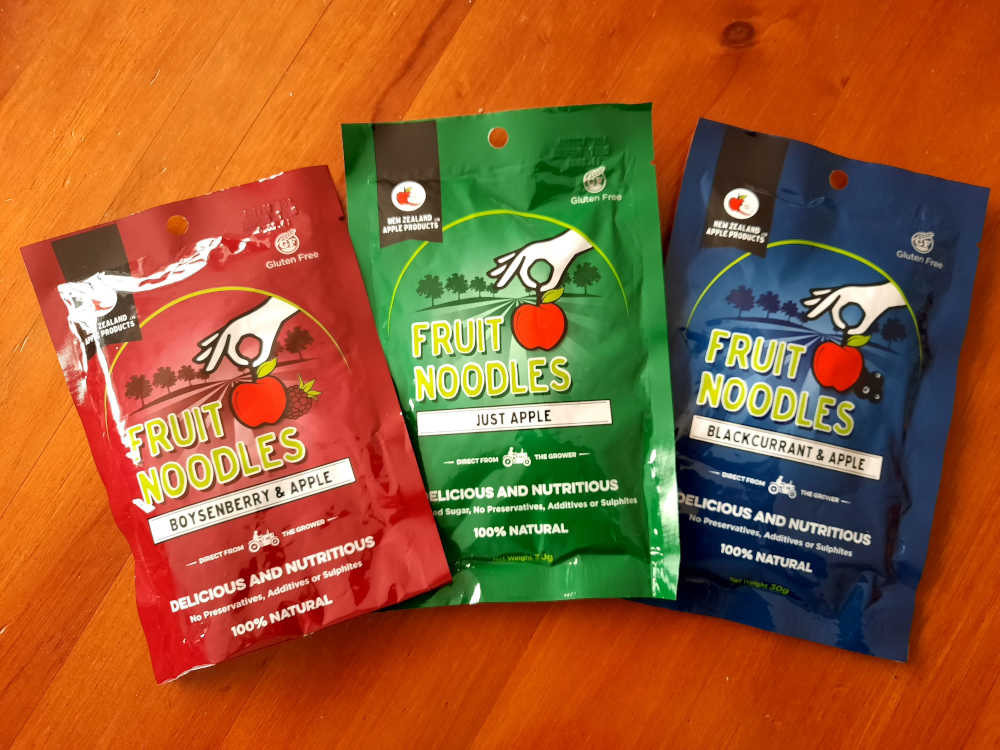
Julie is Editor for Kidspot NZ and our MVP. Her hobbies include laughing uncontrollably at her own jokes, annoying her family by asking questions about movie plots, and never taking anything too seriously. She speaks a little Spanish and a lot of Yorkshire. 

Favourite motto to live by: “It ain’t nothing but a thing”

Tips For Transitioning Back to School

After an extended time in lockdown, the harsh reality of returning to school when they reopen can be a tricky transition for kids.

All kids are different and you will know your child better than anyone. But returning to school after a lockdown due to a global pandemic is a lot different to returning to school after school holidays and you may be surprised by your child’s reaction, whether it be emotional or physical.

Structure

Children feel safer in a structured environment. Whilst some kids will take changes in their stride, others need plenty of support and time to adapt. If your family routine has slipped during the lockdown, work your way back to a more structured day. A good morning routine, healthy breakfast, packed lunch, time for homework and chores, plenty of family time and downtime, and a set bedtime, all go a long way to getting things back to “normal”.

Just because restrictions are changing it doesn’t mean that we have to abandon all of the good stuff that families may have enjoyed recently. If you’ve shared baking afternoons, family games nights, or weekly video conferences with grandparents, keep those things going.

Before they head back to school talk to your child about the changes that they may see (physical distancing, masks worn on public transport, etc) so that they are not overwhelmed. Explain to them that these measures are purely to continue to keep us safe and keep up the great work that our nation has done in working to mitigate the effects of the virus.

Think about how your own day will be changed due to work commitments and discuss how this will impact your child, ie pick up from school, the time you are home, etc.

Be ready for school

No one, and I mean NO ONE, wants that first day back at school to be the day that you can’t find their school shoes, or they miss the bus, or the car won’t start! Before the first day, run through this checklist:

  • Find their uniform (including shoes and socks) and make sure it’s clean and ready to wear
  • Ensure you have a supply of face masks and hand sanitiser
  • Hunt out the lunch boxes and shop for (or make) some of their favourite lunch box fillers
  • For college kids, figure out the correct timetable and required books
  • Charge up and update devices
  • Ensure you have quick and healthy breakfasts available
  • Check up on school and public transport options and timetables and ensure that bus and train passes have credit on them
  • If your car has been sat around for most of the lockdown, give it a bit of a run out and make sure that everything is working fine

Don’t be too enthusiastic!

We love our children. But we also need some personal space and time to think (and breathe!). Try not to be too over-enthusiastic about the kids heading back to school – show some genuine sadness when sending kids back to school and welcome them back at the end of the day with open arms.

Try not to project your anxieties

This is not an easy one. Parents across the country will be feeling apprehension about sending their children out after lockdown. Even though we know it’s as safe as it can be, there’s always going to be apprehension and those nagging thoughts. Try not to express any huge worries with your child around.

Communicate

Open communication with your child is something that should always be present in a loving and healthy family environment. Be open to talking with your child about any of their concerns. Put yourself in their shoes and try to understand their fears or anxiety. Do not dismiss their emotions. Positively validate their feelings and help them to find strategies to work through the issues.

For instance, if they say they are scared of returning to school because of the virus, don’t respond with, “So am I!” A positive response would be, “I understand that you are feeling scared, but schools are safer because of the awesome work our country has done fighting the virus.” You could ask them if they would feel braver if you accompanied them to the classroom or if they had a friend to go to school with.

If they feel overwhelmed whilst at school, remind them that they can always talk to their teacher.

You could teach them the Magic Minute from Sparklers for mindfulness.

Some kids may be keen to get back to school while others prefer online learning. Try not to focus on the negatives. Ask your child what they are looking forward to about returning to school (seeing friends, favourite subjects, etc). If there is an activity or routine that they or the family have started in lockdown that they enjoy, see if you can work it into their day going forward.

Also remind kids that they shouldn’t always believe what they hear from their friends or in the playground about the virus or the restrictions. Be prepared for some random questions!

Something to look forward to

Having something to look forward to can help kids deal with some changes. If there’s a fun activity coming up, a family celebration, or just a family movie night at home on a Friday, scheduling in something that they will enjoy really does help.

Don’t overschedule

Remember those first few days after the summer holidays when your kid was like a walking zombie after school? Be prepared to allow for some nap time (even for the teens!) while their body clocks and minds adjust.

It can be tempting to jump back into the wide world with gusto but try to keep the schedule under control for a few weeks while things settle down.

If your child is sick, keep them at home

Any runny nose, sore throat, or fever needs to be referred to your doctor for testing. The likelihood of your child contracting COVID-19 is small but we must all work together to keep it that way. If your child is sick, notify the school, keep them at home, and contact your health professional.

What’s the hardest thing about sending the kids back to school?

See more:

her world julieWritten by Julie Scanlon
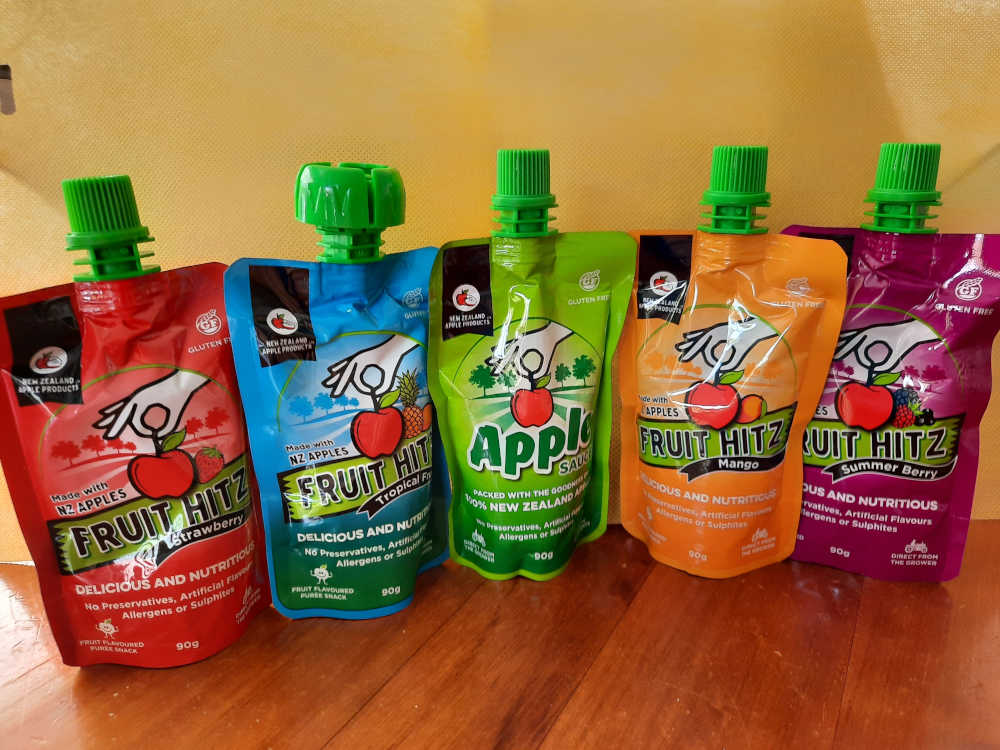
Julie is Editor for Kidspot NZ and our MVP. Her hobbies include laughing uncontrollably at her own jokes, annoying her family by asking questions about movie plots, and never taking anything too seriously. She speaks a little Spanish and a lot of Yorkshire. 

Favourite motto to live by: “It ain’t nothing but a thing”

Getting Kids Fighting Fit For The Return To School

If you’re a bit apprehensive about sending the kids out into the world when they return to school, you are not alone – it’s a natural response. As we have come together to reduce the effects of COVID-19, our schools are ready to welcome back students in the safest way possible.

Of course, beyond the COVID-19 vaccine, it never hurts to give a boost to your child’s general immunity to help reduce the number of viruses and illnesses that they may pick up or reduce the severity of symptoms. So here are some tips on how to get the kids fighting fit for back to school.

Hand washing and hygiene

You have heard this over and over again but one of the most important things that a child can do to protect themselves from illness is to wash their hands. Remind kids to use soap and warm running water, rub vigorously for at least 20 seconds ensuring they fully cover their hands and fingernails, rinse, then dry thoroughly using a clean towel. Kids should be washing their hands before eating, after using the bathroom, after playing with a pet or animal, after coughing, sneezing or blowing their nose, and after touching something potentially contaminated (e.g. chewed pencils, used tissue, etc.).

Going back to school may be a bit of a drag for kids, but they also need to keep up their usual hygiene practices of regular bathing/showers, teeth cleaning, and laundering clothes.

Rest and relax

A good night’s sleep does amazing things for the immune system, as being run-down leaves you more susceptible to illness. If the bedtime routine has slipped a little (or a lot!), now’s a good time to get things back on track. Remember to allow kids some “down time” too, away from school work, sports, and intensive activities.

Healthy food

What goes into our bodies has a big influence on our health. Cram plenty of fresh fruit and vegetables into those lunch boxes and family meals. Cook with herbs and spices plus garlic, onion, ginger, curry powder, turmeric, and black peppercorns for an immunity boost. And remember, keep them hydrated – water is the best choice.

Gut heroes

Gut bacteria play a vital role in supporting the immune system. When gut bacteria become imbalanced, a person’s ability to fight off infections is altered and they may experience an increase in colds and flu. Probiotics are a supplement containing live bacteria. When taken, they can boost your friendly gut bacteria. Probiotics can often be found in some fermented foods like yogurt, kefir, and cottage cheese (check the product labels).

Sun and fun

A deficiency in vitamin D can result in increased susceptibility to infection. Sunny days in the winter may not be as frequent so make the most of opportunities during that time to enjoy the sunshine – and remember to practice sun safety during warmer months.

Stress can make us vulnerable to illness and disease too, so take up some opportunities for the family to unwind and share some laughs with a fun activity, ie, family walk, backyard game of soccer, scavenger hunt, bike ride, etc.

Vaccinate

Check with your doctor or health professional that your child is up to date with their required vaccinations including COVID-19 and the annual flu jab.

If your child is sick, keep them at home

Any runny nose, sore throat, or fever needs to be referred to your doctor for testing. The likelihood of your child contracting COVID-19 is small but we must all work together to keep it that way. If your child is sick, notify the school, keep them at home, and contact your health professional.

Medical Disclaimer: As per our T&Cs, we make every effort to ensure the information we provide is accurate and updated, but the information contained in this website is not intended and must not be taken to be the provision or practise of medical advice or services nor a substitute for medical advice, diagnosis or treatment. If you have questions, concerns about your health or treatment or would like more information, contact your doctor. Always see your doctor or another qualified health professional before starting or changing any treatment.

How are you helping to boost your family’s immunity?

See more:

her world julieWritten by Julie Scanlon

Julie is Editor for Kidspot NZ and our MVP. Her hobbies include laughing uncontrollably at her own jokes, annoying her family by asking questions about movie plots, and never taking anything too seriously. She speaks a little Spanish and a lot of Yorkshire. 

Favourite motto to live by: “It ain’t nothing but a thing”

New Ways To Keep The Kids Learning At Home

A wonderful thing to come out of our time back in lockdown is an abundance of fascinating and fun online and at-home learning opportunities for kids that are still accessible.

We’ve brought together some of our favourite picks for you to explore. We hope that these will keep the kids occupied and learning whilst having fun.

Kiwi kids

Kapa Haka 4 Kids

Join Matua Whaitiri Poutawa on YouTube for awesome sessions of Kapa Haka.

Join in the fun

We’re going to the zoo!

Auckland Zoo have created a series of videos showing the habitats of some of their inhabitants. See meerkats, orangutans, otters and more.

Watch the animal cams

Online taonga jigsaw puzzles

Te Papa have a great collection of online jigsaw puzzles with a Kiwi flavour. You can set the difficulty too!

Try an online Te Papa jigsaw

Emergency preparedness

It’s important for kids to keep up their awareness of what to do in different types of emergencies. This game was created by New Zealand Civil Defence.

Play What’s the Plan Stan?

Maths, Science, History

Take a virtual field trip

World renowned museums and art galleries are ready to be explored online. Whether you want to visit the Guggenheim in New York, the Van Gogh Museum in Amsterdam, or the National Museum of Anthropology in Mexico City, sit back and be virtually transported there.

See 12 famous museums and art galleries

Take a virtual tour of The Louvre in Paris

Avoid the crowds at the Sistine Chapel

An afternoon at the museum

The National Museum of Natural History in Washing DC is one of the most famous museums in the world. Their virtual tours are just like being there.

Virtual tours of The National Museum of Natural History

Africa live!

A live webcam at an African watering hole reveals simply amazing sights!

Tune in to the African Animals Water Hole live feed

Music and the arts

Learn to draw with Disney

Is there a better way to learn how to draw cartoon characters than with the best in the business? Disney Parks offers YouTube instructions on how to draw your favourite Disney characters like Tinkerbell, Olaf, Winnie the Pooh, Stitch, and more.

Disney’s How-To Draw series

Shakespeare from your couch

The Globe Theatre in London offers streaming Shakespeare plays for everyone to watch.

Check out which Shakespeare play is coming up next

Postmodern Juicebox

Postmodern Jukebox have a huge following around the world. They have created a musical educational series for parents with young children called Postmodern Juicebox. Watch the episodes with Tim the Tambourine Guy, Clara, and special guests.

Get musical with Postmodern Juicebox

What online or at-home learning resources have you found?

See more:

her world julieWritten by Julie Scanlon

Julie is Editor for Kidspot NZ and our MVP. Her hobbies include laughing uncontrollably at her own jokes, annoying her family by asking questions about movie plots, and never taking anything too seriously. She speaks a little Spanish and a lot of Yorkshire. 

Favourite motto to live by: “It ain’t nothing but a thing”

Don’t Give Up The Sweet Treats With Lakanto Monkfruit Sweetener

Editor Review for Lakanto

I just won’t do it. I don’t want to give up those occasional sweet treats. I admit it – I don’t want to quit sugar! But in reality, it’s not the sugar I’m craving – it’s the sweetness.

I don’t always hunt out sweet treats when the munchies hit. But, if I’m going there, then I don’t want to be disappointed by ending up with a treat that’s more blah than bling. The local bakery make the most amazing apple slices around. That’s the heights I’m aiming for when I bake make my own goodies (which is probably impossible!), so I’ve got my work cut out for me.

I’ve often eyed up artificial sweeteners and thought, nope, what’s the point of sacrificing taste when making a treat? That was until Lakanto Monkfruit Sweetener popped up as a genuine contender.

What is Lakanto Monkfruit Sweetener?

In 1995, Lakanto was created to help people around the world quit sugar, to lose weight, help control blood sugar, and live a healthier life.

Lakanto is #ResponsiblySweet – an all-natural, 1 for 1 sugar replacement sweetener that cooks, bakes, and tastes like sugar, with 93% fewer calories but without the aftertaste of artificial sweeteners!

It is natural in taste and texture – just like real sugar. Its sweetness profile is nearly identical to that of sugar. Being heat stable makes it suitable for beverages, cooking and baking. You can now enjoy Lakanto in your favourite drinks, foods and recipes.

  • Naturally sweet
  • 93% less calories than sugar
  • Zero glycemic load affect
  • Gluten free
  • Keto friendly
  • Vegan
  • Stevia free

The results

I’m all for finding alternative, healthier ways to whip up some baking treats for the family. I recently made some cocoa cookies using honey instead of sugar. But you don’t substitute one cup of sugar with one cup of honey. Oh no. You have to do the math – a lot of math! Plus a lot of googling, and trial and error, to find not only the correct amount of alternative sweetener needed but also the other ingredients that you need to add/remove/adjust because of the chemical reactions of that alternative. I came away from that baking session with a tub of mediocre cookies and a chemistry degree!

That’s why I love Lakanto Monkfruit Sweetener. It’s a one-for-one replacement. A big thumbs up for baking without the need for homework. My son and I have been doing a large amount of baking during the lockdown (who hasn’t?) and Monkfruit has become a staple in the pantry. We’ve made cookies, puddings, slices, and cakes, and you would never know that the sugar element had been replaced. The result and taste are just as good. And now I feel like I’ve earned my ‘Mum of the Moment’ badge for providing goodies that are healthier for the family.

I’m now holding out for a delivery of the Golden version of the Lakanto Monkfruit Sweetener which is a substitute for brown sugar. I’m keen to give it a try as a pourable lump-free brown sugar replacement.

The fact that Lakanto is an easy, healthier substitute that can also be used to replace sugar in warming winter drinks makes it a winner in our home.

Have you tried Lakanto Monkfruit Sweetener? What would you make with it?

See more:

her world julieWritten by Julie Scanlon
Julie is Editor for Kidspot NZ and our MVP. Her hobbies include laughing uncontrollably at her own jokes, annoying her family by asking questions about movie plots, and never taking anything too seriously. She speaks a little Spanish and a lot of Yorkshire. 

Favourite motto to live by: “It ain’t nothing but a thing”

5 Questions To Help You Find Your Purpose

Whilst were in the midst of a pandemic we’re often left with a lot of free time on our hands. To fill our days we need to sometimes get back to basics and figure out what makes us tick and what keeps us happy.  Do we need all the material surroundings or are we happy with just the basics?

If we put the pandemic aside, we all need to remember that, we were all put on this earth for a reason. We all have a talent or destiny! If you’re not too sure what that is then read on for some tips on how to find your purpose.

1. Who makes me happy and why?

Firstly we need to think about those around you that make you happy. Do you have a couple of good friends that you can’t wait to catch up with? The type of friends that when you leave their company you feel relaxed and have a huge smile on your face? Figure out who they are and what you love about them. They say like attracts like, so the qualities you think are great in your friends you will often see in yourself.

Surround yourself with the vibes of the people you wish to be like. I’m not talking celebrities here but positive people that you aim to be like. If you leave someone’s company feeling upset or anything less than happy, it’s not worth it.

2. What am I good at?

Now, as Kiwis we are super good at never praising ourselves. Because if you spoke about how great you are you would look like a fool right? Wrong! Start by making a list of what skills you have and don’t be shy! If you’re great at folding all the washing as soon as it’s off the line, then that’s awesome. That means you’re able to follow through with a project. Include that as a skill! Are you great at running? Can you pirouette better than your six year old? Do you enjoy drawing? Find the things!

Expand your interests and explore your talents. Join a local sports team, or take an art class, for example. We all have to start somewhere in finding ourselves so don’t be discouraged if you’re not the best in the group straight away.

3. How can I tackle each day with a positive attitude?

The first decision you make each day is how you are going to handle today’s challenges. Start by appreciating the small things, such as the weather or even be thankful that you have access to an alarm clock to wake you up on time. When we start the day with gratitude it sets the tone for the rest of the day and often makes getting up in the morning easier day by day.

4. What can I do to take better care of myself?

When you start to look after yourself and fill your own ‘cup’ up first you feel better all around and then become more positive in life. We all get stuck in the same patterns but treat yourself every once in a while. Feeling good about yourself is important to boost your confidence! Meditation, yoga, exercise, spa treatments, getting out into nature, cooking classes … how you fill your cup is up to you.

5. How can I make a positive impact on someone else’s day?

Being positive and doing good not only has good repercussions for the person on the receiving end but it also releases endorphins and makes you feel good too.

An easy way to make a positive impact on someone else’s day is to authentically connect with another person. This is as easy as having a conversation with no distractions, no phones, and listening properly. You could also challenge yourself to give five compliments each day. If you see a stranger with cool eyeshadow then make sure you tell them! I’m sure they would have put a lot of effort into the look so will appreciate someone noticing it. If you get up before everyone else in your house why not make their coffee and put it next to their work lunch ready for them? Small gestures go a long way and it sets the tone for the rest of the day. Don’t underestimate how good you will make others and yourself feel.

analesha

Written by Analesha Little

A beauty guru with a love for travel, wine and Uber Eats, Analesha enjoys writing about everything from makeup to motherhood and all the sassy bits in between. 

Favourite quote: “Beauty begins the moment you decide to be yourself”

Does Your Child Know Where They Live?

If your child was to become separated from you, would they be able to tell the authorities where they live? Or what their phone number is? Or even what their parents’ names are?

No one ever thinks that they will be the parent with a lost preschooler or young child, but it happens so easily. You take your eye off them for a second out in public and they’re gone! It can be frightening, especially if your child doesn’t know how to get in touch with you.

Teaching kids their contact information is important for safety reasons and can be started from around age three or four. It’s also great for helping kids understand their place in their community and in the world.

What to teach kids

Firstly, find out what they already know. Thanks mainly to our country’s amazing sporting abilities they probably already know that they live in New Zealand!

Then start with the basics. Firstly, help them to learn their full name and the name of their parents/caregivers. Then work on their house/apartment number, street address, suburb and city or town, and country. Remembering phone numbers is a lot trickier in this modern age when a lot of people don’t have a landline and mobile numbers are so long but have a go at teaching them one number.

Tell your child that it is important that they know their contact information but avoid scaring them with horror stories of abduction! Just tell them that if they need to get in touch with you, they will have the information they need. Help them to understand when they should share their contact information and who with. Also ensure that they understand that just because they know where they live they still are not allowed to go anywhere without you or a caregiver. For older children, ensure that they know that they should never divulge personal contact information online.

How to teach them their contact information

There are a multitude of ways that you can teach your child their personal contact information. Repetition like simple write and repeat exercises, role-play and fun learning are key. Here are a few other ideas.

  • Sing the phone number as a catchy tune
  • Use a calculator to show them the order they press the buttons for their phone number
  • Make your phone number out of LEGO bricks
  • Make up cards with each letter of their full name and arrange them in order or use fridge magnets
  • Get them to draw a picture of the family and add the proper names of each person and pet
  • Write a letter/postcard to a parent/caregiver in their own home so they can see their name and address
  • Show them the number on their mailbox, the name on their street sign, their town name on road signs, etc
  • Make a map of your neighbourhood and use toy cars, paper houses, and figures to show them their street and local things like shops, a park, or a relative’s house

Beyond their neighbourhood

Extending your child’s learning to understand their place in the world is a fun activity. You can do this in several ways but the concept is that each step of their location gets bigger.

For instance, use cardboard boxes of various shapes that will fit into each other.

  • The smallest box is their house, so write your address on this one and add a picture of a house
  • For the next size up, put the name of your suburb and a neighbourhood map
  • For the next biggest box, put the name of your city/town and a picture of something that your city is known for, ie a landmark or sports team
  • The next box is for your country with a map of NZ (and mark on the map where your city/town is)
  • The final box is Earth so pop a picture of our world on it and mark where NZ is
  • You can then show your child how their home fits within our world
  • Instead of boxes, you can also use containers, or just different sized paper/cardboard shapes and stack them
  • You can even turn it into a fun learning game of pass the parcel starting with Earth and each layer bringing them closer to home (with a small treat for their bedroom in the final wrapping!)

How do you teach your child their contact information?

See more:

her world julieWritten by Julie Scanlon
Julie is Editor for Kidspot NZ and our MVP. Her hobbies include laughing uncontrollably at her own jokes, annoying her family by asking questions about movie plots, and never taking anything too seriously. She speaks a little Spanish and a lot of Yorkshire. 

Favourite motto to live by: “It ain’t nothing but a thing”

Toddler Driving Test for Early Detection of Autism

Early detection of autism could be as simple as driving to the dairy with the quick and easy 60 second Toddler Driving Test.

Kiwi parents can now check if their toddler is showing early signs of autism spectrum disorder (ASD), simply by tuning into the radio in their car. Autism New Zealand has recently launched the ‘Toddler Driving Test’, a fun 60 second audio campaign which will play across national radio stations and is also avaiable on Spotify.
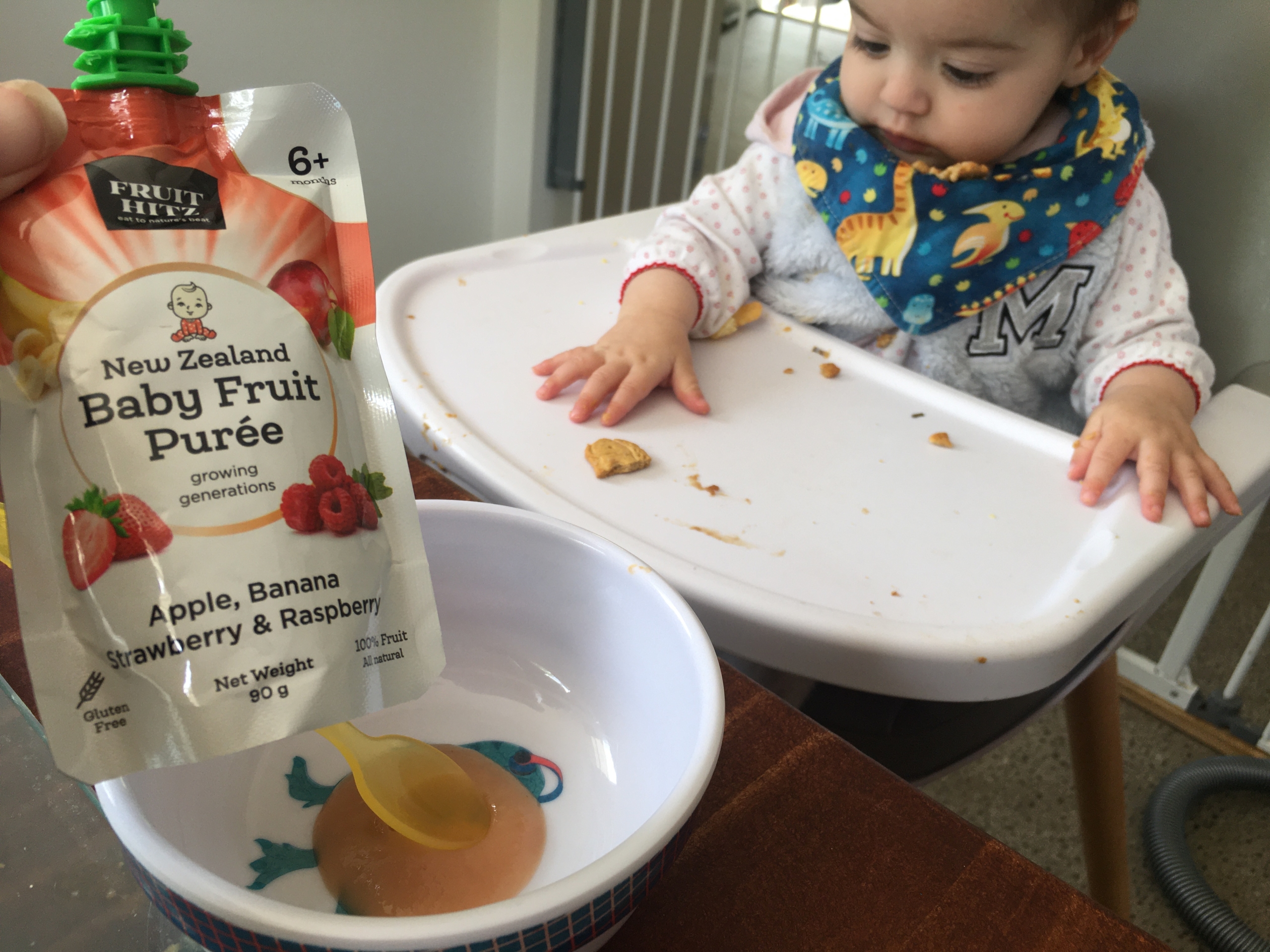
The Toddler Driving Test is a world-first initiative designed to navigate the considerable barriers to early testing by delivering an accessible early detection test where almost every toddler can be found – the booster seat.

Identifying the early signs

Autism is thought to affect one in 59 New Zealanders and while many signs of autism can appear from as early as infancy, the average age of diagnosis is 6.4 years. For many children in the country diagnosis may not come until after they’ve begun school.

The Toddler Driving Test aims to assist Kiwi parents in identifying early signs of autism in children from 12 months of age, prompting next steps for further assessment and potential diagnosis. Autism New Zealand’s Chief Executive, Dane Dougan, says he is proud of the work the charity has done and hopes that this campaign will not only help lower the average age of diagnosis through early detection in New Zealand but equip families with the tools they need early on.

“The beauty of the Toddler Driving Test is its simplicity. In many cases, a test wouldn’t be conducted at all unless their child is showing significant signs, but now parents are potentially able to detect early signs of autism in the car while listening to their favourite radio station.”

Dougan goes onto say that, “The earlier autism is detected and in turn diagnosed by qualified clinicians, the sooner the family can access everything they need to help them connect with their child and connect their child with the world.”

Early diagnosis is key

Studies1 have indicated that children diagnosed early demonstrated better verbal and overall cognition at school age, were more likely to attend mainstream school and required less ongoing support than children diagnosed later.

Hannah Waddington, a spokesperson from the Victoria University of Wellington’s Autism Clinic agrees that early detection and intervention is key.

“The earlier we identify children who may have autism, the sooner we can provide effective support to them and their whānau. It is important that we all work together to bring down the age of identification,” says Waddington.

Take the Toddler Driving Test

The short audio clip is designed to be played in the car and prompts parents to do three simple tests with their toddler including checking their response to their name, eye contact, and the toddler’s ability to imitate their parent.

Parents looking to access the Toddler Driving Test can hear it played on NZME radio stations this month, by visiting the website toddlerdrivingtest.co.nz or on the Toddler Driving Test Spotify playlist.

For more information or to speak to an Autism New Zealand Outreach Coordinator please visit www.autismnz.org.nz.

1 Clark, M. L. E., Vinen, Z., Barbaro, J., & Dissanayake, C. (2017) School Age Outcomes of Children Diagnosed Early and Later with Autism Spectrum Disorder. Journal of Autism and Developmental Disorders, 48, 92–102 doi:10.1007/s10803-017-3279-x

Information provided by Autism NZ

Helping Your Teen Stay Safe On The Roads

Once your teen has that much sought-after restricted driver’s licence in their hand it can be an anxious time for parents. The first six to 12 months of driving alone are the most risky, so we’ve picked up some tips to help parents guide their teen driver to stay safe on the roads.

Every driver’s skill levels are different but young restricted drivers are statistically more likely to have a serious crash in their first six to 12 months driving solo than at any other time. In fact, a driver on a restricted licence is seven times more likely to be involved in a fatal or serious injury crash than other drivers so it is extremely important for parents to stay involved and help keep them safe.

In 2019*, young drivers aged between 16 and 24 were involved in:

3,058 minor injury crashes
612 serious injury crashes
71 fatal crashes

*Note: Crash data for 2019 is not yet complete. Data is for all crashes reported by the Police to the NZ Transport Agency for the year 2019 as recorded in CAS at 11/05/2020.

Know the risks

“The risk of crashing diminishes with experience and the development of decision-making skills to recognise risky situations and make safe choices.” NZTA.govt.nz

Drivers on a restricted licence are subject to conditions that restrict them from driving without a supervisor between 10pm and 5am and carrying passengers at any time without a supervisor. The reason for these restrictions is that driving at night or carrying inexperienced passengers are two of the riskiest situations for young drivers.

Staying involved

You have two things going for you as a parent helping your teen driver stay safe. Firstly, you likely have years of driving experience. Secondly, you know your child better than anyone. So you know their strengths, their weaknesses, what may distract them, their reactions, etc.

Even though you won’t always be in the car with them, you can still stay involved in their safety by helping them to identify the risks they might face and working together to manage those risks safely.
Start with the right car

It makes sense to put your young driver in the safest car possible. Determining which car is the safest doesn’t mean having to spend hours researching makes and models. You can check the overall safety rating of the cars you own, or any you intend to purchase, at www.rightcar.govt.nz . Vehicles with 4 and 5 stars are the safest, while 1 and 2 star vehicles provide little or no protection in a crash.

Practical tips for parents

A restricted driver has passed their practical driving test but there is still a lot to learn. Build on the experience and skills from those L plate days with these tips.

  • Do regular trips with them to see how they are progressing and to keep an eye on their speed, acceleration, road position, and any bad habits they may pick up.
  • Help them practise anticipating and responding to hazards. Go for a drive and park up safely. Ask them to identify hazards on the stretch of road including those that might be hidden, for example, when large vehicles obscure other vehicles or pedestrians that may appear without warning. Progress to identifying hazards during driving.


  • Do some proactive driving practice with them for new situations, ie motorway driving, heavy traffic, new routes, negotiating road works, driving in poor weather or light.
  • Show them how to identify and mitigate different road conditions (slowing down, putting on lights, etc).
  • Give them supervised driving practice at night and while carrying passengers.
  • Help them know what to do when unexpected events occur on the road, ie a breakdown, accident, in the presence of emergency vehicles, etc. Talk about what they need to do to keep them and others safe, who they need to contact, etc.
  • Talk to them about the risks of driving when tired, sick, distracted or emotional.
  • Remind them of the risks involved in using a smartphone while driving. Make an agreement that their phone is always out of sight so they’re not tempted.
  • Help them develop strategies to avoid pressure to drive and manage distractions like loud music, gadgets and food.
  • Help them plan their route if they’re driving to a place for the first time, and encourage them to take breaks.
  • Set down ground rules around driving that you all agree to stick to, ie picking them up if they don’t feel safe to drive.
  • Help them prepare for their full licence test by using the resources available on the Drive website.

Sources include NZTA.govt.nz

Did you make an agreement with your young driver? What did you include?

See more:

her world julieWritten by Julie Scanlon
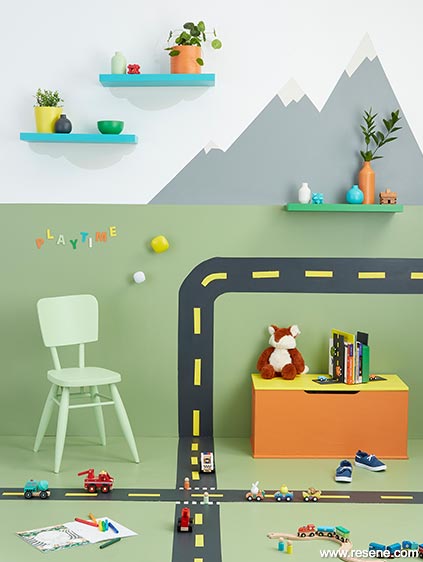
Julie is Editor for Kidspot NZ and our MVP. Her hobbies include laughing uncontrollably at her own jokes, annoying her family by asking questions about movie plots, and never taking anything too seriously. She speaks a little Spanish and a lot of Yorkshire. 

Favourite motto to live by: “It ain’t nothing but a thing”

Join the Catch Up

Join our community of parents and let the Kidspot Catchup be your guide to creating unforgetable family moments.